 Skip to content


Market Making Sportsbooks: How Retail Lines Really Move
Market-making sportsbooks are the consumer-facing books where you actually place your bets. A handful, like Pinnacle, originate lines by pricing games from scratch and absorbing sharp action. Most others license those prices, then shade them based on their own risk and customer base. If you buy picks from a service like Elite Bettings, the single best habit you can build right now is shopping the line and tracking closing-line value (CLV) as your benchmark for whether a pick was actually worth the price you paid.
Key Takeaways
Beating retail sportsbooks consistently requires shopping lines across multiple books, benchmarking against closing-line value, and reading sharp money signals before you bet.
| Point | Details |
|---|---|
| Shop every line | Compare prices across at least three books before placing any bet to capture the best number. |
| Use CLV as your benchmark | Devig a sharp book’s closing line to judge whether your price actually beat the market. |
| Watch for reverse line movement | A line moving against public betting percentage signals professional money is influencing the price. |
| Match the book to the bet | Send high-confidence, high-stake bets to books with deeper limits and less aggressive shading. |
| Track documented results | A picks provider like Elite Bettings publishing full CLV history is more trustworthy than selective win claims. |
Table of Contents
- How Sportsbooks Set and Move Betting Lines
- Why Do Different Sportsbooks Show Different Prices?
- How to Spot Sharp Money and True Market-Making Moves
- Practical Tactics for Line Shopping and Timing Bets
- Which Retail Books Act Like Market Makers?
- Buying Expert Picks: What to Look For and How Elite Bettings Delivers
- Pre-Bet Checklist Before You Lock In a Pick
- How Market-Making Sportsbooks Manage Risk and Balance Their Books
- How Liquidity and Market Depth Shape Line Setting
- Spotting Line Discrepancies and Value Opportunities
- How Injuries and Weather Move Betting Lines
- Reading Consensus Betting Data in Real Time
- Why Sportsbooks Adjust Lines the Way They Do
- Why Understanding Market-Making Sportsbooks Matters for Pick Buyers
- Sources
- FAQ
How Sportsbooks Set and Move Betting Lines
Every line starts with a model. Traders feed in power ratings, historical matchup data, and injury reports to build an opening number, then adjust it as new information and money arrive.
The inputs that move a line most:
- Statistical models and power ratings that generate the baseline spread or total
- Injury and lineup news that shifts win probability in hours or minutes
- Public betting volume, which pulls lines toward the popular side
- Sharp or professional money, which pulls lines toward the mathematically correct side
An originator like Pinnacle posts a line and adjusts it as sharp bettors test it. Retail books then license those pricing feeds and apply their own margin, tightening or loosening based on who’s betting. The vig (usually built into odds like -110) is how books manage profit regardless of outcome. It’s not a probability statement. It’s a fee.
Pro Tip: Compare the same game across three books before you bet. If one number stands out, it’s often the last one to catch up to sharp money, not the smartest price on the board.
Why Do Different Sportsbooks Show Different Prices?
Two books covering the same Sunday matchup can post genuinely different numbers, and neither one is “wrong.” Price gaps come from real business decisions, not sloppiness.
- Different risk tolerances and how much exposure a book wants on either side
- A customer base skewed recreational versus one with sharper bettors
- Manual trader judgment on volatile or lower-liquidity markets
- Promotional pricing or reduced-juice specials meant to attract volume
- Lag in distribution timing as pricing feeds update at different speeds
A game might show -3 at -110 on one app and -2.5 at -115 on another. That’s a 0.05 to 0.15 gap in implied probability. It looks tiny on one bet. Over a full season of picks, that gap compounds into real money.
How to Spot Sharp Money and True Market-Making Moves
The clearest tell is reverse line movement, when a line moves opposite to where the public is betting. This kind of divergence between sharp money and public betting volume is one of the most reliable signals in the sport.
Watch for these signals together, not in isolation:
- Reverse line movement against the public betting percentage
- Heavy early movement on a market with relatively low volume
- Divergence between a sharp-origin book and recreational books on the same game
- Sudden limit cuts or max-bet reductions on a specific side
Public money often moves lines more than actual team form does, which is exactly why reverse movement stands out as a signal worth trusting.
Pro Tip: Track early-morning line moves on spreads and totals specifically. Sharp consensus tends to form fastest in those markets, well before recreational money shows up in the afternoon.
Practical Tactics for Line Shopping and Timing Bets
Turning theory into profit means building a repeatable routine every time you place a bet.
- Open accounts at multiple books, including at least one known for tighter, sharper pricing.
- Watch an originator or sharp book as your fair-price benchmark before betting anywhere else.
- Devig the closing line at that benchmark book to compute a true fair probability, a widely used method for judging retail prices.
- Lock the best available price once it beats your benchmark, don’t wait hoping for a better number.
- Record your CLV on every bet so you can measure whether your picks beat the market over time.
Useful tools for this routine:
- Odds aggregators like OddsChecker and OddsPortal to compare prices across dozens of books in seconds
- CLV tracking spreadsheets or apps to log the line you got against the closing number
- Rotating multiple sportsbook accounts so you’re never stuck with one book’s inflated vig
Line shopping across several books can add several percentage points to your long-term edge, which is often the difference between a break-even year and a profitable one.
Pro Tip: If a book’s price is only slightly worse than your benchmark, take it anyway rather than chasing the best number and risking a limit. Getting flagged as a sharp bettor costs you more long-term than a half-point ever will.
Which Retail Books Act Like Market Makers?
Not every sportsbook behaves the same way once a line hits the market. Some move fast and mirror sharp consensus closely. Others lag, shade harder, or cater almost entirely to recreational volume.
- DraftKings: Large recreational base, moves lines quickly on public sports like the NFL, moderate limits
- FanDuel: Similar recreational skew, competitive early lines, tightens quickly once volume builds
- BetMGM: Broad market coverage, moderate sharp respect, standard -110 vig on most markets
- Circa Sports: Known among professionals for high limits and closer alignment with sharp pricing
- Caesars: Strong promotional pricing, useful for reduced-juice hunting, standard limit structure
- OddsChecker and OddsPortal: Aggregators, not books, used to compare prices across dozens of operators instantly
- Elite Bettings: Not a book at all, a picks provider that uses CLV benchmarking against sharp lines to validate its calls
📊 Sharp/low-vig books tend to run tighter margins and higher limits, while recreational-heavy books carry more vig and limit winners faster. That’s exactly why your biggest, highest-confidence bets belong at the book least likely to cut your limits.
Buying Expert Picks: What to Look For and How Elite Bettings Delivers
Before paying for anyone’s picks, check three things: a documented track record, CLV tracking on every published pick, and a visible line movement history showing when the pick was made relative to the closing number. A provider that only shows its best weeks isn’t giving you the full picture.
Elite Bettings publishes full results across NFL, NBA, NCAAF, NCAAB, and MLB, no cherry-picking. The numbers: a documented strong hit rate and positive ROI across a large sample of picks since 2016. Every pick is evaluated against closing-line value, the same benchmark quant analysts treat as the strongest public signal of whether a bet had real edge at the time it was placed.
🎯 Ready to stop guessing and start betting with a documented edge?
Elite Bettings tracks every pick’s closing-line value so you know exactly how each call performed against the market, not just whether it won. Your first pick is FREE, no risk, no card required to try it.
👉 Grab your free expert pick now and see the CLV-first approach in action.
Pro Tip: When you place a pick, use a sharp-respecting book like Circa or a low-vig option so your price is closer to fair value. If you need a sportsbook to bet with, Stake is a strong option worth opening an account with.
Pre-Bet Checklist Before You Lock In a Pick
Run through this before every wager, no exceptions:
- Confirm the best line across your open accounts using an aggregator.
- Check it against your CLV benchmark by devigging a sharp book’s current price.
- Verify injury and lineup news hasn’t shifted since the pick was published.
- Set your stake size according to your bankroll rules, never based on confidence alone.
- Decide whether to lock now or wait for late, in-play movement to work in your favor.
Pro Tip: If the line is about to move against you, take a slightly worse price now rather than risk missing the market entirely.
How Market-Making Sportsbooks Manage Risk and Balance Their Books
Risk management at a retail sportsbook isn’t about picking winners. It’s about balancing action so the book profits from the vig no matter the outcome. When money floods one side of a spread, traders move the line to attract balancing bets on the other side, reducing the book’s exposure.

When balance isn’t possible, books lean on limits. A sharp bettor who consistently beats closing lines gets capped, sometimes to $50 or $100 max bets, while a recreational bettor betting the same market might get offered thousands. This isn’t personal. It’s a business protecting margin against bettors who show measurable, repeatable edge.
Books also hedge exposure across markets. A sportsbook heavy on one side of a same-game parlay might adjust related player-prop lines to offset that risk elsewhere, even on markets that look unrelated to a casual bettor. Layoff betting between books, where an operator places its own bets with another book to offload risk, plays a similar role behind the scenes, though it’s far less visible to retail customers.
Understanding this changes how you read a line. A number that looks “off” isn’t necessarily a mistake. It might reflect a book managing lopsided exposure on that specific game, which is exactly the kind of imbalance that creates short windows of value for bettors paying attention.
How Liquidity and Market Depth Shape Line Setting
Market depth refers to how much money a book can absorb on a given side before it needs to move the price. Deep markets, like NFL sides and totals, take heavy volume before shifting even a half-point. Thin markets, like a mid-tier college basketball prop, can swing multiple points on a handful of large bets.
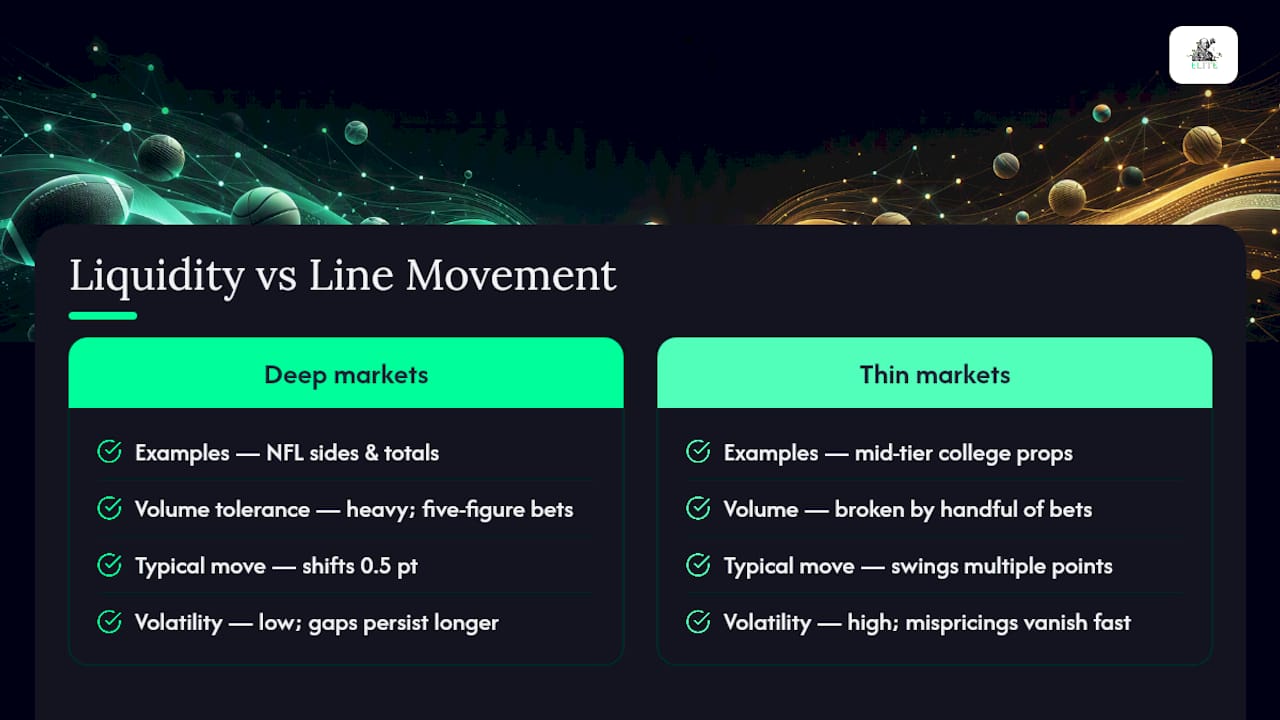
This is why sharp bettors gravitate toward high-limit books like Circa Sports for their biggest positions. A book with deep liquidity can take a five-figure bet without flinching, which means its price reflects genuine market consensus rather than one trader’s overreaction to a single wager.
Thin liquidity cuts both ways for you as a bettor. It creates more volatility, which means more chances for a mispriced number to appear briefly. It also means those numbers vanish fast, since even moderate money can correct them within minutes. Retail books with lower depth adjust more erratically to news and volume, which is part of why their lines lag behind sharp consensus more often than deep-market operators do.
Practically, this means your approach should differ by market type. On high-liquidity NFL sides, a stale price at one book is a real opportunity because the gap won’t close on its own quickly. On thin player-prop markets, treat any outlier price with more caution. It might reflect a legitimate information edge, or it might just be a book that hasn’t adjusted yet.
Spotting Line Discrepancies and Value Opportunities
The clearest discrepancies show up when one book hasn’t caught up to a sharp move yet. Say Circa Sports moves a total from 47 to 45.5 after a key injury report, but a recreational book is still posting 47 twenty minutes later. That gap is where value lives, and it’s exactly what odds comparison tools help you find before it disappears.
True arbitrage is rarer but worth understanding. It happens when the odds across two books are so far apart that betting both sides guarantees a profit regardless of outcome, for example, one book offering +105 on a side while another offers -102 on the opposite side of the same game. These windows close fast, usually within minutes, since sportsbooks monitor pricing feeds and correct outliers quickly once volume starts flowing.
More common than arbitrage is straightforward value betting: a price that beats your devigged fair number even though it isn’t a guaranteed profit. Spotting these gaps consistently, rather than chasing one-off discrepancies, is what separates a bettor with a real edge from someone getting lucky on a stale number.
How Injuries and Weather Move Betting Lines
News moves lines faster than almost anything else. A star quarterback ruled out an hour before kickoff can shift a spread by three to seven points within minutes, and the speed of that move tells you something too. Fast, decisive shifts across every book usually mean the news is confirmed and widely reported. A slower, uneven move where only one or two books adjust can mean the information is still filtering through, which briefly creates the same kind of gap discussed above.
Weather works more gradually but matters most for totals. Wind forecasts above 20 miles per hour in an outdoor NFL game typically pull totals down as passing and kicking accuracy drops. Sharp bettors watch forecast updates through the week, and totals often drift lower two or three days before kickoff as models incorporate updated weather data, well before casual bettors start paying attention Thursday or Friday.
The key skill here is timing your read of the news against the market’s read. If a report breaks and the total hasn’t moved yet, that’s a signal to act, not to assume the market already knows something you don’t. If the number has already moved significantly, you’re likely too late to catch that specific piece of value, though the overreaction itself can sometimes create an opposite opportunity if the market oversells the news.
Reading Consensus Betting Data in Real Time
Consensus data tools show you what percentage of bets and tickets are landing on each side of a market across the industry. The gap between ticket percentage and money percentage is often more useful than either number alone.
Watching this data in real time means checking it at multiple points before kickoff, not just once. A market that’s 60/40 on Tuesday can flip to 45/55 by Sunday morning as professional money arrives closer to game time, particularly in markets where sharp bettors wait for final injury confirmations before committing.
Cross-reference consensus percentages against actual line movement. If the number hasn’t moved despite a lopsided ticket count, the book likely already priced in the imbalance, or professional money on the other side is quietly offsetting it. That combination, heavy one-sided tickets with a stable line, often means sharp action is balancing the book from the other direction, exactly the kind of signal a casual glance at the odds alone would miss entirely.
Why Sportsbooks Adjust Lines the Way They Do
Line movement isn’t purely mathematical. Trading desks respond to predictable patterns in how bettors behave, and those patterns shape pricing decisions as much as raw probability does.
Recreational bettors overwhelmingly favor betting favorites and overs, a well-documented behavioral tilt that books account for by pricing favorites slightly worse than a pure model would suggest. That’s not an accident. It’s a deliberate response to the fact that popular sides attract disproportionate volume regardless of true win probability, and books need that skew priced in to stay balanced.
Books also anticipate herd behavior around major news cycles. When a big storyline breaks, a marquee injury, a coaching change, a controversy, public money often overreacts in a predictable direction. Sharp traders sometimes shade a line ahead of that expected reaction rather than waiting for it, effectively pricing in the public’s anticipated response before it happens.
There’s also a defensive psychology at play around bettors who’ve beaten the book before. Once an account shows a pattern of beating closing lines, that behavior itself becomes information the book prices around, both through tighter limits and through faster adjustment when that specific account is active. Recognizing that sportsbooks are reading bettor psychology, not just running numbers, reflects legitimate differences in business strategy rather than a flaw in the market. It’s simply how a business balances risk while operating multiple sportsbooks competing for the same volume of bets.
Why Understanding Market-Making Sportsbooks Matters for Pick Buyers
We built Elite Bettings around one core idea: a pick is only as good as its closing-line value. Anyone can show you a winning record from a lucky stretch. What actually proves skill is beating the closing number consistently, week after week, across sports betting trends that shift constantly.
That’s why we track and publish every result, win or loss, with full CLV history attached. Transparency isn’t a marketing angle for us. It’s the only honest way to prove a picks service adds value beyond what you’d get flipping a coin against the market.
Sources
Building a real edge means checking a few reliable sources before every bet, not relying on gut feel.
- Line shopping and how sportsbooks source prices
- How sportsbooks set betting lines — Sporting News
- Closing-line value explained — Pinnacle OddsDropper
- How bookmakers set odds — GamblingCalc
- Market efficiency and line origination — Compare n’ Bet
Use OddsPortal when you want historical context on how a market moved over days. Use OddsChecker when you need the fastest possible snapshot of current prices across books right before kickoff.
FAQ
What Does “Market Making Sportsbook” Actually Mean?
It refers to a retail sportsbook whose posted lines bettors use to place wagers, either an originator that prices games directly or, more commonly, a book that licenses and shades an originator’s line.
How Do I Know If a Line Movement Is From Sharp Money?
Look for reverse line movement, where the price shifts opposite to the public betting percentage, along with sudden limit cuts or a gap between a sharp-origin book and recreational books.
What Is a Good Closing-Line Value to Aim For?
Should I Use Multiple Sportsbook Accounts?
Yes. Holding accounts at several books, including at least one sharp-respecting option like Circa Sports, lets you shop for the best price and avoid relying on a single book’s shaded number.
Is Line Shopping Worth the Extra Effort?
Comparing prices across books before betting can add real percentage points to your long-term results, often the difference between a losing and profitable season on the same picks.