 Skip to content


NHL Puck Line Betting: Win More With CLV Strategy
TL;DR:
- The NHL puck line is a fixed goal spread of plus or minus 1.5 goals used for betting on favorites and underdogs. Successful puck-line betting relies on understanding game settlement rules, odds versus moneyline value, and monitoring closing line value with disciplined bankroll management. Elite-bettings offers tools to identify value, track CLV, and verify long-term profitability in puck-line betting.

The NHL puck line is hockey’s fixed ±1.5 goal spread. Favorites are priced at -1.5 (must win by 2+), underdogs at +1.5 (win outright or lose by exactly 1). Use -1.5 when a heavy favorite is so mispriced on the moneyline that the puck line returns better value for a similar expected outcome. Use +1.5 when you want a one-goal cushion on an underdog without committing to an outright win.
Three things every puck-line bettor must know before placing a bet:
- OT/SO settlement: Any game that reaches overtime automatically settles as a one-goal margin. That means +1.5 wins and -1.5 loses the moment a game hits extra time in full-game markets.
- Empty-net impact: Empty-net goals occur in roughly 20–25% of NHL games and can flip a -1.5 result in the final 90 seconds.
- Odds vs. moneyline tradeoff: Sportsbooks adjust the price, not the margin. A -200 moneyline favorite might be -1.5 at +115, which is a meaningful payout swing for the same team.
Table of Contents
- How are puck-line bets settled?
- Puck line vs. moneyline: which market gives you better value?
- How to find puck-line value using CLV, sharp money, and advanced stats
- Bankroll management and bet sizing for puck-line plays
- How sportsbooks detect and restrict winning puck-line bettors
- Common puck-line mistakes and how to avoid them
- Worked examples: CLV math on real puck-line scenarios
- Key Takeaways
- The case for CLV-first betting over chasing streaks
- How Elite-bettings helps you capture puck-line CLV
- Useful sources
- FAQ
How are puck-line bets settled?
The core rule is straightforward. A favorite at -1.5 covers only with a two-goal win or better. An underdog at +1.5 covers with any outright win or a one-goal loss. A one-goal regulation win by the favorite is a loss for -1.5 bettors.
Overtime and shootouts are where bettors get burned. Because OT and SO always produce a one-goal margin, every full-game -1.5 bet loses the moment the game goes to extra time. There is no exception.
Some sportsbooks offer regulation-only puck-line markets, where a tie after 60 minutes settles as a push rather than a loss for -1.5. Regulation-only markets are not universal, so check your book’s rules before placing. Alternate puck lines (-2.5, +2.5) are also available at some books and carry steeper odds in exchange for a wider or tighter margin.
- Favorite -1.5 wins: team wins by 2 or more goals in regulation, OT, or SO
- Underdog +1.5 wins: team wins outright OR loses by exactly 1 goal
- Game goes to OT/SO: -1.5 loses, +1.5 wins (full-game market)
- Regulation-only market: OT/SO result in a push, not a loss
Pro Tip: Confirm the starting goalie before betting. Late goalie swaps shift game-script probabilities significantly, and the line often moves 10–20 cents within minutes of confirmation. Betting before that move is one of the cleanest CLV opportunities on the board.
Puck line vs. moneyline: which market gives you better value?
Each market answers a different question. The moneyline asks who wins. The puck line asks who wins and by how much. Choosing the right one depends on your read of the game script, not just the winner.
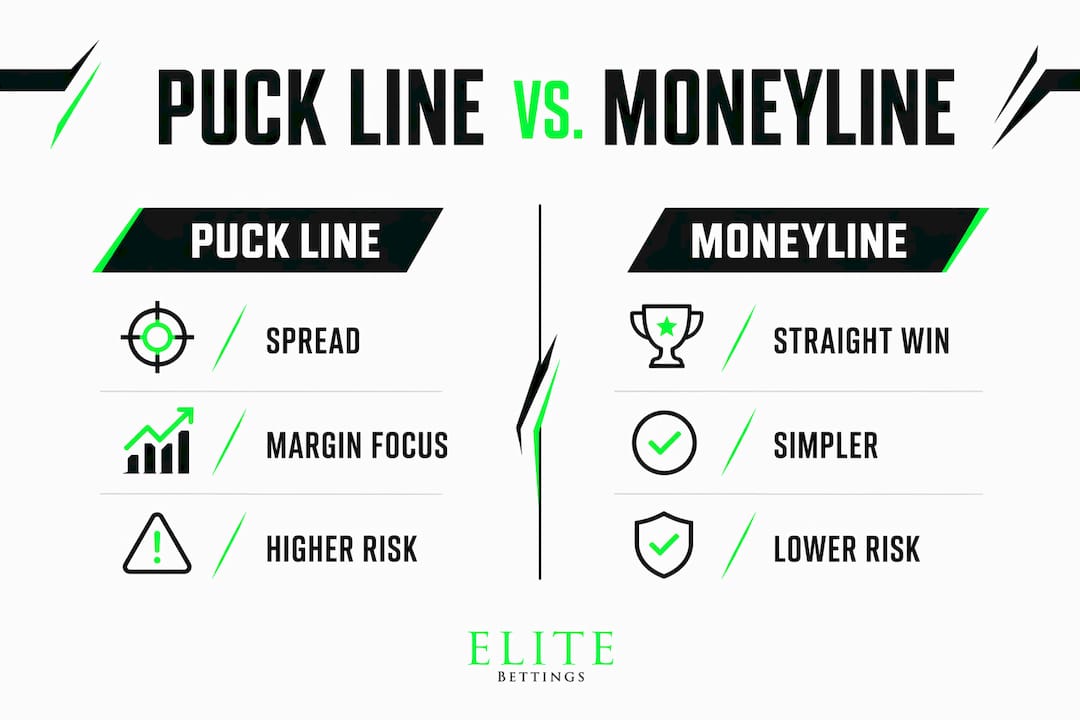
When a favorite is priced at -200 or heavier on the moneyline, the puck line at -1.5 often returns a positive number (+100 to +130 range). If your model says this team wins by 2+ goals 55% of the time, that +115 puck-line price implies only a 46.5% breakeven. That gap is where value lives.
The +1.5 underdog is a different calculation. You are buying insurance: the team can lose by one and you still cash. That insurance costs you odds relative to the moneyline. If the underdog is +160 on the moneyline but only +1.5 at -140, you need to decide whether the one-goal cushion is worth giving up 300 cents of price.
- Use -1.5 when: the favorite is -180 or heavier on the moneyline AND your model projects a multi-goal win
- Use +1.5 when: the underdog has a realistic path to keeping it close but not necessarily winning outright
- Stick to the moneyline when: the game script is unpredictable or the favorite is only a slight edge
Because NHL games average roughly 5–6 total goals, a 1.5-goal margin is structurally significant. Many games are decided by one goal, which is exactly why +1.5 cushions carry real value and why -1.5 requires a genuine edge.
How to find puck-line value using CLV, sharp money, and advanced stats
Closing Line Value (CLV) is the difference between the odds you locked in and the odds the market settled at right before puck drop. Consistent positive CLV is the single best predictor of long-term profitability, more reliable than short-term win rate. A bettor with a 48% win rate and steady positive CLV will outperform a 55% winner who consistently buys bad prices.
Simple CLV calculation:
- Record your entry price (e.g., -1.5 at +118)
- Convert to implied probability: 100 ÷ (100 + 118) = 45.9%
- Record the closing price (e.g., -1.5 at +105)
- Convert closing to implied probability: 100 ÷ (100 + 105) = 48.8%
- CLV = 48.8% − 45.9% = +2.9% (positive, you beat the market)
Signals that suggest positive puck-line value before the market sharpens:
- Early soft opening lines before sharp money arrives
- Late goalie confirmation (line moves 10–20 cents, bet before)
- Public money heavily on one side (fade the public when sharp money disagrees)
- Expected goals (xG) differential favoring the team the market undervalues
- High-danger chance splits showing one team controlling play despite a close score
Advanced stats that matter specifically for puck-line decisions: xG differential (who is generating quality chances), PDO (shooting % + save % combined, a regression indicator), and high-danger scoring chances. A team with a strong xG edge but a losing record due to poor PDO is a candidate for positive regression and a -1.5 cover.
Pro Tip: Use multiple sportsbooks and timestamp every line entry. Line-shopping consistently generates 3–5 cents of CLV on average per bet. Over 200+ bets, that compounds into a measurable long-run edge.

Bankroll management and bet sizing for puck-line plays
Puck-line bets carry more variance than moneyline bets because the margin requirement is strict. A conservative Kelly-based approach keeps you in the game through losing runs.
- Estimate your edge as a percentage (e.g., your CLV average is +3%)
- Apply a fractional Kelly stake: use 25–33% of full Kelly to reduce variance
- On a $1,000 bankroll with a 3% edge at +115 odds, full Kelly suggests roughly 4.5% of bankroll; fractional Kelly brings that to 1.1–1.5% per bet ($11–$15)
- Never exceed 3–5% of bankroll on a single puck-line play regardless of perceived edge
For alternate puck lines (-2.5), cut stake size further. The margin is harder to cover and variance spikes. Treat -2.5 plays as speculative and size them at half your standard unit.
Track every bet with these fields:
- Entry price and timestamp
- Closing price and CLV result
- Outcome (win/loss/push)
- Running ROI by market type
Keeping this log is what separates disciplined bettors from guessers. After 200+ bets, your CLV average tells you whether your process has real edge or whether you have been running hot.
How sportsbooks detect and restrict winning puck-line bettors
Sportsbooks track CLV internally. Accounts that consistently beat the closing line by 5% or more get flagged for review, then limited. It is not personal; it is risk management on their end.
Common restriction triggers:
- Repeatedly betting the same market at the same book at opening or soft lines
- Consistent positive CLV across a large sample
- Bet sizing that scales with perceived edge (a pattern sharp-detection systems recognize)
Mitigation tactics that preserve access:
- Spread action across multiple books so no single book sees your full volume
- Vary bet sizes so your pattern is less predictable
- Avoid hammering the same market at the same book repeatedly
- Use a professional handicapping service when your own access is restricted
Pro Tip: If a book limits you, document your full betting record with timestamps and CLV data before contacting support. A transparent, verifiable record is your strongest case for a limit review.
Common puck-line mistakes and how to avoid them
Most puck-line losses that sting the most are avoidable. They come from process failures, not bad luck.
- Ignoring OT/SO settlement: Betting -1.5 on a team likely to win a close game is a structural mistake. Check the game-script projection first.
- Skipping regulation-only markets: When your edge is a regulation win but not a blowout, the regulation-only market is the right tool.
- Not tracking CLV: Without CLV data, you cannot tell whether you have an edge or are just running hot.
- Overbetting short-term streaks: Three consecutive -1.5 wins does not validate your process. Sample size matters.
- Skipping line-shopping: Accepting the first price you see costs you CLV on every single bet.
- Betting before goalie confirmation: Late scratches shift the entire game-script probability. Wait for the confirmed lineup.
Pre-bet checklist: confirm settlement rules at your book, check the starting goalie, compare prices across at least two books, timestamp your entry, and log the bet immediately.
Worked examples: CLV math on real puck-line scenarios
Example 1: Backing a heavy favorite at -1.5
You bet Colorado -1.5 at +108 at 10 AM. By puck drop, the line moves to -1.5 at -105.
- Entry implied probability: 100 ÷ 208 = 48.1%
- Closing implied probability: 100 ÷ 195 = 51.3%
- CLV: 51.3% − 48.1% = +3.2%
Colorado wins 4–2. You cash. But even if they had won 3–2 (no cover), your process was correct. You beat the closing line by 3.2%, which is a strong result.
Example 2: Buying +1.5 on an underdog
You bet Nashville +1.5 at -128 at noon. By game time, the line is +1.5 at -145.
- Entry implied probability: 128 ÷ 228 = 56.1%
- Closing implied probability: 145 ÷ 245 = 59.2%
- CLV: 59.2% − 56.1% = +3.1%
Nashville loses 3–2. You cover. The +1.5 cushion did exactly what you bought it for.
| Bet | Entry Odds | Closing Odds | Entry Prob | Closing Prob | CLV |
|---|---|---|---|---|---|
| Colorado -1.5 | +108 | -105 | 48.1% | 51.3% | +3.2% |
| Nashville +1.5 | -128 | -145 | 56.1% | 59.2% | +3.1% |
Both bets show positive CLV. Over a large sample, a consistent +3% CLV average puts you firmly in profitable territory.
Key Takeaways
The puck line is a fixed ±1.5 goal spread where long-term profitability depends on beating the closing line consistently, not just picking winners.
| Point | Details |
|---|---|
| OT/SO settlement rule | Any game reaching extra time locks +1.5 as a winner and -1.5 as a loser in full-game markets. |
| CLV over win rate | A bettor with positive CLV and a 48% win rate can outperform a 55% winner buying bad prices. |
| Line-shopping compounds | Shopping prices across books generates 3–5 cents of CLV per bet, compounding into a real long-run edge. |
| Bet sizing discipline | Use 25–33% fractional Kelly and never exceed 3–5% of bankroll on a single puck-line play. |
| Elite-bettings approach | Elite-bettings applies CLV monitoring, timestamped lines, and documented picks with a documented hit rate. |
The case for CLV-first betting over chasing streaks
Most bettors measure themselves by last week’s record. That is the wrong scoreboard. A three-game winning streak on -1.5 favorites tells you almost nothing about whether your process has edge. What tells you something real is whether you consistently got better prices than where the market closed.
The pros who sustain profitability target average CLV of 2–5% across large samples. That is not glamorous. It does not make for exciting social media posts. But it is the number that separates repeatable edge from variance. Patience and sample size are the actual discipline here. Review your CLV after 200+ bets, not after 20.
If your CLV is flat or negative after a meaningful sample, the honest answer is that your process needs work, or you need better information. That is when a professional service with a documented, timestamped track record becomes worth considering, not as a shortcut, but as a calibration tool.
How Elite-bettings helps you capture puck-line CLV
Consistent puck-line profits require three things most bettors lack: model-backed picks, timestamped line entries, and a fully documented record you can audit. Elite-bettings delivers all three.

Elite-bettings uses CLV monitoring and sharp-money analysis to identify puck-line value before the market adjusts. Every pick comes with a timestamp and entry price so you can verify CLV yourself. The documented track record shows transparent results you can review rather than marketing claims you have to take on faith. A money-back guarantee option means you are not locked into a blind commitment.
For bettors who want to stop guessing at prices and start measuring real edge, check the subscription options at Elite-bettings and see the full documented record before deciding.
General information only. Confirm current rules with your sportsbook and consult a qualified professional for your specific situation.
Useful sources
- FOX Sports: What Is the Puck Line? — foundational puck-line mechanics and empty-net data
- The Hockey News: NHL Puck Line Explained — sport-specific scoring context
- Bettingsite.net: NHL Puck Line Guide — OT/SO settlement rules
- Online-Betting.org: Puck Line Betting Explained — regulation-only market notes
- Market Math: Closing Line Value — CLV definition, sportsbook restriction triggers
- CalcMyBets: CLV Guide — CLV vs. win rate, sample size discipline
- Compare n’ Bet: CLV as the Most Important Metric — line-shopping and CLV compounding
Always verify settlement rules at your specific sportsbook. Regulation-only markets handle OT/SO differently from full-game markets.
FAQ
What is the puck line in NHL betting?
The puck line is hockey’s fixed point spread, set at ±1.5 goals. Favorites must win by 2 or more; underdogs cover with a win or a one-goal loss.
Does overtime count for puck-line bets?
Yes, in standard full-game markets. Any game that reaches OT or a shootout produces a one-goal margin, so +1.5 wins and -1.5 loses automatically.
When should you bet -1.5 instead of the moneyline?
When a heavy favorite is priced at -180 or steeper on the moneyline and the -1.5 returns a positive number, the puck line often offers better value for a similar expected outcome.
What is CLV and why does it matter for puck-line betting?
CLV measures whether you got a better price than where the market closed. Consistent positive CLV predicts long-term profitability better than win rate alone.
How does Elite-bettings help with NHL puck-line picks?
Elite-bettings provides CLV-monitored, timestamped puck-line picks with a transparent record bettors can verify before subscribing.