 Skip to content


Closing Line Value: The Sharpest Metric in Sports Betting

Table of Contents
- What is closing line value and why it predicts long-term profit
- How to calculate closing line value and interpret your edge
- Which markets give you the most reliable CLV signal
- Common misconceptions about closing line value you need to drop
- How Elite-bettings uses CLV to deliver documented, consistent results
- How professional handicappers use CLV to improve returns
- Strategies to identify and predict closing line moves
- Tools and resources to track closing line value in real time
- Case studies: when CLV predicted the outcome and when it did not
- Key Takeaways
- FAQ
What is closing line value and why it predicts long-term profit
Closing line value (CLV) is the difference between the odds you locked in when placing a bet and the final market odds just before game start. Beat the closing line, and you secured better odds than the market’s final consensus. That gap is not just a number. It tells you whether your bet held a genuine edge before the result was ever decided.
CLV is the primary skill metric in sports betting, not your win rate. Short-term results can be misleading due to variance, with luck masking both good and bad processes. Positive CLV, tracked consistently, proves your bets carry positive expected value (+EV) over time.
- Beat the closing line: You read the market correctly and got a better price than the consensus.
- Lost to the closing line: The market moved against you, signaling a weaker bet regardless of outcome.
- CLV as a skill metric: It separates process from luck far faster than win/loss records alone.
Pro Tip: Elite-bettings focuses on NFL and NBA markets specifically because those are the leagues where CLV signals are most reliable and actionable.
How to calculate closing line value and interpret your edge
The cleanest way to measure CLV uses implied probability, not raw odds. Convert your bet odds and the no-vig closing odds to implied probabilities, then subtract.

CLV % = Closing Implied Probability minus Your Implied Probability
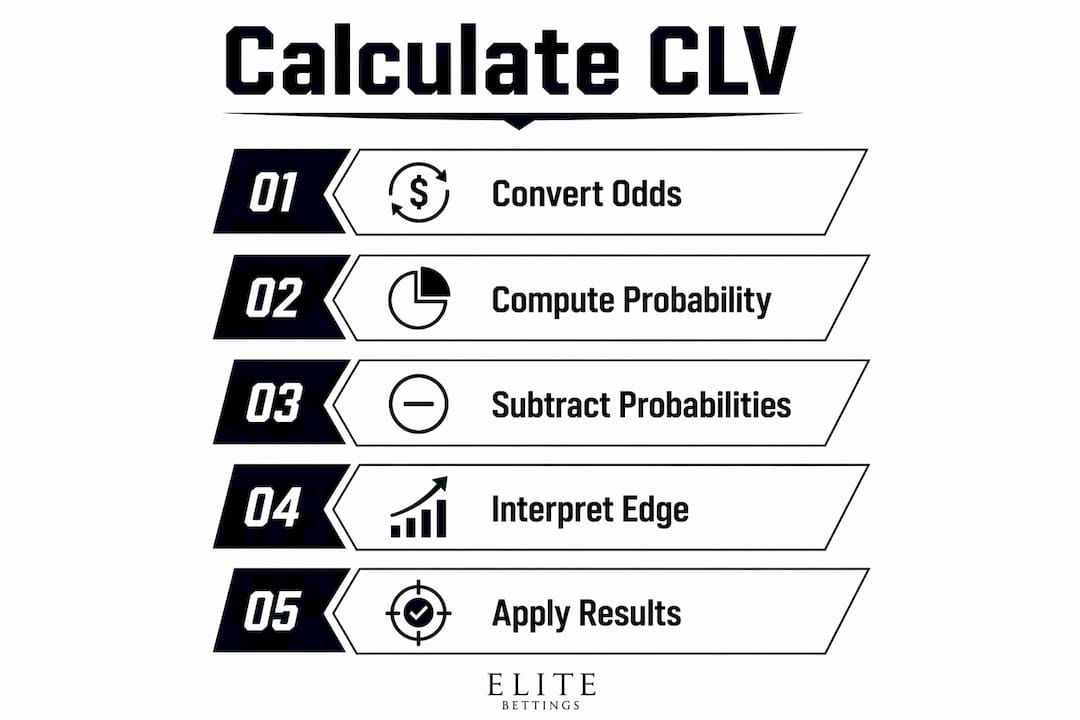
A positive result means you got a better price. A negative result means the market moved against you.
| Bet Type | Your Odds | Closing Odds | Your Implied Prob. | Closing Implied Prob. | CLV |
|---|---|---|---|---|---|
| Moneyline (favorite) | — | — | — | — | +3% |
| Moneyline (underdog) | — | — | — | — | +3% |
| Spread | — | — | varies | varies | use half-point calc |
For spreads, find the line difference first, then convert to a probability edge using a half-point calculator. Raw odds comparisons on spreads without that step will overstate or understate your actual edge.
Interpreting your CLV average across bets:
- +2% to +8%: Consistent and realistic edge, indicating genuine skill in liquid markets.
- +1% to +2%: Solid, sustainable profit over a large sample, just above break-even.
- 0% to +1%: Marginal; may not overcome vig.
- Negative: Review your timing, line sources, and process.
Which markets give you the most reliable CLV signal
CLV’s predictive power depends entirely on market liquidity. In liquid markets, sharp bettors move lines efficiently, making the closing line a reliable probability estimate. In thin markets, the closing line reflects very little sharp input, so beating it means far less.
High-reliability markets:
- NFL spreads: Lines open a week early, absorb heavy sharp action, the highest liquidity in U.S. sports betting.
- NBA totals: Large market, injury news moves lines sharply and predictably.
- MLB moneylines: Pitcher changes create clear, trackable line movement.
Low-reliability markets:
- Player props: Low limits, wide margins, minimal sharp money.
- Minor leagues and obscure props: Closing lines shaped by almost no sharp input.
- Parlays: No single closing line to benchmark against.
Elite-bettings operates primarily in NFL and NBA markets for exactly this reason. Those are the leagues where CLV analysis produces the clearest, most actionable signals.
Common misconceptions about closing line value you need to drop
The biggest mistake bettors make is treating CLV as a bet-by-bet verdict. One bet with negative CLV is not automatically a bad bet, and one with positive CLV does not guarantee a win. Variance is real, especially over samples under 100 bets.
- Myth: Raw odds tell the full story. Always use no-vig closing lines. Raw lines include the sportsbook’s margin, which distorts your actual edge measurement.
- Myth: Huge CLV means you’re elite. Large positive CLV margins above 10% often indicate you’re moving a thin market with your own bet, not finding genuine value. Realistic, consistent edges run closer to +2% to +8%.
- Myth: Positive CLV replaces bankroll management. CLV identifies edge. It does not protect your bankroll from a bad run. Sound staking discipline is still required.
- Myth: You need to beat the closing line most of the time. Achieving positive CLV more than half the time is generally considered a strong signal of a genuine long-term edge.
How Elite-bettings uses CLV to deliver documented, consistent results
Elite-bettings builds its entire handicapping methodology around identifying positive CLV opportunities before the market corrects. Every pick is evaluated not just for likely outcome but for whether the odds available represent genuine value against where the line will close.
Elite-bettings maintains a 74% hit rate with full documentation of all results, not selective records. That transparency is the standard professional handicappers hold themselves to. Bettors who follow Elite-bettings’ picks report measurable profit increases, backed by a process grounded in CLV analysis rather than gut feel or public trends.
Pro Tip: Professional handicappers track CLV continuously as the primary metric to confirm edge, not win rate. That discipline is what separates sustainable profit from lucky streaks.
How professional handicappers use CLV to improve returns
Professional handicappers treat the betting market as the measuring stick, not the scoreboard. They measure success by whether their bets consistently beat the closing line, not by whether they won last week. This process focus is what allows them to identify and correct weaknesses in their models before losses pile up.
The key practice is continuous tracking. A handicapper who logs every bet’s opening odds, bet odds, and closing odds can calculate average CLV across hundreds of bets. A consistent positive average CLV in the +2% to +8% range is evidence of genuine skill in liquid markets. That data also reveals which sports, bet types, or timing windows produce the strongest edges.
Professionals also use CLV to validate new angles quickly. CLV can show statistical significance in as few as 50 bets, compared to thousands needed for win rate to separate skill from luck.
Strategies to identify and predict closing line moves
Predicting where a line will move before it moves is how you capture CLV. The most reliable strategies:
- Bet favorites early. Opening lines on NFL games are softest in the first 24–48 hours before sharp money corrects them. Bet favorites early, underdogs late is a proven timing principle.
- React to news faster than the books. Injury announcements and lineup changes move lines sharply. If you confirm news before a sportsbook adjusts, you lock in value before the market catches up.
- Follow sharp book movement. When a market-making book moves a line without obvious public reason, that signals sharp money. Betting the same direction early captures CLV before the move completes.
- Identify reverse line movement (RLM). RLM occurs when a line moves opposite to the direction public betting would suggest. If 70% of bets are on one side but the line moves the other way, sharp money is driving it. That is a strong signal to follow.
Tools and resources to track closing line value in real time
Tracking CLV manually in a spreadsheet works, but dedicated tools automate the closing line comparison and save hours of data entry.
OddsJam pulls closing odds from sharp books automatically and calculates your CLV for each logged bet. Its bet tracker shows which percentage of your wagers beat the closing line, color-coded for quick review.
Betstamp offers similar automation, logging your bets and comparing them against closing lines from multiple books. It also flags accounts showing consistent positive CLV, which is useful for understanding your own betting profile.
Pinnacle’s closing line is widely considered the gold standard benchmark. Because Pinnacle operates with the lowest margins and accepts sharp money, its closing prices reflect the most efficient probability estimates available.
For spread CLV, a half-point calculator is necessary to convert line differences into probability edges accurately. Most dedicated CLV tools include this conversion automatically.
Case studies: when CLV predicted the outcome and when it did not
Success case: You bet the Chiefs -3 early in the week. By kickoff, the line has moved to -4. You captured a full point of CLV. Even if the Chiefs win by exactly 3 and you push, your process was correct. Over hundreds of similar bets, that one-point edge translates directly to profit.
Failure case: You bet a moneyline underdog at +200. A star player gets ruled out, and the line surges to +250. You now hold negative CLV. The market moved sharply against your position after you bet. Even if the underdog wins, the process was flawed because you missed the information that the market priced in.
The thin-market trap: A bettor consistently beats closing lines in low-volume prop markets by +12–15%. That sounds elite, but margins that large in illiquid markets often mean the bettor’s own action is moving the line, not that they found genuine value. Sustainable CLV in liquid markets runs in the +2% to +8% range.
Key Takeaways
Closing line value is the single most reliable indicator of long-term betting skill, and consistently beating it by +2% to +8% across hundreds of bets produces measurable profit.
| Point | Details |
|---|---|
| CLV definition | The gap between your bet odds and the final market odds before game start. |
| Skill signal | Positive CLV proves edge faster than win rate, with significance possible in 50 bets. |
| Best markets | NFL spreads and NBA totals offer the most reliable CLV signals due to high liquidity. |
| Realistic edge | Consistent CLV of +2% to +8% indicates genuine skill; above +10% often signals thin-market impact. |
| Elite-bettings track record | Elite-bettings documents a 74% hit rate using CLV-focused analysis across NFL and NBA markets. |
FAQ
What does closing line value mean in betting?
CLV is the difference between the odds you bet and the final odds when the market closes. Positive CLV means you secured a better price than the market’s final consensus, indicating a well-timed, well-researched bet.
How do I calculate CLV for a moneyline bet?
Convert your bet odds and the no-vig closing odds to implied probabilities, then subtract your implied probability from the closing implied probability. A positive result means you captured value.
Can I lose a bet and still have positive CLV?
Yes. Positive CLV means your price was better than the market’s final estimate, but individual outcomes still involve variance. Over hundreds of bets, consistent positive CLV leads to long-term profit.
What is reverse line movement (RLM)?
RLM occurs when a betting line moves opposite to the direction public money would suggest. If most bets are on one team but the line moves against them, sharp money is driving the move. Following RLM is one of the most reliable ways to identify CLV opportunities.
How does Elite-bettings use CLV in its picks?
Elite-bettings evaluates every pick against where the line is likely to close, focusing on NFL and NBA markets where CLV signals are most predictive. Their documented 74% hit rate reflects a process built on positive CLV identification, not public trends.