 Skip to content


Sharp Money Betting: How to Spot and Follow Pro Bets
TL;DR:
- Sharp money involves wagers from professional bettors exploiting mispriced lines before the market corrects. Key indicators include reverse line movement, large handle-to-ticket gaps, and rapid line shifts across multiple sportsbooks. Combining these signals with disciplined staking and account management enhances betting value and persistence.
Sharp money betting means tracking wagers placed by professional bettors and syndicates who use data models to exploit mispriced lines — and acting on the signals those bets leave behind before the market corrects. The single best first move: monitor reverse line movement (RLM) on any game you’re considering, then line-shop before placing your bet to capture the best available number.
TL;DR — three signals to watch right now:
- Reverse line movement (RLM): the line moves against the public betting side
- Bet% vs. handle% gap: a team draws 30% of tickets but 65%+ of the money
- Steam moves and line freezes: rapid cross-book shifts or a book holding its number despite heavy public action
⚠️ Caution: following sharp signals without account management can trigger limit reductions. Read the risks section before scaling up.
Table of Contents
- What “sharp money” really means — and what it doesn’t
- How sportsbooks report money% vs. bet% — and how to read them
- Key signals that point to sharp action in the market
- What tools and data categories help you track sharp money
- How experienced bettors act on sharp signals — timing and staking
- Risks you need to know — limits, taxes, and common traps ⚠️
- Your six-point checklist to spot sharp money today ✅
- Elite-bettings: CLV-driven picks with a documented track record
- Key Takeaways
- How Elite-bettings reads sharp signals in practice
- What Elite-bettings offers bettors who want sharp-style edges
- Useful sources and further reading
- FAQ
What “sharp money” really means — and what it doesn’t
Sharp money refers to wagers from professional bettors and syndicates who build statistical models, track closing-line value (CLV), and target lines they believe are mispriced. These bettors represent a small fraction of total action, yet they consistently drive significant line movement because sportsbooks respect their accuracy.
The contrast with public (“square”) money is stark. Public bettors respond to narratives — a team’s recent win streak, a star player’s media buzz, home-field emotion. Sharps respond to numbers. When a popular team draws 75% of tickets but the line moves in favor of the underdog, the market is telling you something: the money side, not the ticket side, is winning the argument.
A common beginner mistake is equating bet size with sharp action. A $50,000 wager from an uninformed high roller is not sharp money. What makes a bettor “sharp” is consistent CLV-positive performance over hundreds of bets — beating the closing line repeatedly, not just winning one big game.
Pro Tip: CLV (closing-line value) is the gold standard for measuring a bettor’s edge. If you consistently get better odds than the closing number at a sharp-oriented book, you’re betting with positive expected value (+EV). Track your CLV on every wager, not just your win/loss record.
How sportsbooks report money% vs. bet% — and how to read them
Sportsbooks and data aggregators publish two distinct metrics. Bet percentage (also called ticket percentage) counts the raw number of bets placed on each side. Money percentage (handle percentage) measures the total dollar volume wagered on each side. The gap between them is where sharp signals live.
| Bet % (Tickets) | Money % (Handle) | Line Movement | Interpretation |
|---|---|---|---|
| 65% on Team A | — | Moves toward A | Public-driven; likely square action |
| 30% on Team B | 65% on Team B | Moves toward B | Classic sharp indicator (RLM) |
| 50% each | 50% each | Flat | No clear signal; wait for more data |
| 65% on Team A | 65% on Team A | Moves away from A | Possible sharp fade of the public side |
When a team receives only 30% of tickets but accounts for 65% or more of the handle, a small number of large, informed bets are driving the money side. That concentrated handle vs. dispersed tickets pattern is one of the most reliable sharp indicators available on public consensus pages.
You’ll find these metrics on consensus dashboards and oddsmeter-style pages that aggregate data across multiple U.S. sportsbooks. Look for the split between “% of bets” and “% of money” columns — any gap wider than a notable percentage deserves a closer look.
Key signals that point to sharp action in the market
Not every line move means sharps are involved. These are the signals that carry the most weight:
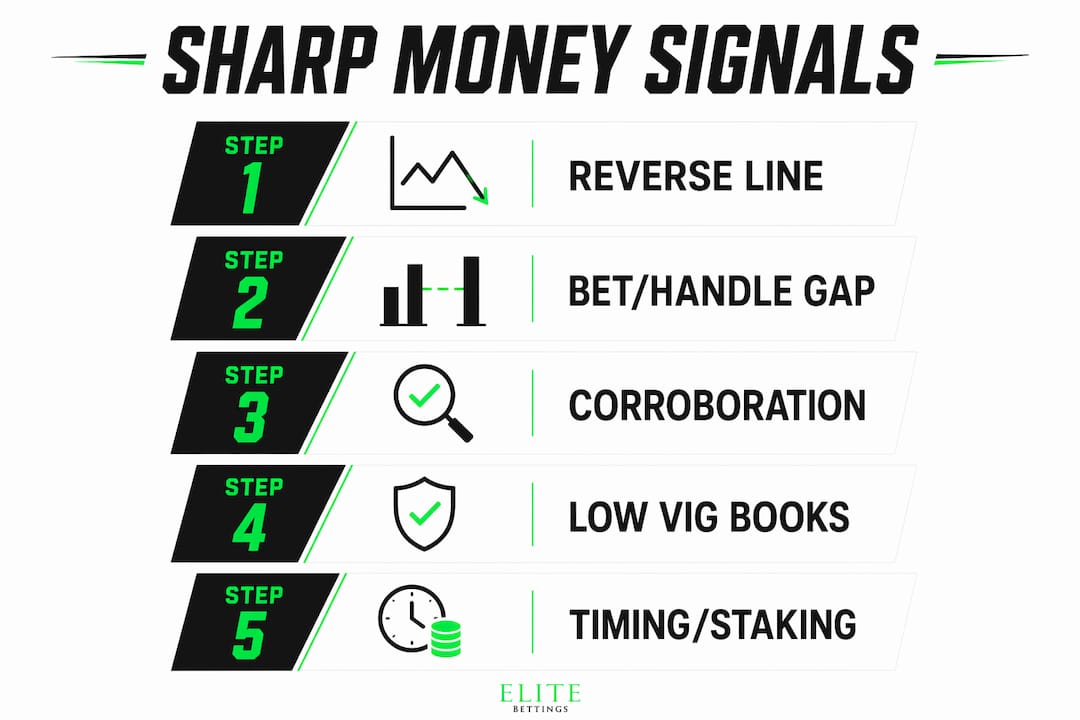
- Reverse line movement (RLM): The line shifts against the side receiving the majority of public tickets. If 68% of bettors are on the favorite but the spread moves in favor of the underdog, sharp money is almost certainly on the dog. This is the most cited sharp indicator.
- Steam moves: A rapid, synchronized line shift across multiple books within minutes. Sharps often use coordinated placement across several sportsbooks to maximize exposure before the market adjusts.
- Line freezes: A book holds its number despite heavy one-sided public action. This typically means the book has already absorbed sharp money on the other side and is comfortable with its liability position.
- Bet% vs. handle% gaps: Per the table above, a 20% ticket share producing 65%+ of handle is a classic sharp signal.
- Late, high-confidence money: Large wagers placed close to game time, after injury reports and weather data are finalized, often carry the most information.
Mini case example: Say Team A opens as a 3-point favorite and draws 72% of public tickets. By Thursday, the line has moved to Team A –2. That’s RLM — the line moved toward the underdog despite lopsided public support for the favorite. A bettor who noticed this on Tuesday and took Team B +3 captured a full point of value before the market corrected. That extra point is the edge.
Sharp signals like RLM are most reliable when multiple indicators align. A single data point rarely confirms a sharp play.
What tools and data categories help you track sharp money
No single tool gives you the complete picture. The most effective approach combines several data categories:
| Tool Category | What It Shows | Key Dimension |
|---|---|---|
| Consensus / money% pages | Bet% vs. handle% splits across books | Coverage and refresh speed |
| Line-history archives | Opening line vs. current line over time | Timing of movement |
| Betting exchanges (e.g., liquidity data) | Real-money volume at each price point | Liquidity detection |
| Odds aggregators | Best available price across U.S. books | Price (vig comparison) |
| Alert / signal services | Automated notifications on steam moves | Actionability and speed |
Sharp-oriented sportsbooks tend to operate with materially lower vig — roughly 2.5–3.5% on main markets — compared to mainstream retail books at 4.5–5.5%. Props can carry 8–15% vig. That difference compounds over hundreds of bets, so price-shopping isn’t optional for anyone serious about +EV play.
The most reliable approach: corroborate at least three signals before acting. Exchange volume spiking on one side, combined with a bet%/handle% gap and confirmed RLM, gives you far more confidence than any single metric alone.
How experienced bettors act on sharp signals — timing and staking
Sharps typically act at two moments: very early on opening lines (to exploit soft mispricings before the market adjusts) or very late near game time (after new injury, weather, or lineup information arrives). Each approach has tradeoffs.

Early plays capture the best number but carry more uncertainty. Late plays carry more information but the line has often already moved. For recreational bettors following sharp signals, the practical window is usually within the first few hours after a line opens — before the public piles in and before the book tightens its limits.
Staking and bankroll basics:
- Size each bet at 1–3% of your total bankroll per play, scaling with your confidence in the signal corroboration.
- Never chase a line that has already moved significantly — you’re buying a corrected price, not an edge.
- Line-shop across at least three books before placing any wager. A half-point difference on a spread bet can shift your long-run ROI meaningfully.
Pro Tip: When signals conflict — say, RLM points one way but the handle% gap is small — apply a simple corroboration checklist: (1) Is there confirmed RLM? (2) Is the handle gap 20%+? (3) Is exchange liquidity moving in the same direction? If you can’t check two of three boxes, pass the game.
On account management: the legal and allowed approach is to maintain accounts at multiple licensed U.S. sportsbooks and prioritize sharp-friendly operators that offer better limits. Diversifying your book portfolio preserves your access to lines longer than concentrating all volume at one book.
Risks you need to know — limits, taxes, and common traps ⚠️
Winning consistently on U.S.-regulated platforms triggers two types of responses: sportsbook account actions and tax reporting obligations. Both are real and both require preparation.
Sportsbooks monitor CLV-positive accounts closely. Once a book identifies you as a consistent winner, it typically reduces your maximum stake, sometimes dramatically. Bet rejections and account reviews follow. This is standard industry practice, not a personal grievance — books are businesses managing liability.
On the tax side, large wins on U.S.-regulated platforms can trigger W-2G reporting requirements. Keep detailed records of every wager, win, and loss. A professional tax advisor familiar with gambling income is worth consulting if your volume is significant.
Common traps to avoid:
- Misreading RLM: Not every line move against the public is sharp. Books sometimes shade lines to balance action, not because sharps hit them.
- Following stale sharp reports: A sharp signal from 48 hours ago may already be fully priced in. Timing matters.
- Chasing public lines after sharps already bought value: If the line has moved three points since opening, the edge is gone. You’re buying the corrected price.
Your six-point checklist to spot sharp money today ✅
Use this before betting any game:
- Check line history: Compare the opening line to the current line. Identify the direction and timing of movement.
- Compare bet% vs. handle%: Look for gaps of 20% or more between ticket share and money share — for example, a side drawing 30% of tickets but 65%+ of the handle.
- Confirm RLM: Is the line moving against the majority of public tickets? If yes, flag it.
- Verify exchange liquidity or steam: Is volume spiking on the same side as the handle gap?
- Line-shop: Check at least three licensed U.S. books for the best available number before placing.
- Size your bet per staking rules: 1–3% of bankroll, scaled to signal strength.
For documented sharp-style picks already filtered through this process, check Elite-bettings’ expert picks page — every play comes with a full record and CLV context.
Elite-bettings: CLV-driven picks with a documented track record
Elite-bettings applies sharp-money analysis — CLV tracking, RLM monitoring, and bet%/handle% corroboration — to deliver picks across the NFL, NBA, NCAAF, NCAAB, and MLB. Every pick is documented, not cherry-picked.
Elite-bettings has posted a 73% win rate and an average ROI of 8.5% across more than 1,500 picks since 2016. These are client-supplied performance figures based on the full documented record, not a selective sample.
That consistency comes from the same framework described in this article: CLV-positive selection, multi-signal corroboration, and disciplined staking. The service is built for bettors who want the analytical work done without spending hours on consensus pages every week.
The full track record, including individual game results and CLV data, is available for review. Transparency is the standard, not the exception.
View Expert Picks and Documented Results
Key Takeaways
Sharp money betting is most reliably identified by combining reverse line movement, a 20%+ bet%/handle% gap, and corroborating exchange liquidity — acting on any single signal alone rarely produces consistent +EV results.
| Point | Details |
|---|---|
| CLV is the real measure | Consistent CLV-positive betting defines a sharp; single large bets do not. |
| Handle gap signals sharps | A 20%+ gap between ticket% and money% is a reliable sharp indicator. |
| Timing windows matter | Early plays capture better lines; late plays carry more information. |
| Vig drag is real | Sharp books run 2.5–3.5% vig vs. 4.5–5.5% at retail books — line-shop every bet. |
| Elite-bettings | Documented 73% win rate and 8.5% average ROI over 1,500+ picks since 2016. |
How Elite-bettings reads sharp signals in practice
The threshold for acting on RLM at Elite-bettings is never a single data point. The team requires at least two corroborating signals before a play goes out — typically confirmed RLM plus a meaningful handle gap, with exchange volume as a tiebreaker when the picture is mixed. That discipline is what separates a documented 73% win rate from a lucky run.
Responsible account management is part of the process too. Preserving access to sharp-friendly books matters as much as finding the edge. Concentrating volume at one book is the fastest way to lose your limits and your ability to act on future plays.
If you want to go deeper on the methodology, Elite-bettings publishes educational content alongside its picks so you understand the reasoning, not just the result.
What Elite-bettings offers bettors who want sharp-style edges
Most bettors don’t have time to monitor consensus pages, track line history across six books, and calculate CLV before every game. Elite-bettings does that work for you. The service delivers CLV-analyzed picks for major U.S. sports leagues with a full documented record going back to 2016 — 73% win rate, 8.5% average ROI, over 1,500 picks on file.
For executing your bets, Stake is the recommended sportsbook — competitive lines, fast payouts, and a platform built for serious bettors.
Ready to stop guessing which side the pros are on? Get picks that come with the receipts.
Access Expert Picks at Elite-bettings
General information only — not financial or legal advice. Confirm current tax and reporting requirements with a qualified professional for your specific situation.
Useful sources and further reading
- VegasOdds — Sharp Money Definition: Clear primer on what sharp money is and how it moves lines.
- BettorEdge — Line Movement Explained: Detailed breakdown of bet% vs. handle% and RLM mechanics.
- The Action Network — Sharp Money 101: Bet signals, RLM, and corroboration strategies for U.S. bettors.
- OddsJam — What Is a Sharp Bettor?: CLV as the standard performance metric for professional bettors.
- OddsReference — Sportsbook Vig Comparison: Vig data across sharp and retail books for line-shopping decisions.
- AgentBets — Best Sportsbooks for Sharps: Account reaction data and tax/reporting guidance for U.S. bettors.
FAQ
What is considered sharp money in betting?
Sharp money refers to wagers placed by professional bettors and syndicates who use data models to target mispriced lines. It’s defined by consistent CLV-positive performance over many bets, not by the size of any single wager.
What are the sharpest sportsbooks?
Sharp-oriented books are those that accept larger wagers from winning players and offer lower vig — roughly 2.5–3.5% on main markets versus 4.5–5.5% at mainstream retail books. They also tend to produce more accurate closing lines because informed money flows through them.
What happens if you win large amounts on a U.S. sportsbook?
Consistent large wins typically trigger two responses: the sportsbook may reduce your maximum stake or flag your account for review, and U.S. tax law requires W-2G reporting for certain gambling winnings. Keep detailed records and consult a tax professional.
In what states are moneyline bets legal?
Sports betting, including moneyline wagers, is legal in many U.S. states, with regulated online sportsbooks operating in states including New Jersey, Pennsylvania, Illinois, Colorado, and Michigan, among others. Always verify your state’s current status with its gaming regulatory authority before placing bets.