 Skip to content


Alternate Lines Betting: A Model-Driven How-To for Bettors
An alternate line lets you buy or sell points on a spread, total, or prop for a different price than the mainline offers. Use one when your own number shows the sportsbook mispriced that specific alternate, when you can grab a key number like 3 or 7 in football, or when a line has gone stale and the book hasn’t caught up. Skip it when you’re just paying extra juice to feel safer about a bet you’d make anyway.
Here’s the fast version before you commit any money:
- Definition: Alternate lines are adjusted spreads, totals, or prop numbers away from the mainline, priced with different odds to reflect the shifted risk.
- When it’s worth it: Your model disagrees with the book’s number, you’re capturing a key number cheaply, or you’re locking in a line before it moves.
- Red flag: Overpaying for juice. If the price you’re giving up exceeds the edge you’re gaining, the alternate is worse than the original line, not better. 🚩
Key Takeaways
Alternate lines create genuine value only when your model’s fair number and the sportsbook’s price diverge enough to survive the extra hold typically built into off-market alternates.
| Point | Details |
|---|---|
| Definition matters | An alternate line shifts the spread, total, or prop number and reprices the odds to match. |
| Key numbers rule football | Moving across 3 or 7 in the NFL changes win probability more than an equivalent move elsewhere. |
| Extra hold is real | Off-market alternates often carry 1 to 3% more hold than mainlines, so build that into your EV math. |
| Shop before you bet | Identical alternate numbers can differ 10 to 20 cents across books, so always compare prices. |
| Elite Bettings applies this daily | Our picks run through the same fair-price checklist, documented with a solid track record over many picks. |
Rule of thumb: Only buy a half-point around a key number when the price you’re paying costs less than your model’s edge plus the estimated extra hold, roughly 1 to 3%.
Table of Contents
- What Alternate Lines Betting Actually Means
- Types of Alternate Lines and Where They Show Up
- How Sportsbooks Price Alternate Lines: Juice, Hold, and Liquidity
- Worked Examples You Can Reproduce
- When Alternate Lines Make Sense (And When They Don’t)
- How to Evaluate Whether an Alt Line Is +EV
- Where to Find Alternate Lines and Which Tools Help
- Impact of Alternate Lines Betting on Bankroll Management
- Legal Considerations and Regulations Regarding Alternate Lines Betting
- How Elite Bettings Uses Alternate Lines
- Get Model-Backed Alternate Line Picks From Elite Bettings
- Research-Backed Resources for Alternate Lines Betting
- Sources
- FAQ
What Alternate Lines Betting Actually Means
A mainline is the standard spread, total, or moneyline a sportsbook posts for a game, typically priced near even juice on both sides. An alternate line takes that same market and shifts the number up or down, adjusting the odds to compensate. Bet the Chiefs at -3.5 (the mainline) and you might pay -110. Move to -2.5 and the book will charge you more, maybe -145, because you’re now winning on a wider range of outcomes.
That’s the entire mechanic: shift the number, reprice the risk. Sportsbooks build entire menus this way, and once you understand the pattern, every alt line on the board reads the same regardless of sport.
The vocabulary is worth locking down because it shows up everywhere on sportsbook boards:
- Buying points means moving the spread in your favor (e.g., from -3.5 to -2.5), which costs more juice.
- Selling points means moving the spread against you for a better price (e.g., from -3.5 to -4.5 at plus money), which increases variance but boosts payout.
- Alt total applies the identical logic to over/under numbers.
- Alt prop applies it to player statistics, like rushing yards or points scored.
- Push rules matter more on alternates that land on whole numbers. A bet landing exactly on the number typically refunds your stake.
Picture a real board: the mainline reads Cowboys -3 (-110) / Eagles +3 (-110). Scroll to the alt menu and you’ll see Cowboys -1.5 (-135), Cowboys -2.5 (-125), Cowboys -4.5 (+105), Cowboys -6.5 (+165), and so on. Same game, same two teams, a dozen different risk profiles.
Types of Alternate Lines and Where They Show Up
Every major sportsbook builds out alt markets across four broad categories:
- Alt spreads — shifted point spreads on football, basketball, and college matchups.
- Alt totals — adjusted over/under numbers for combined scoring.
- Alternate player props — moved thresholds on yards, points, assists, strikeouts, or shots on goal.
- Alternate run lines and puck lines — baseball and hockey equivalents of the spread, usually built around a fixed 1.5-run or 1.5-goal margin with alternates stretching to 2.5 or shrinking to 0.5.
Sport matters here more than most bettors realize. In the NFL, the numbers 3 and 7 dominate scoring margins because of how field goals and touchdowns stack up, which makes half-point moves around those numbers unusually valuable — alternate lines are priced using a probability distribution across final scores, and that distribution clusters hard around those key numbers. College football sees similar clustering, though blowouts widen the tails. The NBA trades in bigger spreads and more possessions, so half-points matter less individually and totals swing more with pace. MLB run lines are usually fixed at 1.5, so the “alternate” action often means moving to 1 run or up to 2.5, which changes the bet’s relationship to one-run games entirely.
Menu depth varies by sport, too. Football and basketball tend to offer the deepest alt boards because scoring is granular enough to support dozens of price points. Baseball and hockey menus are thinner since scoring is lower and one-run or one-goal swings dominate the outcome anyway.
How Sportsbooks Price Alternate Lines: Juice, Hold, and Liquidity
Sportsbooks make money on the spread between what they’d pay out if the market were perfectly fair and what they actually charge you. That spread is called hold, and it’s baked into the odds through juice (also called vig). On a mainline at -110/-110, the book’s theoretical hold is around 4.5%. Move to an alternate number, and that hold often creeps higher.
Statistic callout: Industry estimates suggest off-market alternate spreads carry roughly 1 to 3 percentage points more hold than the primary line. Fewer bettors trade these markets, so books face less competitive pressure to price them tightly, and they can widen the margin without losing volume.
That extra hold changes your break-even math directly. A bet that needs to hit
of the time to break even at -110 might need to hit 54% or higher once you’ve drifted three points off the mainline. The gap seems small until you’re grinding a full season of bets through it.
| Line Type | Typical Juice | Approximate Hold |
|---|---|---|
| Mainline spread (-110/-110) | -110 both sides | ~4.5% |
| Alt spread, 1 point off | -125 | 4.5% to 6.5% |
| Alt spread, 3+ points off | -135 to +165 range | ~6% to 8% |
| Alt total or prop, off-market | Varies widely | 4.5% to 7.5% |
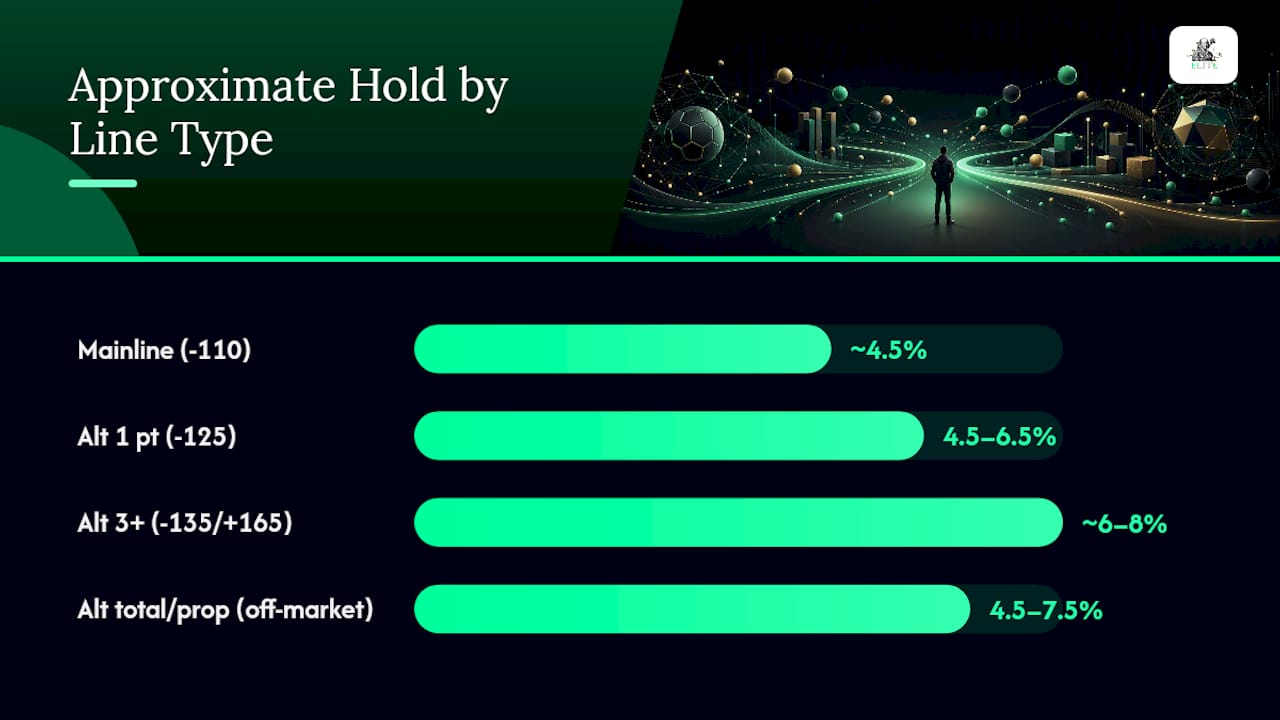
Shopping matters because this hold isn’t fixed across the industry. Two books can offer the identical alternate number with a 10 to 20 cent difference in price, and alternate menus vary significantly in both depth and pricing from one sportsbook to the next. That gap is where a marginal bet turns into a profitable one, or vice versa.
Worked Examples You Can Reproduce
Let’s run the actual numbers so you can repeat this process on your own bets.
Example 1: NFL alternate spread.
Say the mainline is Team A -3 at -110. The sportsbook offers an alternate at -2.5 for -135.
- Convert -135 to implied probability: 135 ÷ (135 + 100) = 57.4%.
- Compare to your model’s fair number at -2.5, which (adjusting slightly up from -3 to reflect the easier cover) you estimate at 55%.
- The book is charging you 57.4% implied probability for a bet you believe is worth 55%. That’s a 2.4-point gap in the book’s favor, meaning this specific alternate is not +EV for you, even though it feels safer.
- Check the mainline instead: -110 implies 52.4%, and your model’s 51.5% is close enough that the standard price is the better play here.
Example 2: Player prop alternate.
A running back’s mainline rushing total is 74.5 yards at -110 on both sides. You believe his true median output is closer to 80 yards. The book offers an alternate at 64.5 yards over, priced at -220.
- Convert -220: 220 ÷ (220 + 100) = 68.75% implied probability.
- Your model says he clears 64.5 yards about 74% of the time based on his season logs.
- EV per $1 staked = (0.74 × $0.4545) minus (0.26 × $1) = $0.336 minus $0.26 = +$0.076, or roughly 7.6 cents of edge per dollar risked.
- That’s a real, quantifiable edge, assuming your 74% projection holds up under scrutiny.
| Bet | Book Odds | Implied Probability | Your Model | Edge |
|---|---|---|---|---|
| Team A -2.5 alt spread | -135 | 57.4% | 55% | -2.4% (avoid) |
| RB alt rushing over 64.5 | -220 | 68.75% | 74% | +7.6% (consider) |
The Unabated alt lines calculator automates steps 1 and 2 for spreads and totals, converting a mainline’s fair price into fair prices at every alternate number so you’re not doing this arithmetic by hand every time.
When Alternate Lines Make Sense (And When They Don’t)
The strongest use case for alternates is key-number capture. In football, moving from -3 to -2.5 crosses one of the most common margins of victory in the sport, so that half-point carries disproportionate value compared to a half-point move somewhere between -7 and -8. Moving across a key number changes implied win probability nonlinearly, which is exactly why sharp bettors target single half-point moves around 3 and 7 rather than buying three or four points at once just to feel comfortable.

The second solid use case is locking a stale line. If news breaks and a book is slow to adjust its full alt menu, you can sometimes find value on a number the market has already moved past on the mainline. The third is deliberate variance management heading into parlays or same-game combinations, where a bettor accepts a lower payout on one leg specifically to shore up correlation risk elsewhere in the ticket.
The mistakes tend to repeat themselves. Bettors buy multiple points because a wider spread “feels safer,” without ever checking whether the price paid exceeds the probability gained. Others stack several alternates into the same parlay without running the combined math, effectively paying extra juice twice or three times over. And plenty of bettors treat any alternate as inherently lower-risk, when in reality buying points reduces variance but always comes at a cost, and that cost can outweigh the benefit more often than people assume.
Pro Tip: Most sharp bettors don’t buy multiple points at once. They isolate the single half-point move that crosses a key number, price that one move against their model, and pass on everything else the alt menu offers. This focused approach helps maintain a clearer advantage.
How to Evaluate Whether an Alt Line Is +EV
Run every alternate through the same four-step check before you place it:
- Derive your model’s fair probability at that specific alternate number. Don’t estimate. If you can’t state a number, you’re not ready to bet the alternate.
- Convert the sportsbook’s odds to implied probability and strip out the vig. For American odds, negative odds use odds ÷ (odds + 100); positive odds use 100 ÷ (odds + 100). Then normalize both sides so they sum to 100% instead of the inflated total, which typically lands closer to 104 to 105%.
- Compute your expected value per dollar and subtract for estimated extra hold. Using the 1 to 3% additional hold range as a benchmark, shave that off your raw edge estimate before deciding it’s worth a bet.
- Decide: take it, sell to a different number, or walk away. If your adjusted edge is still positive after accounting for hold, and it fits your bankroll rules, take it. If it’s marginal, check whether a different alternate number on the same game clears the bar. If nothing clears it, pass.
This is the same discipline Elite Bettings applies internally before any alternate makes it into a published pick: model the number first, price the book’s offer second, and only recommend the play when the gap between the two survives the hold adjustment. It’s a repeatable process, not a gut call, and it’s the difference between a documented record and a lucky week.
Where to Find Alternate Lines and Which Tools Help
On desktop, alt menus usually sit behind a small expander icon or a “more lines” tab next to the mainline. On mobile, look for a swipe gesture or a dropdown labeled alt spreads, alt totals, or player props, since screen space forces most books to collapse these menus by default. Prop menus specifically tend to be buried under a separate tab entirely, often labeled “player props” rather than grouped with the main markets.
Three categories of tools make the process faster and more accurate:
- Alt-line calculators convert a fair mainline price into fair prices across every alternate number, so you’re comparing the book’s offer to a real reference point instead of guessing.
- Odds converters handle the American-to-implied-probability math instantly, which matters when you’re checking dozens of alternates across a full slate.
- CLV trackers and spreadsheet templates log your bets against closing lines over time, which is how you find out whether your alternate-line decisions are actually beating the market or just feeling good in the moment. Our guide on closing line value breaks down how to read that signal correctly.
Shopping matters as much as the math. Since menu pricing varies by 10 to 20 cents between books on identical numbers, checking two or three sportsbooks before placing an alternate is one of the simplest ways to add edge without changing your model at all. Our breakdown of reduced juice sportsbooks is a good starting point if you’re not sure which books tend to price alternates more competitively.
Impact of Alternate Lines Betting on Bankroll Management
Alternates change your bankroll math in a way flat mainline betting doesn’t. Buying points to reduce variance also reduces your payout per unit risked, which means you need a higher win rate on those bets just to keep your ROI flat. Selling points does the opposite: bigger payouts, lower win rate, more volatility in your bankroll curve week to week.
The practical fix is to size alternates differently than mainline bets. A half-point buy around a key number that shows genuine model edge deserves a standard unit. A speculative sell for plus-money on a wide spread, chasing a bigger number, deserves a smaller stake, because you’re accepting more variance for a less certain edge. Treating every alternate as the same size as your standard mainline bet is one of the fastest ways to turn a sound long-term strategy into a rough month, even when your model is right more often than it’s wrong.
Legal Considerations and Regulations Regarding Alternate Lines Betting
Alternate lines aren’t a separate regulatory category. They fall under the same state-by-state sports betting framework that governs every other market a licensed sportsbook offers. If you’re wagering through a book licensed in your state, alternate spreads, totals, and props are legal wherever standard sports betting is legal, subject to the same age and residency requirements.
The nuance worth knowing is that regulators in some states restrict certain prop categories, particularly player props tied to amateur or collegiate athletes, and those restrictions can extend to alternate versions of those same props. Rules also shift periodically as state gaming commissions update policy, so always confirm current availability through your sportsbook’s own terms rather than assuming last year’s rules still apply. This article offers general information, not legal advice. Check your state’s specific regulations before wagering.
How Elite Bettings Uses Alternate Lines
One of our recent NFL plays involved a divisional underdog getting a full 7 points on the mainline. Our model showed their true number closer to 6, which meant the alternate at +6.5 offered a better price relative to fair value than the standard +7, once we accounted for the shortened price. It wasn’t a flashy call. It was a half-point decision built on a probability gap, and it’s the kind of play that shows up in a documented record rather than a highlight reel.
📊 Every pick, win or loss, gets logged, which is a different standard than services that only publicize their best stretches.
One reminder before you apply any of this yourself: a checklist is only as good as the model behind it. Verify your own calibration against real results before trusting an alternate-line edge with real money.
Get Model-Backed Alternate Line Picks From Elite Bettings
Running the four-step EV checklist on every alternate line is the right process, but it’s also a lot of ongoing work if you’re tracking multiple sports and dozens of games a week. Elite Bettings does that modeling for you and publishes the result as a documented, transparent record. 🎯

Here’s what you get with an Elite Bettings subscription:
- Model-driven line checks on spreads, totals, and props before we ever publish a pick.
- CLV tracking on every recommendation, so you can see whether a pick beat the closing number over time, not just whether it won.
- Real-time alt price alerts when a sportsbook’s alternate menu drifts far enough from fair value to represent a genuine edge.
- Verified performance reporting, covering wins and losses alike, backed by our terms and guarantee.
If you’re ready to see the picks behind the 24% average ROI, check out our Expert Picks page and get today’s model-backed alternate line plays. For placing your bets, we recommend Stake as the top sportsbook for serious bettors looking for competitive pricing and deep alt-line menus. Sign up through our link here to get started.
Research-Backed Resources for Alternate Lines Betting
The calculators and pricing models referenced throughout this guide are worth bookmarking if you’re building your own alternate-line process, and pairing them with responsible-gambling resources keeps your strategy sustainable long-term.
- BettorEdge Alternate Lines Calculator — sample fair-price tables for spotting book overpricing.
- ParlayTools Alt Lines Guide — deeper mechanics on key numbers and menu variation.
- PinnacleOddsDropper on Alternate Spreads — buy/sell point fundamentals.
- National Council on Problem Gambling — support resources if betting stops feeling fun.
- GambleAware — additional responsible gambling tools and support for bettors who need them.
For a broader primer on how sportsbooks build their boards in the first place, our guide to reading betting lines is a solid companion piece to everything covered here.
This article is general information, not a substitute for advice from a qualified financial advisor. Consult a qualified financial professional about your own circumstances before acting on anything here.
Sources
- Alternate Lines Explained: Alt Spreads, Alt Totals, and When to Use Them — ParlayTools
- What Is an Alternate Spread in sports betting? | PinnacleOddsDropper
FAQ
What are alternate lines in betting?
Alternate lines are adjusted versions of a sportsbook’s mainline spread, total, or prop, priced with different odds to reflect the shifted risk. You can buy a better number for worse odds or sell for a worse number at better odds.
What does +3.5 alternate run line mean?
In baseball, a +3.5 alternate run line means the underdog can lose by up to 3 runs and the bet still wins, a much wider cushion than the standard 1.5-run line. It typically comes with heavily reduced payout odds since it’s far more likely to hit.
What does +/- mean in betting?
The plus and minus signs indicate American odds format: a minus sign shows how much you must bet to win $100 (favorite), while a plus sign shows how much you’d win on a $100 bet (underdog). The same signs apply to point spreads, where minus indicates the favorite and plus indicates the underdog.
What does +2.5 alternate run line mean?
A +2.5 alternate run line means the underdog wins the bet if they lose by 2 runs or fewer, or win outright, offering more protection than the standard +1.5 line but at reduced odds. It’s a narrower version of a +3.5 alternate, sitting between the standard line and the widest common alternate.