 Skip to content


MLB Betting Strategy: Win More With Proven Tactics

The most effective MLB betting strategy centers on three non-negotiable pillars: identifying value over picking winners, researching starting pitchers before every wager, and managing your bankroll with flat-bet discipline. Casual bettors chase favorites and hot teams. Profitable bettors chase price inefficiencies.
Here is what separates a sharp MLB approach from a losing one:
- Bet value, not outcomes. A team can win 55% of its games and still be a bad bet at the wrong price.
- Start with the starter. The starting pitcher is the single biggest variable in any game’s outcome. No pitcher research, no bet.
- Track line movement. Overnight line shifts and first five innings (F5) markets reveal where sharp money is going.
- Factor in umpires and weather. Both measurably affect scoring totals and are consistently underpriced by the public.
- Flat-bet 1–2% of your bankroll per play. The 162-game MLB season will produce losing streaks. Bet sizing is what keeps you alive through them.
The sections below break down each of these tactics with the data and mechanics behind them.
Table of Contents
- Why heavy moneyline favorites will drain your bankroll
- How to find real value betting MLB underdogs
- Why umpires belong in your pre-game research
- How overnight lines and first five innings markets reveal sharp action
- How to research pitcher trends before placing any bet
- Betting baseball totals: how ballpark and weather change everything
- The discipline rules that actually make you money betting baseball
- How Elite-bettings approaches MLB betting with documented results
- Elite-bettings gives you the edge without the grind
- Key Takeaways
- FAQ
Why heavy moneyline favorites will drain your bankroll
Betting heavy favorites feels safe. It rarely is. The math works against you faster than most bettors realize.

A team priced at -280 requires you to win a very high percentage of those bets just to break even. The problem? Even the best teams in baseball rarely win 60% of their games over a full season. You are paying a steep price for a win probability the market consistently overestimates.
| Moneyline Odds | Implied Win % | Breakeven Win % Needed |
|---|---|---|
| -150 | 60.0% | 60.0% |
| -200 | 66.7% | 66.7% |
| -280 | 73.7% | 73.7% |
| -350 | 77.8% | 77.8% |
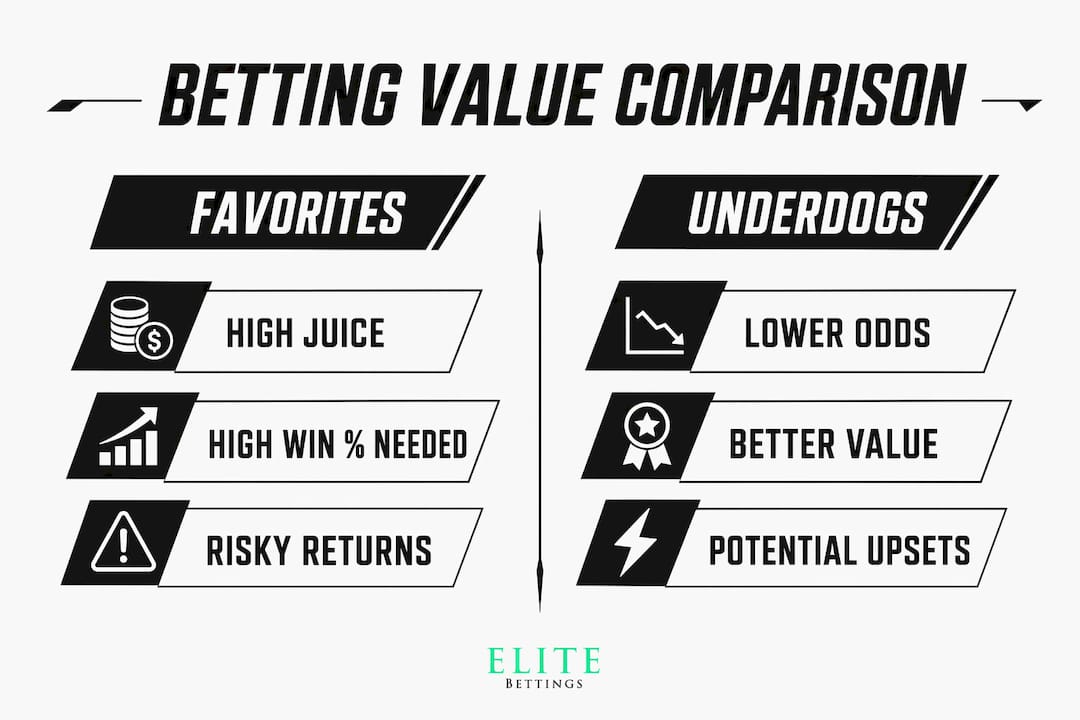
The juice compounds the problem. At -280, you risk $280 to win $100. One loss wipes out nearly three wins. Over a long season, that variance destroys bankrolls that would have survived at flat prices.
The smarter play is to identify moderate favorites in the -120 to -160 range where your edge, if real, actually translates to profit. Anything steeper than -200 demands extraordinary justification, not just “this team is good.”
How to find real value betting MLB underdogs
Underdogs win a notable minority of their games in MLB, even the ones the public dismisses. That baseline matters enormously when you are getting +150 or better on a team with a genuine 42% chance of winning. That is a positive expected value bet, and those are the bets that build long-term profit.
The public consistently overweights favorites because they follow narratives: the ace on the mound, the team on a hot streak, the big-market club, creating underdog value almost every night on the slate.
When to target underdogs:
- Pitcher mismatch is overstated. When a mid-rotation starter faces a “name” ace but the underlying metrics (xFIP, SIERA) are closer than the line suggests, the underdog price is often inflated by reputation rather than reality.
- Public money is lopsided. When 70%+ of public bets are on the favorite, books shade the line further. The underdog price improves, and the true probability gap narrows.
- Home underdog with a rested bullpen. Home field provides a measurable advantage, and a fresh bullpen neutralizes late-inning risk.
- Divisional familiarity. Teams that face each other frequently have tighter true win probabilities than the line implies, making divisional underdogs worth a closer look.
The goal is not to bet every underdog. It is to identify the spots where the price exceeds the true probability by enough to justify the wager.
Why umpires belong in your pre-game research
Most bettors skip umpire research entirely. That is a mistake you can profit from.

Certain umpires have statistically tighter strike zones that directly affect walk rates, strikeout totals, and ultimately run production. An umpire who squeezes the zone forces pitchers to throw more hittable pitches, drives up pitch counts, and shortens outings. The downstream effect on totals is measurable.
Umpires with expansive zones do the opposite. Strikeouts climb, walks drop, and scoring tends to fall. If you are betting an over in a game with a historically low-zone umpire behind the plate, you are fighting a headwind the public has not priced in.
Pro Tip: Before betting any totals game, check the assigned home plate umpire on Baseball Reference or Stathead. Look at their career strikeout rate, walk rate, and runs-per-game average. A single umpire can shift the expected total by half a run or more.
Umpire data is freely available and rarely reflected in opening lines. That gap is your edge.
How overnight lines and first five innings markets reveal sharp action
Line movement is the market’s way of telling you where informed money is going. Reading it correctly is one of the highest-leverage skills in baseball betting.
Overnight lines are posted by sportsbooks the night before a game, often 12–18 hours before first pitch. Sharp bettors hit these lines immediately when they spot value. If a line opens at -115 and moves to -135 by morning with low public betting volume, that move is sharp-driven. Following that signal, or getting ahead of it, is how professionals extract edge.
First five innings (F5) lines are a different tool entirely. They isolate the starting pitcher’s impact by capping the bet at the halfway point of the game. Bullpen variance, which is one of the most unpredictable elements in baseball, is removed from the equation. If your edge is in the pitching matchup, F5 bets are a cleaner expression of that thesis.
Key signals to watch in line movement:
- A line moving against the public betting percentage (line goes up on the favorite while most bets are on the underdog) signals sharp action on the underdog.
- Early steam moves, where multiple books shift simultaneously within minutes, indicate coordinated sharp action.
- Reverse line movement is one of the most reliable indicators of professional money in the market.
Line shopping across multiple sportsbooks nets a modest but meaningful increase in breakeven probability over a season, which on a high-volume sport like MLB can accumulate into real money.
How to research pitcher trends before placing any bet
The starting pitcher is the most predictive single variable in an MLB game. ERA alone tells you almost nothing useful. The metrics that actually matter are the ones that strip out luck and defense.
Key pitcher stats to pull before every bet:
- xFIP and SIERA: These forecast future performance more accurately than ERA by adjusting for defense and batted ball luck. A pitcher with a 4.80 ERA and a 3.40 xFIP is likely due for positive regression.
- WHIP and K%: Walk rate and strikeout rate reveal command and stuff. A pitcher with a rising walk rate is deteriorating regardless of recent results.
- BABIP: Batting average on balls in play above .330 often signals bad luck rather than bad pitching. Below .270 suggests the opposite.
- Spin rate trends: A declining spin rate on a pitcher’s primary breaking ball often precedes a performance drop before it shows up in traditional stats.
- Platoon splits: Some pitchers are dramatically worse against left-handed or right-handed lineups. Match the pitcher’s splits against the opposing lineup’s composition.
- First-inning tendencies: Some starters consistently struggle in the first inning. This is exploitable in F5 and first-inning run markets.
- Bullpen fatigue: Check the last five games of relief ERA and how many high-leverage innings the pen has logged. An overworked bullpen erases a strong starter’s value in the late innings.
Build a simple pre-game checklist. Pitcher research done consistently is what separates bettors who grind out profit from those who guess.
Betting baseball totals: how ballpark and weather change everything
Totals betting in MLB is where environmental factors carry the most weight. The same two pitchers can produce wildly different run totals depending on where and when they play.
- Ballpark altitude and dimensions: Coors Field in Denver is the most extreme example in baseball. The thin air reduces drag on fly balls, inflating home runs and scoring. Petco Park in San Diego suppresses offense with its dimensions and marine air. Ballpark factors shift expected run totals measurably, and books price them in, but not always accurately.
- Wind direction and speed: Wind blowing out to center at 15+ mph can add 0.5–1.5 runs to the expected total. Wind blowing in from center suppresses scoring by a similar margin. Check the forecast within two hours of first pitch, when wind readings are most reliable.
- Temperature: Cold games, particularly in April and May, suppress offense. Batters lose bat speed and pitchers lose grip on breaking balls. Under bets in cold weather have a historical edge.
- Humidity: High humidity keeps the ball from carrying as far. Low humidity, common in desert parks like Chase Field in Phoenix, does the opposite.
- Pitcher-park alignment: A fly-ball pitcher in Coors Field is a totals nightmare. A ground-ball pitcher in a spacious park is a totals gift. Always align the pitcher’s batted ball profile with the park’s tendencies.
The combination of park, weather, and pitcher profile gives you a cleaner read on totals than any single factor alone.
The discipline rules that actually make you money betting baseball
Knowing the right strategies means nothing without the discipline to execute them consistently. This is where most bettors fail.
Core bankroll and discipline rules:
- Flat bet 1–2% of your bankroll per play. Variance in a 162-game season demands strict money management. Losing streaks of 10+ games are normal. Flat betting keeps you in the game through them.
- Limit daily bets. Playing every game on the slate is a losing habit. Sharp bettors are selective. Three to five high-confidence plays per day beats 15 forced ones.
- Never chase losses. Doubling your bet size after a loss to “get even” is how bankrolls collapse. The next game has no memory of the last one.
- Record every bet. Log the game, your line, the closing line, and the result. Without records, you cannot measure whether your edge is real or imaginary.
- Reduce volume in April and early May. Professional handicappers cut betting volume 30–40% in the early season due to small samples, unsettled rotations, and cold weather affecting run production.
Pro Tip: Use fractional Kelly Criterion for bet sizing when you have a strong read on your edge. Full Kelly is too aggressive for the variance in baseball. Half-Kelly or quarter-Kelly keeps your bet sizes rational without sacrificing too much growth.
Closing Line Value (CLV) is the most reliable long-term measure of betting skill. If you consistently beat the closing line, your process is sound. If you are not, the strategy needs adjustment regardless of short-term results. At least 200 bets are needed for CLV metrics to stabilize, and 500+ to meaningfully distinguish skill from variance.
How Elite-bettings approaches MLB betting with documented results
Elite-bettings operates on a methodology that most recreational bettors never reach: systematic, documented, and built around measurable edge rather than gut feel.
The foundation is Closing Line Value tracking. Every pick is recorded at the time of placement and compared against the closing line. CLV tracking over hundreds of bets is the gold standard for proving a strategy’s skill beyond variance, and Elite-bettings applies it to every MLB pick in the database.
What sets the Elite-bettings approach apart:
- A strong documented hit rate across tracked picks, with full records available, not cherry-picked results.
- CLV-first analysis: Picks are evaluated on whether they beat the closing line, not just whether they win. Beating the close consistently is proof of real edge.
- Advanced statistical modeling: xFIP, SIERA, platoon splits, bullpen fatigue metrics, and park factors are all incorporated before a pick is issued.
- DNA System analysis: Situational variables like travel fatigue, strength of schedule, and team performance cycles are layered on top of the statistical base.
- Transparency: All results are documented and accessible. No selective records, no hidden losses.
The difference between a recreational bettor and a professional one is process. Elite-bettings provides the process, the picks, and the documented track record to back it up.
Elite-bettings gives you the edge without the grind
Applying everything in this guide takes hours of daily research: pitcher metrics, umpire data, weather checks, line monitoring, and bankroll tracking. Most bettors do not have that time, and even those who do often lack access to the right data sources.


Elite-bettings delivers that research done for you. With a 74% documented hit rate and picks built on CLV analysis, advanced pitcher metrics, and situational modeling, you get the output of a professional handicapping process without building it yourself. Every pick comes with the reasoning behind it, so you understand the edge, not just the selection.
Whether you are new to MLB betting or looking to sharpen a system that is not producing consistent profit, Elite-bettings offers picks for MLB alongside NFL, NBA, NCAAF, and NCAAB, all backed by a money-back guarantee. The records are public, the methodology is explained, and the picks are priced for bettors who want real value, not a subscription to someone’s highlight reel.
Ready to bet with a documented edge? Visit Elite-bettings and see the current MLB picks with full records.
Key Takeaways
Profitable MLB betting requires beating the closing line consistently, not just picking winners, and that demands value-first analysis, pitcher research, and strict bankroll discipline.
| Point | Details |
|---|---|
| Avoid heavy favorites | A -280 favorite requires a 74% win rate to break even, a threshold most teams never reach. |
| Underdog value is real | MLB underdogs win 38–40% of games; +150 underdogs with true 42%+ win probability are profitable bets. |
| Umpires and weather matter | Home plate umpire tendencies and wind direction can shift expected run totals by 0.5–1.5 runs per game. |
| CLV is the skill benchmark | At least 200 bets are needed for CLV metrics to stabilize; 500+ bets to distinguish skill from variance. |
| Elite-bettings | Offers documented MLB picks with a strong hit rate, CLV tracking, and full transparency on all results. |
FAQ
What is the most profitable MLB betting strategy?
Betting value underdogs and tracking Closing Line Value consistently outperforms chasing favorites. Professionals focus on price inefficiencies rather than picking winners, combining pitcher metrics like xFIP and SIERA with disciplined flat betting of 1–2% per play.
What is the 80/20 rule in betting?
In betting context, the principle suggests that most of your profits come from a small portion of your bets, typically the high-confidence, high-value spots. This is why sharp bettors are selective rather than betting every game on the slate.
How do you make consistent money betting on baseball?
Consistent profit in MLB betting comes from three habits: researching starting pitchers with advanced metrics before every bet, shopping lines across multiple sportsbooks to maximize value, and maintaining strict bankroll rules that survive inevitable losing streaks in a 162-game season.
What is the most effective bankroll management rule for MLB?
Flat betting 1–2% of your total bankroll per play is the standard professional approach. It limits your risk of ruin during losing streaks of 10 or more games, which are statistically normal over a full MLB season.
Does Elite-bettings cover MLB picks?
Yes. Elite-bettings provides documented MLB picks built on CLV analysis, advanced pitcher metrics, and situational modeling, with a strong documented hit rate and a money-back guarantee on the service.