 Skip to content


Parlays vs Straight Bets: Which Wins Long-Term?
For most bettors, straight bets are the better default and parlays work best as a selective, small-stake tool rather than a core strategy. The math backs this up hard: a two-leg parlay at standard odds needs to hit notably more often than a coin flip suggests just to break even, because the sportsbook’s vig compounds on every leg you add. Elite-bettings has documented a high win rate and strong average ROI across many picks since 2016, almost entirely built on disciplined single-bet selection, not parlay chasing.
Here’s the quick evidence behind that verdict:
- 📊 A 2-leg parlay at -110 per leg needs a 27.4% breakeven rate on the combined outcome, well above what casual multi-leggers realize.
- 💰 Vig doesn’t just apply once. It compounds with every leg, quietly eating into your edge.
- ✅ Straight bets isolate pick quality, making them easier to track, size, and improve over time.
Key Takeaways
Straight bets deliver more reliable long-term ROI because vig applies once, while parlays compound that same house edge with every added leg.
| Point | Details |
|---|---|
| Straight bets are the default | They carry a single ~4.5% vig and let you track pick quality cleanly. |
| Parlays compound the house edge | A 2-leg -110 parlay needs about 27.4% breakeven, far worse than a single leg. |
| Limit parlay length | Keep parlays to 2 legs max unless every leg carries a proven edge. |
| Track results separately | Elite-bettings documents a 73% win rate and 24% average ROI across 1,500+ picks since 2016. |
Table of Contents
- Parlays vs Straight Bets: A Side-by-Side Breakdown
- How Do Straight Bets Actually Work?
- What Is a Parlay and How Are Payouts Calculated?
- Breakeven Percentages: Why the Math Favors Singles
- How Do Parlays Affect Bankroll Variance and Betting Psychology?
- When Does It Actually Make Sense to Play a Parlay?
- Common Mistakes That Cost Parlay Bettors Money
- How Elite-bettings Uses CLV to Navigate Parlays and Singles
- Why Discipline Beats the Big Ticket
- Sources
- FAQ
Parlays vs Straight Bets: A Side-by-Side Breakdown
Straight bets ask you to win once. Parlays ask you to win every single time, on every leg, with zero margin for error. That structural difference explains almost everything about why one builds bankrolls and the other builds highlight reels.
- Win requirement: Straight bets need one outcome; parlays need all legs to hit.
- Payout: Straight bets pay modest, predictable returns; parlays offer inflated, lottery-style upside.
- Best use: Straights for long-term ROI; parlays for calculated, occasional swings.
| Bet Type | Win Requirement | Typical Payout | Risk / Hit Frequency | House Edge Effect | Best Use-Case | Common Variants |
|---|---|---|---|---|---|---|
| Straight bet | 1 outcome | Standard (-110 ≈ 1.909x) | Low risk, high hit frequency | Vig applies once (~4.5%) | Long-term bankroll growth | Moneyline, spread, total |
| Parlay | All legs | Amplified, multiplies per leg | High risk, low hit frequency | Vig compounds per leg | Entertainment, selective +EV spots | SGP, teaser, round robin |
The rule of thumb worth tattooing on your betting app: use straight bets to build your bankroll methodically, and treat parlays as an occasional side bet you can afford to lose.
How Do Straight Bets Actually Work?
A straight bet (also called a single bet) is a wager on one outcome, and only that outcome. No stacking, no combining, no all-or-nothing drama. You bet the Chiefs -3.5, the Chiefs cover, you win. Simple.
Understanding betting odds starts with converting American odds to decimal format. At -110, the decimal odds are 1.909. Implied probability comes from dividing 100 by the sum of the absolute odds value plus 100: 110 / (110+100) = 52.38%. That 52.38% is your breakeven point on a single -110 bet, and it’s the same number sportsbooks bake into nearly every side and total they post.
Here’s why singles matter more than most bettors realize:
- Bankroll survival — losing one leg only costs you that one wager, not an entire ticket.
- Clean ROI tracking — you can measure your actual edge pick by pick instead of guessing which leg sank your parlay.
- Isolated pick quality — a good pick pays off on its own merit, not diluted by three other unrelated games.
Straight bets are also how professional handicappers actually make their money. The Fox Sports parlay breakdown confirms parlay payouts are built from the same vigged prices as singles, just multiplied together, which stacks the house’s advantage rather than yours.
Pro Tip: If your bankroll is under $1,000 or you’re still building a documented track record, stick almost exclusively to straight bets. You can’t evaluate your edge accurately when three legs are tangled into one result.
What Is a Parlay and How Are Payouts Calculated?
A parlay combines two or more bets into a single ticket. Every leg has to win for the ticket to pay out. Miss one leg, lose the whole thing, no partial credit.
The math is decimal odds multiplication. Take three legs at -110 each (decimal 1.909 apiece): 1.909 × 1.909 × 1.909 ≈ 6.96. A $50 bet returns roughly $348, compared to $50 × 1.909 = $95.45 on a single -110 bet. That payout gap is exactly why parlays are so tempting, and exactly why sportsbooks push them so aggressively.
Common parlay variants change the math further:
- Same-game parlays (SGPs) combine multiple bets from one game, and sportsbooks often price these as bundled odds rather than pure multiplication because the legs are correlated.
- Teasers let you shift the point spread in your favor across legs in exchange for a smaller payout. Our teaser vs parlay guide breaks down when that trade-off makes sense.
- Round robins split a group of picks into multiple smaller parlays, spreading risk instead of putting everything on one all-or-nothing ticket.
A few sportsbook rules trip up bettors constantly:
- Push handling — if one leg pushes, most books simply reduce the parlay to fewer legs rather than voiding it entirely.
- Correlated-leg re-pricing — books adjust SGP pricing when legs are related (like a QB’s passing yards and his team’s total), since those outcomes aren’t independent.
- Maximum payout caps — some books cap parlay winnings regardless of how the math works out, which matters a lot if you’re chasing a long-shot ticket.
Breakeven Percentages: Why the Math Favors Singles
That’s not a typo.
Here’s how effective house edge scales as legs increase, using standard -110 pricing per leg:
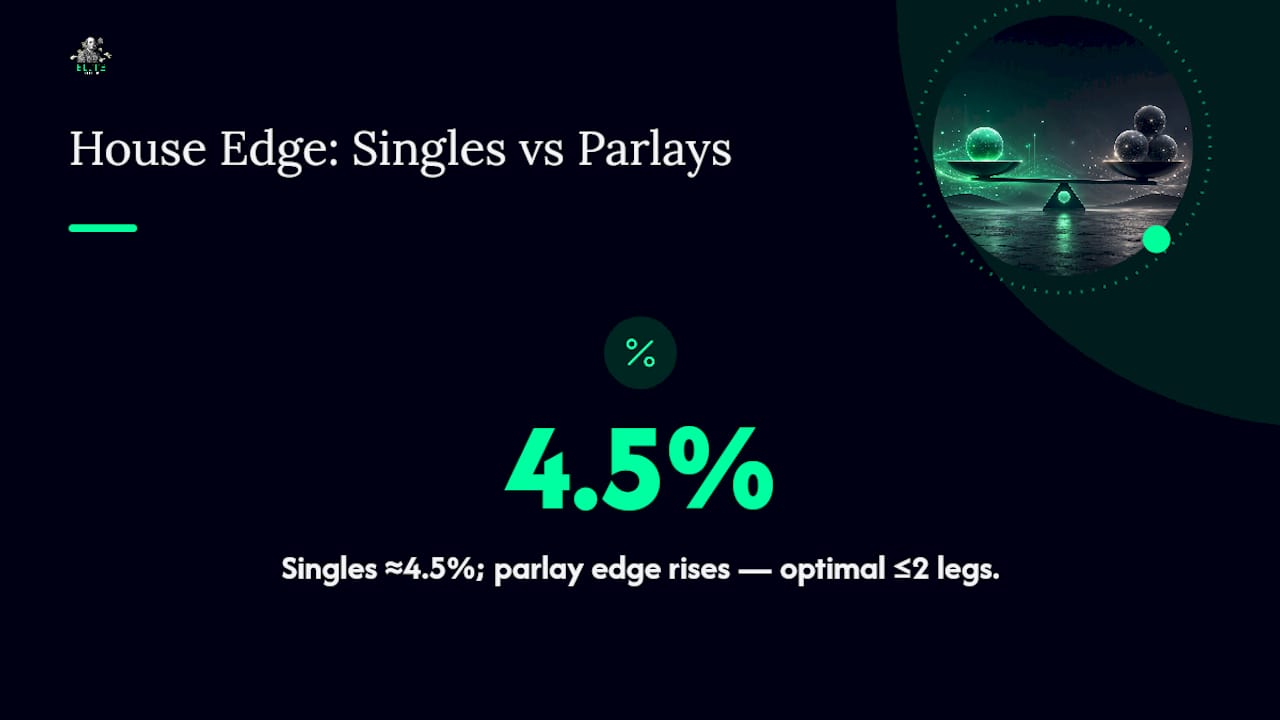
Simulation-based breakdowns show this compounding effect clearly: the house edge on singles stays flat near 4.5%, but it climbs steadily with every leg you bolt onto a parlay ticket. Academic research on optimal parlay length reinforces this, finding that bettors with a genuine edge should rarely combine more than two legs, since optimal parlay length barely changes regardless of how big your edge actually is.

There are exceptions. Parlays can turn EV-positive when every leg individually carries a mathematical edge, when legs are genuinely correlated in your favor (a team covering and going over the total in a blowout, for example), or when a sportsbook promo boosts the payout beyond fair value. Those are edge cases, not a strategy you build a bankroll around.
How Do Parlays Affect Bankroll Variance and Betting Psychology?
Parlays don’t just lower your expected value. They massively increase variance, meaning your results swing harder in both directions. A bettor placing $50 straight bets across a season will see a fairly smooth bankroll curve if their picks carry a real edge. A bettor putting the same $50 into 4-leg parlays will see long losing streaks punctuated by rare, dramatic spikes, and most of those streaks end in a drained bankroll before the spike ever arrives.
- Size parlays smaller than singles. If you risk 1 to 2% of bankroll on a single, cap parlay stakes at a fraction of that, since a miss costs you the entire ticket.
- Track parlays separately from singles so you can see honestly whether they’re adding or subtracting from your overall ROI.
- Set a hard entertainment budget for parlays and never dip into your core bankroll to fund it.
Pro Tip: Treat parlay money like a separate “fun fund,” capped at a fixed dollar amount per week. It keeps the dopamine hit of a big potential payout from wrecking the bankroll you’re using for real long-term profit.
The psychology here is the real trap. Big advertised payouts create what researchers call the “payout size” fallacy: the bigger number feels like better value, even though win frequency falls exponentially with every added leg. Chasing that feeling, rather than the math, is how disciplined bettors turn into recreational ones.
When Does It Actually Make Sense to Play a Parlay?
Parlays aren’t inherently bad. They’re just narrow tools that only work in specific spots:
- ✅ You have a demonstrable, measurable edge on each individual leg, not just a hunch.
- ✅ Legs are genuinely correlated in a way that favors you (same-game outcomes that logically move together).
- ✅ A sportsbook promo or boost pushes the payout above true fair value.
If both legs carry a slight built-in edge from your handicapping, that boost can flip the ticket from break-even to genuinely +EV, unlike a standard unboosted parlay.
The practical rule: keep parlays to 2 legs maximum unless you can prove an edge on every single leg involved.
Common Mistakes That Cost Parlay Bettors Money
Most parlay losses trace back to a handful of repeatable errors:
- Stacking mediocre picks together, hoping quantity makes up for weak individual value.
- Ignoring how vig compounds, then wondering why “obvious” parlays keep losing.
- Over-leveraging bankroll on a low-probability 5 or 6-leg ticket for a shot at a big number.
- Misreading same-game parlay pricing, assuming naive odds multiplication when the book has already re-priced correlated legs.
Sportsbooks promote parlays aggressively because parlay hold runs far higher than straight bet hold. That’s not an accident. It’s the business model.
Watch for push rules that quietly shrink your ticket, correlated-leg re-pricing that changes your expected payout, payout caps on long-shot parlays, and promo terms that void a boost the moment one leg doesn’t qualify.
How Elite-bettings Uses CLV to Navigate Parlays and Singles
Elite-bettings built its reputation on closing line value (CLV) analysis, not lucky parlay swings.
That track record comes almost entirely from single-bet discipline. CLV tells us whether a pick has real long-term value before the market moves, and that signal gets diluted fast once you start bundling legs into parlays. Past performance never guarantees future results, but transparent, fully-documented records are how you separate a real handicapping service from one that only shows its winners.
Ready to see the picks behind those numbers? 👉 Check out our Expert Picks and get personalized, CLV-backed selections instead of guessing which parlay leg to trust.
- If you’re new to placing bets, our guide on how to place a sports bet walks through the mechanics step by step.
- For where to actually place those bets, Stake is our top recommended sportsbook for competitive odds and a smooth betting experience.
Pro Tip: Before you place any parlay, check whether Elite-bettings has documented CLV on each leg individually. A parlay built from two positive-CLV picks is a completely different bet than one built from two coin flips.
Why Discipline Beats the Big Ticket
I’ve watched enough betting slips to know the pattern: the bettors who last are the ones who treat parlays as a treat, not a strategy. Straight bets reward patience and honest tracking. Parlays reward storytelling, the “I was one leg away” kind that keeps people coming back to a losing formula. Reserve parlays for the rare spot where the math actually favors you, budget for them like entertainment, and let your documented results, not your best story, tell you whether your strategy works.
Sources
- The Parlay Puzzle: Expected Utility and Multi-Leg Betting
- Single Bets vs. Parlays: The Math Behind Which Strategy Wins Long-Term (2026) - Practical Web Tools
- What Is a Parlay Bet? How Parlays Work, Odds & Payouts
FAQ
Is It Better to Do Straight Bets or Parlays?
Are Parlays More Profitable Than Straight Bets?
Parlays can pay out much larger sums on a single ticket, but the win frequency drops so sharply that overall expected value is almost always worse than the same picks placed as straight bets.
Is It Smart to Bet on Parlays?
Parlays make sense in narrow spots, such as when every leg carries a proven edge or a sportsbook promo boosts the payout, but they’re risky as a core strategy due to their all-or-nothing structure.
What Are the Disadvantages of Parlay Bets?
Parlays require every leg to win, compound the sportsbook’s vig with each added leg, and create much higher variance, which raises the risk of long losing streaks and bankroll drawdowns.