 Skip to content


Same Game Parlay Strategy: Build Smarter SGPs
TL;DR:
- A disciplined same game parlay strategy involves limiting to two or three legs and focusing on positive correlation. Bettors must devig each leg, compare odds across multiple sportsbooks, and only wager when the adjusted fair probability exceeds offered prices. Proper line-shopping and understanding correlation adjustments create a significant betting edge over the book’s pricing.
The single best rule for a same game parlay strategy: cap your ticket at 2–3 legs, build every leg around one clear game narrative, and only place the bet when your correlation-adjusted fair probability beats what the book is offering. That’s it. Everything else is execution.
TL;DR — Three checks before you place any SGP:
- Devig each leg. Strip the vig from every leg’s offered odds to find the true implied probability.
- Check correlation direction. Ask whether your legs reinforce each other (positive correlation) or work against each other (negative correlation) relative to your game thesis.
- Line-shop. Compare the same SGP across at least two books before submitting. Price differences on identical tickets are common and often significant.
SGPs typically carry a significantly higher hold compared to a single straight bet. That gap is the structural challenge every SGP bettor faces — and the reason discipline beats volume every time.
Table of Contents
- What is a same game parlay, and how does it work?
- How sportsbooks price SGPs: the math you need to know
- Why does the same SGP pay different odds at different books?
- 14 tactical tips for a winning same game parlay strategy
- How to build an SGP step by step: two sample tickets
- Bankroll management and staking for SGPs
- Which books and tools give you the best SGP edge?
- Common SGP mistakes that kill your expected value
- How Elite-bettings spots mispricings and builds repeatable SGP edge
- Key Takeaways
- Why the 2–3 leg narrative approach is the only one worth trusting
- Elite-bettings gives you the SGP edge without the hours of research
- Further reading and tools
- FAQ
What is a same game parlay, and how does it work?
A same game parlay (SGP) bundles two or more betting legs from a single game into one wager. Every leg must win for the ticket to cash. The appeal is obvious: combining multiple outcomes from one game can produce large payouts on a small stake. The risk is equally obvious: one wrong leg kills the whole ticket.
What separates an SGP from a standard multi-game parlay is that the legs are drawn from the same event, which means the outcomes are rarely statistically independent. That dependency is the core mechanic you need to understand.
Three quick examples you’ll recognize in any sportsbook app:
- NFL passing stack: Patrick Mahomes over 275.5 passing yards + Tyreek Hill over 74.5 receiving yards. These are positively correlated — if Mahomes is airing it out, Hill benefits directly.
- Team narrative: Chiefs moneyline + Travis Kelce over 55.5 receiving yards. A Chiefs win often means Kelce was involved. Correlation coefficient on pairings like this runs roughly 0.40–0.55.
- Game-total stack: NBA game total over 224.5 + both starting point guards over their points lines. High-scoring games lift individual scoring props across the board.
Now consider what happens when you ignore correlation. Multiply three legs at 50% each and you get 12.5% joint probability under independence. But if those legs are positively correlated and the true joint probability is 18%, the book that priced the ticket assuming independence just gave you a meaningful edge. That gap is exactly what a disciplined same game parlay strategy hunts for.
How sportsbooks price SGPs: the math you need to know
Understanding the pricing mechanics is what separates recreational SGP bettors from ones who actually find value. There are two distinct margin layers baked into every SGP ticket.
The two-layer margin system
The first layer is standard per-leg vig. Every leg in an SGP carries the same juice as a standalone bet, typically −110 on a two-way market, implying a 52.4% break-even probability on a true 50/50 outcome. A four-leg SGP means you’re paying vig on four separate legs simultaneously.
The second layer is the correlation tax: an additional payout reduction applied specifically because the legs are positively correlated. This haircut is invisible in the headline odds. You see one payout number; you don’t see how much of the discount is per-leg vig versus correlation adjustment.
Stat callout: Books reduce SGP payouts 15–30% versus naive multiplication for correlated legs. On common 5+ leg tickets, that reduction can reach 25–35% or higher.
Step-by-step devig and fair-price calculation
Here’s the arithmetic workflow, applied to a two-leg NFL SGP:
Leg A: Team moneyline −130 → implied probability = 130 / (130 + 100) = 56.5%. Devigged fair probability ≈ 54.5%.

Leg B: QB over 275.5 yards −110 → implied probability = 52.4%. Devigged fair probability ≈ 50.0%.
Independence baseline: 0.545 × 0.500 = 27.25% joint probability → fair odds ≈ +267.
Correlation adjustment: These two legs carry a positive correlation of roughly 0.45–0.55. Applying a simple multiplier (true joint probability ≈ independence baseline × 1.20 for moderate positive correlation) gives an adjusted fair probability of about 32.7% → fair odds ≈ +206.
Compare to the book’s offer. If the book offers +180 on this SGP, the implied probability is 35.7% — higher than your fair estimate of 32.7%. That’s a negative-EV ticket. If the book offers +230, the implied probability is 30.3% — lower than your 32.7% fair estimate. That’s a +EV ticket worth placing.
| Step | Action | Example Result |
|---|---|---|
| 1. Devig each leg | Remove vig to get fair single-leg probability | Leg A: 54.5%, Leg B: 50.0% |
| 2. Independence baseline | Multiply fair probabilities | 27.25% → +267 fair odds |
| 3. Correlation adjustment | Multiply by correlation factor (e.g., 1.20 for moderate positive) | 32.7% → +206 fair odds |
| 4. Compare to book | Check if offered odds imply lower probability than your estimate | +EV if book offers +230 or better |
| 5. Line-shop | Check at least two books for the same ticket | Take the best available price |
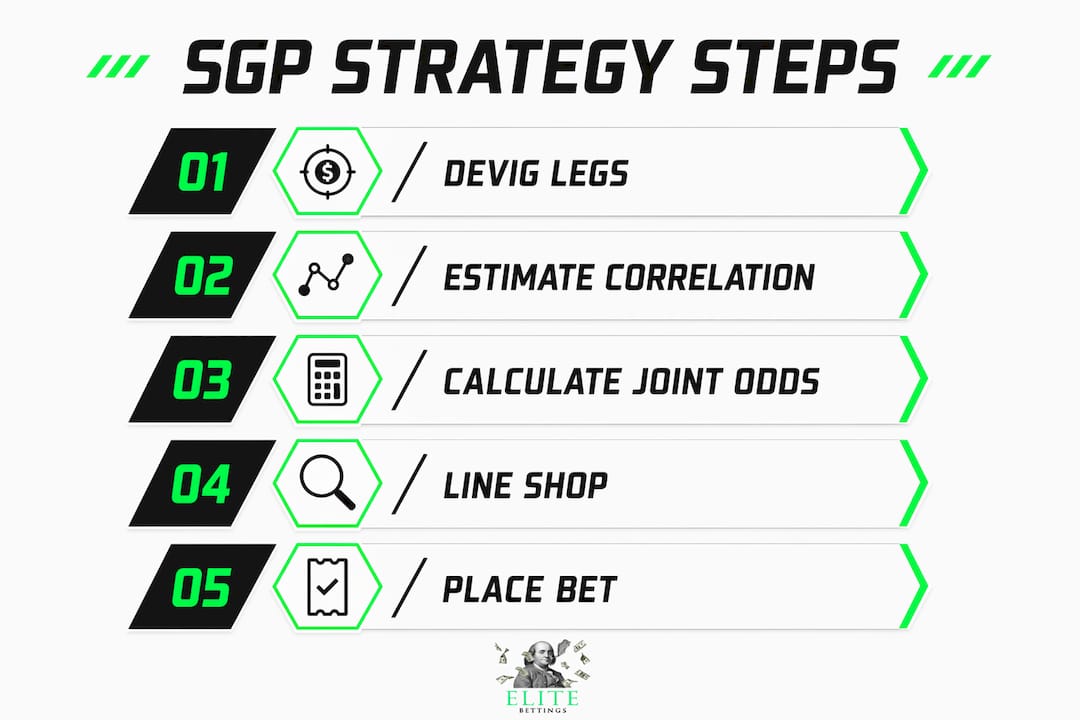
Sportsbooks use Gaussian copula models and empirical frequency tables to estimate joint probabilities. They’re sophisticated — but they’re not perfect, especially on subtle or less-common pairings.
Why does the same SGP pay different odds at different books?
Put the same three-leg NFL SGP into FanDuel, DraftKings, and BetMGM and you’ll often get three different payouts. The gap isn’t random. It comes from real structural differences in how each operator prices correlation.
The main pricing drivers:
- Correlation model sophistication. Books using more granular historical datasets and faster recalibration loops price common pairings more accurately. Less sophisticated models leave detectable gaps.
- Per-leg margin contribution. FanDuel applies roughly 1.3% per-leg margin, DraftKings roughly 1.1%, and BetMGM roughly 1.0% — those differences compound across legs.
- Prop market depth. A book with a deeper player prop menu has more historical data on prop correlations and prices them more tightly. Thinner prop menus mean more model uncertainty and often more conservative (shorter) payouts.
- Real-time liability management. If a specific SGP combination is attracting heavy action, the book shortens the odds further to balance exposure — regardless of the underlying math.
- Promotions and SGP boosts. Boosted SGP products can temporarily offer better-than-fair prices on specific combinations. These are usually capped in stake and time-limited.
What this means in practice: operators with weaker SGP models leave detectable pricing gaps that show up as better payouts on the same ticket. Line-shopping isn’t just good practice — for SGP bettors, it’s often the single largest source of edge available.
| Book | Per-Leg Margin (approx.) | SGP Pricing Behavior |
|---|---|---|
| FanDuel | ~1.3% per leg | Aggressive correlation pricing; deep prop menu |
| DraftKings | ~1.1% per leg | Competitive on common pairings; strong builder |
| BetMGM | ~1.0% per leg | Slightly looser on some prop combos; good for NBA |
| Caesars | Varies | Frequent SGP boosts; check for promo windows |
14 tactical tips for a winning same game parlay strategy
The foundation of every profitable SGP is a clear game thesis. Pick a narrative — “this is a high-scoring shootout,” “this team wins by controlling the run game” — and then build every leg to reinforce that story. Legs that don’t serve the thesis are just noise that adds hold without adding edge.
- Cap legs at 2–3. Each added leg multiplies the embedded hold. Adding legs increases the book’s tax faster than it increases potential reward; compact tickets outperform random stacks over time.
- Start with the thesis. Write one sentence describing the game script you expect. Every leg you add must follow from that sentence.
- Prefer QB + WR1 stacks in pass-heavy matchups. QB passing yards and WR1 receiving yards carry a correlation of roughly 0.65–0.75. When the matchup favors passing, this pairing is one of the most reliably positive correlations available.
- Devig before you build. Run the devig math on each leg before you even think about combining them. If a single leg is already bad value, the SGP version is worse.
- Estimate pairwise correlation. For a 3-leg ticket, you have three pairs (n choose 2 = 3). Check the direction and rough magnitude of each pair. One negatively correlated pair can offset two positive ones.
- Avoid mixing contradictory legs. A team moneyline win combined with the opposing star player’s points over is a classic negative-correlation trap. If the team wins comfortably, the opposing star may sit in the fourth quarter.
- Line-shop every ticket. Check at least two books. On a 3-leg SGP, price differences of +50 to +100 in American odds are common across major U.S. operators.
- Use promos strategically, not emotionally. SGP boosts can offer genuine value — but only when the underlying legs are already sound. Never add a weak leg just to qualify for a boost.
- Size conservatively. SGPs are high-variance by design. Even a +EV ticket loses most of the time. Size accordingly (more on this in the bankroll section below).
- Track closing-line value (CLV). If your SGP legs consistently close at worse odds than when you placed them, your leg selection is sharp. CLV is the most reliable long-term quality signal.
- Prefer stable props. Rushing yards and receiving yards for featured players are more stable week-to-week than touchdowns or first-basket props. Stable props mean more predictable correlation behavior.
- Beware mass-marketed boosts. When a book promotes a specific SGP combination to millions of users, the odds are almost certainly priced to the book’s advantage. Treat marketed SGPs as entertainment, not edge.
- Check for voided-leg policies. If a key player is scratched after you place the bet, some books void the leg and recalculate; others grade it a loss. Know the policy before you build a ticket around a player’s prop.
- Record every ticket. Log the legs, the offered odds, your estimated fair odds, and the result. Without records, you can’t identify which pairings are generating value and which are leaking money.
Pro Tip: Books often overprice the QB-to-moneyline correlation (they’ve seen it a thousand times) but underprice the WR1-to-game-total correlation. A WR1 receiving yards over combined with a game total over is frequently a better-value pairing than the obvious QB + moneyline stack — and it’s less likely to be aggressively taxed.
Pro Tip: When a sportsbook blocks a specific leg combination in its SGP builder, that’s a signal those legs are highly correlated. Look for structurally similar pairings the book doesn’t block — that’s often where the underpriced correlation lives.
How to build an SGP step by step: two sample tickets
Here’s the repeatable checklist, applied to two real-world ticket types.
The SGP build checklist
- Identify your thesis. One sentence: what game script do you expect?
- Shortlist legs that support it. List 3–5 candidates; every candidate must follow from the thesis.
- Devig each leg. Calculate fair single-leg probability for each candidate.
- Estimate pairwise correlations. Assign a rough direction and magnitude to each pair.
- Compute joint fair odds. Multiply devigged probabilities, then apply correlation multiplier.
- Compare to book’s offered price. Calculate implied probability of the offered odds.
- Line-shop. Check at least one other book for the same combination.
- Size the bet if +EV. Use the staking rules below.
Sample ticket 1: NFL passing game
Thesis: High-scoring game, both teams pass heavily, Chiefs cover at home.
| Leg | Offered Odds | Devigged Prob. |
|---|---|---|
| Mahomes over 275.5 pass yds | −110 | 50.0% |
Independence baseline: 0.575 × 0.513 × 0.500 = 14.75% → fair odds ≈ +578.
Correlation adjustment (all three legs positively correlated, moderate-to-strong): multiply by 1.30 → adjusted fair probability ≈ 19.2% → fair odds ≈ +421.
If the book offers +380, implied probability is 20.8% — negative EV. If the book offers +460, implied probability is 17.9% — positive EV. Shop until you find +EV or pass.
Sample ticket 2: NBA scoring stack
Thesis: High-scoring game, both stars go off, total clears easily.

| Leg | Offered Odds | Devigged Prob. |
|---|---|---|
| Game total over 224.5 | −110 | 50.0% |
Independence baseline: 0.500 × 0.513 = 25.65% → fair odds ≈ +290.
Correlation adjustment (game total and star points carry roughly 0.50–0.60 correlation): multiply by 1.25 → adjusted fair probability ≈ 32.1% → fair odds ≈ +212.
If the book offers +190, that’s negative EV. If the book offers +240, that’s positive EV. Two legs, clean thesis, easy to evaluate.
Record these inputs: thesis, each leg’s offered odds, devigged probability, correlation estimate, joint fair odds, offered SGP odds, book used, and final result. A simple spreadsheet with these eight fields is enough to build a meaningful dataset over 30–50 tickets.
Bankroll management and staking for SGPs
SGPs are high-variance instruments. Even a well-constructed +EV ticket hits less than 30% of the time on a 3-leg ticket. Your staking approach needs to reflect that reality.
Recommended stake sizing
| Confidence Level | Ticket Type | Suggested Stake (% of bankroll) |
|---|---|---|
| Entertainment / exploratory | 2–3 leg, no devig analysis | — |
| Moderate conviction | 2–3 leg, devigged, positive correlation confirmed | — |
| High conviction | 2-leg, strong +EV confirmed, line-shopped | — |
| Never | 5+ leg stacks | — |
Keep total SGP exposure below 10% of your bankroll in any single week. SGPs should be a tactical slice of your overall betting plan, not the whole portfolio.
A note on progression systems: The 1-3-2-6 staking system (increasing stakes after wins, resetting after a loss) is sometimes suggested for SGPs. It does not change underlying expected value — it only reshapes variance. If your SGPs are negative EV, a progression system accelerates losses. Fix the EV problem first; staking technique is secondary.
Tracking metrics to maintain:
- CLV per leg (did the line move in your favor after you placed?)
- Leg-by-leg hit rate (which leg types are you getting right most often?)
- Return per ticket (average profit/loss per SGP placed)
- Hold experienced (compare your actual returns to the theoretical hold)
- Tickets per week (frequency discipline matters as much as sizing)
Which books and tools give you the best SGP edge?
The right toolkit makes the devig-and-shop workflow fast enough to be practical. Here’s what actually matters.
Tool categories:
- Odds aggregators (OddsJam, Action Network): pull live lines from multiple books so you can spot the best SGP price without opening five apps.
- Parlay calculators (covers.com parlay calculator, sportsbettingoddscalculator.com): convert offered odds to implied probabilities and check your devig math quickly.
- SGP builders (native to each sportsbook app): FanDuel and DraftKings both have deep, flexible builders with wide prop menus. Use the builder at the book with the deepest prop coverage for your sport, then compare the payout to at least one other book.
- Closing-line trackers: any tool that logs the line at close versus your entry price. CLV tracking is the most reliable long-term quality signal for SGP leg selection.
Per-book SGP notes:
- FanDuel: Deep prop menu, especially for NFL. Correlation pricing is aggressive on well-known pairings. Strong for finding boosts on featured games.
- DraftKings: Competitive on common NFL and NBA pairings. Builder flexibility is excellent. Per-leg margin is slightly lower than FanDuel, which can mean marginally better prices on some tickets.
- BetMGM: Slightly looser on certain NBA prop combinations. Worth checking for NBA SGPs specifically.
- Caesars: Frequent SGP boost promotions. Check the boost calendar — occasionally these offer genuine value on specific combinations.
- Stake: Our top recommended sportsbook for SGP bettors. Stake offers competitive SGP pricing, a wide prop menu, and a user-friendly builder that makes the devig-and-shop workflow fast. If you’re building a multi-book line-shopping routine, Stake belongs in it.
Pro Tip: Combine at least one odds aggregator with the builder at the book that has the deepest prop menu for your sport. Running both together takes under five minutes and is the fastest way to confirm whether a ticket is worth placing.
Common SGP mistakes that kill your expected value
Most SGP losses aren’t bad luck. They’re the result of a small set of repeatable errors. Here’s what to watch for.
The most common mistakes:
- Overloading longshots. Adding a 4th or 5th leg because the payout looks exciting. Each leg multiplies the hold; the payout grows slower than the embedded tax.
- Mixing contradictory legs. Combining a team moneyline win with the opposing team’s star player going over his scoring line. These legs work against each other — negative correlation means the true joint probability is lower than independence suggests, and the book often doesn’t compensate you for it.
- Chasing boosts emotionally. Accepting a weak leg combination because a book is promoting it. Boosted SGPs are priced for the book’s benefit, not yours.
- Skipping the devig step. Building an SGP on legs that are already bad value at the single-leg level. The SGP version compounds the problem.
- Failing to line-shop. Placing the first SGP price you see. On a 3-leg ticket, the difference between the best and worst available price across major U.S. books can easily be +50 to +100 in American odds.
- Oversized stakes. Treating a 3-leg SGP like a straight bet and sizing it at 3–5% of bankroll. High-variance tickets require proportionally smaller stakes.
Quick red-flag checklist before you submit:
- [ ] Did I devig every leg?
- [ ] Are all legs positively correlated with my thesis?
- [ ] Did I check at least one other book’s price?
- [ ] Is my stake below 3% of bankroll?
- [ ] Am I adding this leg because it helps my thesis, or because it boosts the payout?
If you can’t check every box, pass on the ticket. There will be another game.
How Elite-bettings spots mispricings and builds repeatable SGP edge
The methodology behind Elite-bettings’ SGP picks follows the same framework outlined in this article, applied systematically across hundreds of games per season.
The process in brief:
- Devig every leg across multiple books to establish fair single-leg probabilities.
- Estimate pairwise correlations using historical game data and matchup-specific context (weather, injury reports, pace of play, defensive scheme).
- Test model outputs against offered prices at FanDuel, DraftKings, BetMGM, Caesars, and Stake to identify where the book’s correlation adjustment appears to overshoot or undershoot the true joint probability.
- Flag the mispricing. Only tickets where the offered price implies a lower probability than the correlation-adjusted model estimate are considered.
A mispricing example: Books frequently overprice the QB-to-moneyline correlation (it’s the most-watched pairing, so they’re conservative) and underprice the WR1-to-game-total correlation. A WR1 receiving yards over combined with a game total over often carries a higher true joint probability than the book’s offered price implies. That’s the type of systematic gap Elite-bettings targets.
Track record: Elite-bettings has documented a 73% win rate and an average ROI of 8.5% across over 1,500 picks since 2016 — with full records available, not cherry-picked results.
Every pick comes with the reasoning behind the correlation read, the devigged probabilities, and the line-shopping recommendation. That transparency is what lets you evaluate the methodology, not just the outcome.
Ready to put this into practice with model-backed picks? Access Elite-bettings’ expert picks and see the documented track record for yourself.
Key Takeaways
A disciplined same game parlay strategy built around 2–3 correlated legs, devigged probabilities, and line-shopping is the most repeatable path to positive expected value on SGP wagers.
| Point | Details |
|---|---|
| Cap legs at 2–3 | Each added leg multiplies the embedded hold faster than it grows the payout. |
| Devig and adjust for correlation | Strip vig from each leg, then apply a correlation multiplier before comparing to the book’s offered price. |
| SGP hold runs substantially higher than a straight bet | Typical SGP hold is between 15% and 30% — only place tickets where your model shows +EV. |
| Line-shop every ticket | Per-leg margin differences across books mean the same SGP can pay materially different odds. |
| Elite-bettings picks | Model-backed SGP picks with a documented strong win rate and positive ROI over many picks since 2016. |
Why the 2–3 leg narrative approach is the only one worth trusting
The conventional wisdom on SGPs is that they’re a fun, high-payout product you play for entertainment. That framing is exactly what sportsbooks want you to believe — because it keeps bettors focused on payout size rather than hold percentage.
The real insight is narrower and more useful: SGPs are only worth placing when you have a specific, defensible read on how two or three outcomes within a game are correlated, and when the book’s offered price implies a lower joint probability than your model does. That condition is met less often than most bettors think. The answer isn’t to play more SGPs — it’s to play fewer, better ones.
The WR1-to-game-total pairing is a good illustration. Books have priced the QB-to-moneyline correlation thousands of times. They’re good at it. But the WR1-to-game-total pairing is subtler, less frequently analyzed, and more often mispriced. That’s where manual narrative analysis still finds value that a model trained on high-frequency pairings misses. Two legs, one clear thesis, one underpriced correlation. That’s the whole game.
Discipline in leg count and thesis clarity isn’t a conservative approach. It’s the aggressive one — because it keeps your bets in the narrow zone where you actually have an edge.
Elite-bettings gives you the SGP edge without the hours of research
Building +EV SGPs the right way takes time: devigging legs, estimating correlations, comparing prices across books, logging results. Elite-bettings does that work for you, delivering model-backed picks with full documentation of the reasoning behind each one.
 Alt text: Expert same game parlay picks and SGP betting strategy analysis — Elite Bettings
Every pick covers NFL, NBA, NCAAF, NCAAB, and MLB. Each comes with the correlation read, the devigged probability, and the recommended book. The track record is fully documented: 73% win rate and 8.5% average ROI on over 1,500 picks since 2016. There’s a money-back guarantee, so the risk of trying the service is low.
When you’re ready to stop guessing at correlation adjustments and start placing picks that have already been vetted against the book’s pricing, check out Elite-bettings’ expert picks page. The next documented pick is waiting.
For your sportsbook, we recommend Stake — competitive SGP pricing, a deep prop menu, and a builder that makes line-shopping fast.
Further reading and tools
-
Sports Betting Odds Calculator — SGP Correlation Guide: A practical breakdown of correlation coefficients by sport and leg type, with a built-in SGP calculator. Start here if you want to quantify correlation before building a ticket.
-
Wizard of Odds — SGP Mathematics of Correlation: The most rigorous public explanation of Gaussian copula pricing and empirical frequency methods. Essential reading if you want to understand how books actually build their correlation models.
-
BidCanvas — Same-Game Parlay Margin Mechanics: Operator-level analysis of per-leg margin contributions and how pricing sophistication drives GGR. Useful for understanding why prices vary across books.
-
The Wager Theorem — How Sportsbooks Price SGPs: Clear explanation of the two-layer margin system (per-leg vig plus correlation tax) and where the systematic opportunity for bettors exists.
-
Sports Command — SGP Correlation Playbook: Practitioner-focused guide on identifying underpriced correlations, including the WR1-to-game-total mispricing pattern.
-
Sharksnip — SGP Math, Risk, and Reward: Solid overview of hold percentages by leg count and why 5+ leg SGPs are structurally disadvantageous for bettors.
-
DayTrading.com — 1-3-2-6 Staking System: Explains why progression staking systems don’t fix negative-EV bets — a useful corrective for bettors who think staking technique can substitute for edge.
-
Elite-bettings — Expert Picks: Model-backed picks with documented track record, CLV analysis, and full results history across NFL, NBA, and other major U.S. leagues.
FAQ
What is a good same game parlay strategy?
Build 2–3 leg SGPs around a single game thesis using positively correlated outcomes, devig each leg to confirm fair value, and only place the ticket when the book’s offered price implies a lower joint probability than your correlation-adjusted estimate.
What are the best tips for winning same game parlays?
Cap your ticket at 2–3 legs, prefer pairings with documented positive correlation (QB + WR1, game total + passing props), line-shop across at least two books, and track closing-line value to measure the quality of your leg selection over time.
What is the most profitable parlay betting strategy?
The most profitable approach is a narrative-driven, compact SGP where every leg reinforces one game script — two- and three-leg SGPs that support a coherent thesis consistently outperform random multi-leg stacks because they minimize the compounding hold while targeting genuine correlation edges.
What is the 1-3-2-6 staking system, and does it work for SGPs?
The 1-3-2-6 system increases your stake after each win and resets after a loss; it changes variance but not expected value, so it cannot rescue a negative-EV SGP. Fix the underlying edge problem first.
How does Elite-bettings help with same game parlay picks?
Elite-bettings provides model-backed SGP picks with documented correlation reads, devigged probabilities, and line-shopping recommendations, backed by a 73% win rate and 8.5% average ROI on over 1,500 picks since 2016. You can access the picks at elite-bettings.com/pages/expert-picks.
This article is general information for educational purposes. It is not professional financial or gambling advice. Confirm current rules, odds, and legal status with your sportsbook and applicable state regulations before placing any wager.