 Skip to content


Teaser vs Parlay: The 2026 Bettor's Strategy Guide

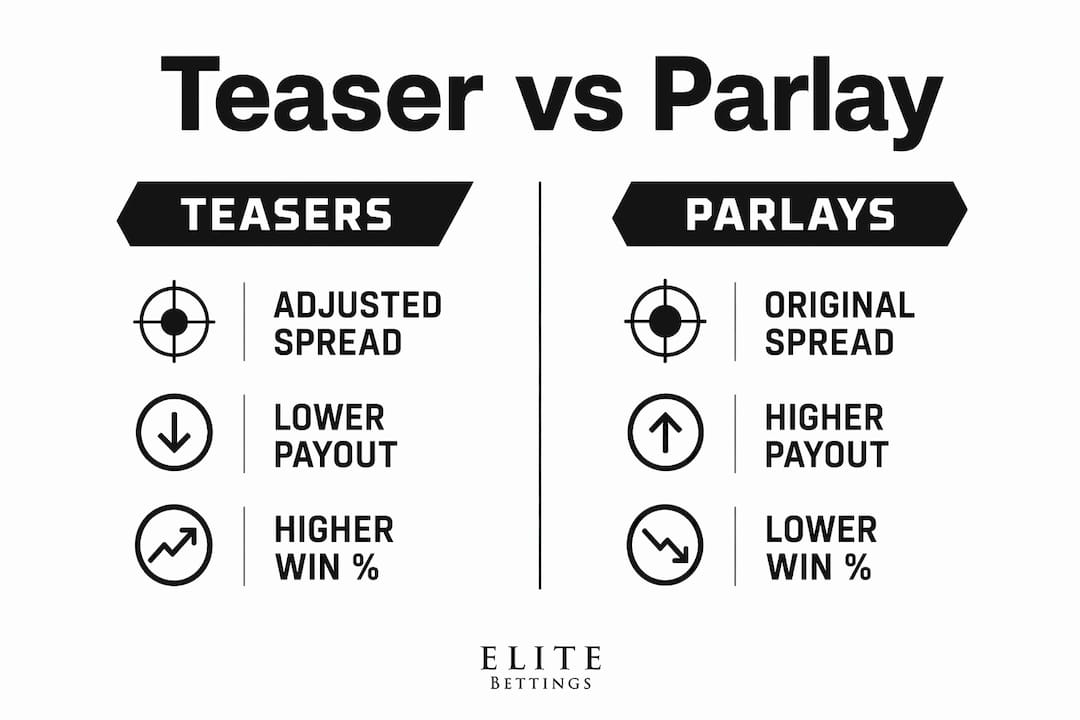
Teasers and parlays are both multi-leg wagers where every selection must win for you to collect, but they handle point spreads and payouts in completely different ways. Here is the core breakdown before we go deeper:
- Teaser bet: You adjust the point spread or total in your favor by a fixed number of points (typically 6, 6.5, or 7 in football; 4 or 4.5 in basketball) across all legs. The adjusted spreads make each leg easier to win, but the sportsbook lowers your payout accordingly.
- Parlay bet: All legs play at the original sportsbook spreads and odds. The odds multiply per leg, producing much larger potential payouts, but your probability of winning drops sharply.
- Both require a clean sweep: One losing leg kills the entire ticket, whether it is a teaser or a parlay.
- Risk-reward contrast: Teasers trade payout size for a higher win probability. Parlays do the opposite, stacking risk for a bigger payday.
- Sport fit: NFL is the prime market for teasers because scoring clusters around field goals and touchdowns. Parlays are popular across NFL, NBA, MLB, and college sports.
Table of Contents
- How teaser bets actually work
- How parlay bets work and why they pay more
- Payout comparison: what you actually get paid
- Reverse teasers (pleasers): why sharp bettors avoid them
- When to choose a teaser vs a parlay: strategy that actually works
- How Elite-bettings approaches teasers and parlays for documented results
- Key Takeaways
- FAQ
How teaser bets actually work
A teaser is best understood as a modified parlay where you buy points. The sportsbook lets you shift each spread or total by a set number of points in your favor, and in exchange, it cuts your payout. Every leg still has to win using the new, adjusted line.
Point adjustment options in football vs. basketball:
| Sport | Common Teaser Points | Effect on Spread |
|---|---|---|
| NFL | 6 points | –7 favorite becomes –1; +1 dog becomes +7 |
| NFL | 6.5 points | –7 becomes –0.5; +1 becomes +7.5 |
| NFL | 7 points | –7 becomes 0 (pick); +1 becomes +7 |
| NBA | 4 points | –5 favorite becomes –1; +3 dog becomes +7 |
| NBA | 4.5 points | –5 becomes +0.5; +3 becomes +7.5 |
NFL teaser example: Say you like the Chiefs (–7) and the Eagles (+1) on the same Sunday. On a standard 6-point teaser, the Chiefs move to –1 and the Eagles move to +7. Both legs are now far more comfortable to cover. If both teams cover their adjusted spreads, you win at the teaser payout (typically around –120 for a two-team, 6-point teaser).
NBA teaser example: You want the Lakers (–4) and the Celtics (+2) on a 4-point teaser. The Lakers shift to even money (pick) and the Celtics move to +6. Both still need to cover, but the cushion is real.
Key mechanics to remember:
- All legs use the same point adjustment amount across the ticket.
- NFL teasers offer better +EV potential than NBA teasers because NFL scoring margins cluster tightly around field goals and touchdowns, making those point shifts more meaningful.
- A push on any leg typically voids that leg and reduces the teaser to fewer teams, depending on the sportsbook’s rules.
How parlay bets work and why they pay more
A parlay combines two or more selections at their original spreads and odds. When all legs win, the payouts multiply, which is what makes parlays so attractive to recreational bettors chasing a big score.

Standard parlay payout reference (–110 legs):
| Legs | Approximate Payout (American) | Approximate Decimal Multiplier |
|---|---|---|
| 2-team | a few hundred percent | a few times |
| 3-team | significantly higher | much higher |
| 4-team | much higher | much higher |
| 5-team | much higher | much higher |
| 6-team | very high | very high |
NFL parlay example: You back the Bills (–3), the Cowboys (+6), and the 49ers (–5.5) in a three-team parlay. All three must cover at those original spreads. If they do, a $100 bet returns roughly $700. Miss one, and you lose the whole ticket.
NBA parlay example: You combine the Bucks (–6.5), the Suns (+4), and the Nuggets (–3) in a three-teamer. Same rule applies: all three cover at the original lines or the ticket is dead.
What makes parlays tempting and dangerous at the same time:
- Odds multiply with each additional leg, but so does the probability of failure.
- The sportsbook’s edge compounds with every leg you add, which is why six-team parlays rarely hit.
- Parlays on correlated outcomes (same-game parlays) carry their own separate pricing rules and risks.
Payout comparison: what you actually get paid
The clearest way to see the teaser vs parlay difference is to put the numbers side by side. Teaser payouts are fixed by the sportsbook using a set payout matrix, while parlay payouts multiply based on each leg’s individual odds.
Two-team teaser payout comparison by point adjustment:
| Teaser Points | Typical Payout (2-team) | Implied Win Probability |
|---|---|---|
| 6 points | –120 | ~55% |
| 6.5 points | –130 | ~57% |
| 7 points | –140 | ~58% |
Standard 2-team parlay (–110 each leg):
| Legs | Payout | Implied Win Probability |
|---|---|---|
| 2-team parlay | a few hundred percent (approximate payout) | ~28% |
The gap is stark. A two-team parlay pays significantly more but wins less often. A two-team, 6-point teaser pays less but wins with noticeably higher frequency. You are essentially paying for that extra probability with a much smaller return.
Side-by-side comparison:
| Feature | Teaser | Parlay |
|---|---|---|
| Spread adjustment | Yes, in bettor’s favor | No, original lines |
| Payout size | Lower, fixed by sportsbook | Higher, multiplicative |
| Win probability | Higher | Lower |
| Best sport | NFL | NFL, NBA, MLB, NCAAF |
| Leg requirement | 2+ (all must win) | 2+ (all must win) |
| Payout model | Fixed matrix | Multiplied odds |
Reverse teasers (pleasers): why sharp bettors avoid them
A reverse teaser, also called a pleaser, flips the concept. Instead of moving spreads in your favor, you move them against yourself in exchange for a larger payout. It sounds like a calculated risk. In practice, it is one of the worst bets you can place.
Pleasers carry roughly a 22% win probability and come with substantial bookmaker juice built in. This means you lose about four out of every five pleasers. - The bookmaker margin on pleasers is significantly higher than on standard teasers or parlays.
- Sharp bettors avoid pleasers because the outsized risk relative to payout shortens bankrolls fast.
- There is no documented strategy that makes pleasers profitable long-term at scale.
- Rare use case: some recreational bettors use them for entertainment on heavy favorites, but this is not a strategy worth building around.
The bottom line on pleasers: skip them. The payout looks exciting until you understand the probability behind it.
When to choose a teaser vs a parlay: strategy that actually works
Choosing between a teaser and a parlay is not just about preference. It is about finding situations where the math tilts in your direction.
The Wong Teaser: the most proven NFL teaser strategy

The Wong Teaser strategy focuses on two-team, 6-point NFL teasers that cross the key numbers 3 and 7. These numbers represent field goals and touchdowns, the two most common scoring margins in football. When your teaser adjustment moves a spread through both 3 and 7, you gain a meaningful statistical edge over the sportsbook’s standard line.
For example: teasing a –7.5 favorite down to –1.5 crosses both key numbers. Teasing a +0.5 underdog up to +6.5 also crosses both. That is the setup the Wong Teaser targets.
This strategy remains mathematically sound in 2026, but watch the juice. When sportsbooks price two-team, 6-point teasers at –130 or higher instead of –120, the edge shrinks or disappears entirely.
Strategic tips for teaser and parlay betting:
- Limit teasers to two legs. Three-leg teasers almost never produce positive expected value because the probability decay outpaces the adjusted payout.
- Shop lines across multiple sportsbooks before placing any teaser. A half-point difference in the spread can determine whether you cross a key number.
- Use parlays when you have strong conviction on multiple independent outcomes and want to maximize the payout on a smaller stake.
- Avoid parlays with more than four legs unless you are betting for entertainment rather than profit.
- NFL teasers outperform NBA teasers in expected value because basketball scoring is more volatile and the key number clusters are less defined.
- Never tease totals in high-scoring games. Teaser value drops sharply when point distributions are wide.
Pro Tip: On a two-team NFL teaser, always check whether your adjusted spread crosses both 3 and 7. If it only crosses one, the edge is much thinner and the –120 juice may not be worth it.
How Elite-bettings approaches teasers and parlays for documented results
Most bettors pick teasers or parlays based on gut feel. Elite-bettings uses a different framework: critical line value (CLV) analysis combined with selective leg construction to identify when a teaser or parlay actually carries positive expected value.
Elite-bettings documents a 74% hit rate on NFL and NBA picks, and that transparency extends to how those picks are applied in teaser and parlay structures. When the documented pick record shows consistent CLV-positive selections, building a two-team teaser around those picks gives you a structurally sound ticket, not just a hopeful one.
For bankroll sizing, the Kelly Criterion is the professional standard. Applied to teasers, it typically recommends smaller position sizes than straight bets because the edge, while real in Wong Teaser setups, is thinner than a standard spread bet. Betting 1%–2% of your bankroll per teaser is a reasonable starting point.
Pro Tip: Before adding any leg to a teaser or parlay, ask whether that pick has documented line value. If you cannot answer that question with data, the leg does not belong on the ticket.
Line shopping is non-negotiable at this level. A teaser priced at –120 at one book and –130 at another is a meaningfully different bet. Over a full season, that 10-cent difference in juice compounds into a significant bankroll impact.
Key Takeaways
Teasers trade payout size for higher win probability, while parlays multiply odds for bigger payouts at much lower win rates, making bet type selection a function of your edge, not your preference.
| Point | Details |
|---|---|
| Teaser mechanics | You buy points to adjust spreads in your favor, but the sportsbook cuts your payout in exchange. |
| Parlay payouts | Odds multiply per leg, turning a 2-team parlay into roughly a few hundred percent (approximate payout) versus a teaser’s –120. |
| Wong Teaser edge | Two-team, 6-point NFL teasers crossing key numbers 3 and 7 remain the most defensible teaser strategy in 2026. |
| Limit teaser legs | Three-leg teasers almost never produce positive expected value; professionals stick to two legs. |
| Pleasers are traps | Reverse teasers carry roughly 22% win probability and high bookmaker margin — avoid them. |
FAQ
Are teasers better than parlays?
Neither is universally better. Teasers offer higher win probability at lower payouts, while parlays pay more but win far less often. The right choice depends on your edge and the specific game matchups.
What is a teaser bet example?
A two-team, 6-point NFL teaser on the Chiefs (–7) and Eagles (+1) moves those lines to Chiefs –1 and Eagles +7. Both adjusted spreads must cover for the bet to pay out.
Are teasers a good bet?
Two-team, 6-point NFL teasers crossing key numbers 3 and 7 can carry positive expected value when priced at –120 juice. Three-leg teasers and NBA teasers rarely offer the same edge.
What is considered a teaser in sports betting?
A teaser is a modified parlay where you shift the point spread or total in your favor by a fixed number of points across all legs, accepting a reduced payout in exchange for the easier lines.

If you want picks already filtered for CLV and built for teaser and parlay construction, Elite-bettings gives you documented records, transparent results, and a strong hit rate across NFL and NBA. Stop guessing which legs belong on your ticket.