 Skip to content


Today's MLB Run Line Picks: Data-Driven Card & Unit Plan
Today’s top MLB run line picks are a three-game card backed by starting pitcher edges, bullpen depth, and confirmed lineup data. Here’s the shortlist with recommended stakes:
🔥 Pick 1 — Favorite −1.5 (Top Ace Matchup): Back the heavy favorite’s run line at −1.5. Recommended: 2 units. Rationale: elite starter vs. a bottom-five rotation arm, plus a top-three bullpen by ERA.
⚾ Pick 2 — Underdog +1.5 (Close Moneyline Game): Take the dog at +1.5 in a near pick’em. Recommended: 1.5 units. Rationale: one-run game environment, favorable park, and a shaky opposing closer.
📊 Pick 3 — Favorite −1.5 (Bullpen Blowout Spot): Strong starter, weak opposing lineup, and a wind-out park. Recommended: 1 unit. Rationale: run-differential model projects a 2.4-run margin.
🏆 Elite-bettings has tracked a strong average ROI and a high win rate on documented plays since 2016. Every result is on the record.
For the full daily card with exact teams, lines, and odds, access today’s expert picks directly on the Elite-bettings platform.
Key Takeaways
| Point | Details |
|---|---|
| Read ±1.5 correctly | −1.5 requires a 2+ run win; +1.5 cashes even if your team loses by one. |
| Use break-even math | Compare juice-adjusted break-even rates to your model’s cover probability before every pick. |
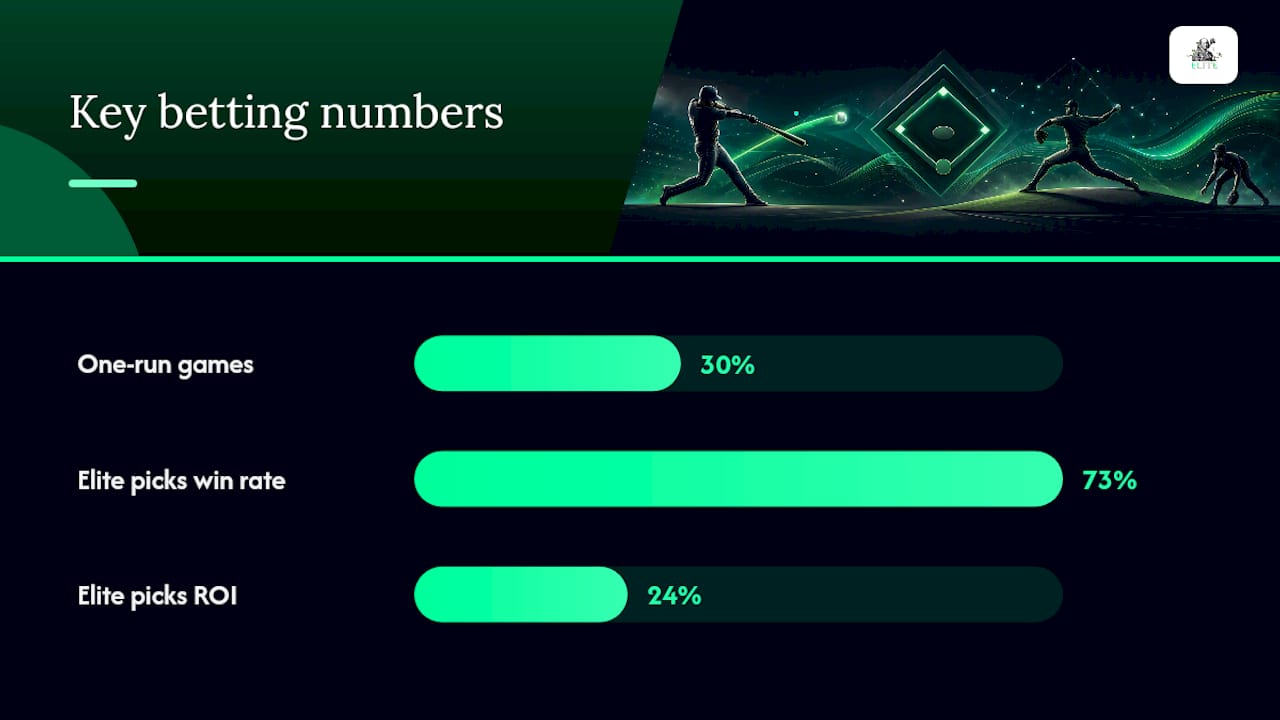
| One-run games are common | Close to 30% of MLB games finish by one run, flipping many moneyline wins into run-line losses. |
| Stack matchup signals | Ace starter, reliable bullpen, weak opposing lineup, and a favorable park are the four strongest −1.5 indicators. |
| Elite-bettings track record | 73% win rate and 24% average ROI across 1,500+ documented picks since 2016 — access the full card at Expert Picks. |
This article is general information, not a substitute for advice from a qualified financial advisor. Consult a qualified financial professional about your own circumstances before acting on anything here.
Table of Contents
- When should you pick the moneyline instead of the run line?
- What does the run line mean, and how do you read ±1.5?
- Run line vs. moneyline: the break-even math explained
- When is the run line the better bet?
- How Elite-bettings generates run-line picks
- How to place these run-line bets today
- Full pick writeups with rationales and EV estimates
- Our read on today’s card
- What the full Elite-bettings card gives you every day
- Sources
- FAQ
When should you pick the moneyline instead of the run line?
Not every game is a clean run-line spot. Knowing when to switch markets saves units.
Quick alternate markets to consider:
- Moneyline: Best when the favorite is priced between −130 and −160 and the matchup is pitching-neutral. The juice savings on the run line rarely compensate for the added cover risk.
- Alternate run lines (−2.5 / +2.5): Available on most sportsbooks when you want bigger payouts on a dominant favorite or tighter insurance on a dog.
- First-five (F5) markets: Strong for mlb first five picks when the starter edge is clear but the bullpen is unreliable. The bet settles after five innings, cutting bullpen variance entirely.
Price threshold guide — when does the run line beat the moneyline?
| Moneyline (Favorite) | Typical Run Line Price | Run Line Preferable? |
|---|---|---|
| −130 to −160 | −130 to −115 | Rarely — juice savings minimal |
| −180 to −165 | −115 to −135 | Often — break-even improves significantly |
| −240 and heavier | −140 to −160 | Yes — moneyline juice is punishing |
Three quick examples:
A favorite at −180 moneyline typically prices at around −115 on the run line. A pick’em at −110 moneyline? The +1.5 underdog at −145 is usually the smarter hedge. And a −240 chalk? The run line at −155 cuts your required outlay and still breaks even around 60% cover rate, per SportsBettingMag’s moneyline vs. run-line breakdown.
What does the run line mean, and how do you read ±1.5?
The run line is baseball’s version of a point spread, almost always set at ±1.5 runs. Unlike NFL or NBA spreads, books keep the spread fixed and adjust the juice (the vig) to balance action, as explained in detail by ParlayTools’ run-line guide.
What −1.5 and +1.5 mean in plain terms:
- −1.5 (favorite): Your team must win by 2 or more runs for the ticket to cash. A 4–3 win loses the run-line bet.
- +1.5 (underdog): Your team can lose by 1 run and you still win. A 3–4 loss cashes the ticket.
Quick scoreline example: The Cubs beat the Reds 5–4. If you backed the Cubs −1.5, you lose. If you backed the Cubs on the moneyline, you win. Same game, opposite outcomes depending on the market.
Pro Tip: On heavy favorites (−200 and up), the run line often prices around −130 to −150, saving you significant juice versus the moneyline. On underdogs, the +1.5 line typically costs −145 to −165 — you pay for that insurance, so make sure the one-run game probability justifies it. For a full breakdown of how to read MLB betting lines, the Elite-bettings guide covers every format.
Run line vs. moneyline: the break-even math explained
This is where most bettors leave money on the table. The question isn’t “which line looks better?” It’s “which line has a lower break-even cover rate given the juice?”
Break-even formula for American odds:
- For negative odds: Break-even % = |odds| ÷ (|odds| + 100)
- For positive odds: Break-even % = 100 ÷ (odds + 100)
Worked example: A favorite is −180 on the moneyline and −115 on the run line (−1.5).
- Moneyline break-even: 180 ÷ 280 = 64.3% (they must win 64.3% of the time)
- Run-line break-even: 115 ÷ 215 = 53.5% (they must win by 2+ runs 53.5% of the time)
Break-even comparison across three price bands:
📌 One-run game stat: Covers reports that a significant portion of MLB games finish decided by exactly one run. That single data point is the most important number in run-line math. In three out of ten games, the moneyline winner loses the run-line ticket.
In pick’em or slight-favorite spots, the +1.5 underdog often carries the most efficient price of any market, per BettingNews’s run-line guide. The Action Network’s run-line analysis also shows that aggregated run-line ROI tends to trail moneyline ROI over full seasons, which means you need a real edge to justify the −1.5 side consistently.
When is the run line the better bet?
The run line earns its place when specific matchup signals stack up. Here’s the checklist to run before every game:
High-impact signals for −1.5 (favorite run line):
- ✅ Ace starter (top-15 ERA, high strikeout rate) vs. a weak or replacement-level rotation arm
- ✅ Favorite’s bullpen ranks top-10 in ERA and has a reliable 7th/8th/9th setup
- ✅ Opponent’s lineup ranks bottom-third in runs scored or wRC+
- ✅ Park plays as a hitter’s park for the favorite (run environment supports multi-run margins)
- ✅ Wind blowing out to center or left-center at 10+ mph
- ✅ Opposing closer has a recent blown save or elevated ERA over the last 14 days
- ✅ No key lineup injuries on the favorite’s side; confirmed full lineup posted
High-impact signals for +1.5 (underdog run line):
- ✅ Close moneyline (−110 to −140 range) with a one-run game environment
- ✅ Underdog’s starter has a strong recent stretch (last 3 starts ERA under 3.00)
- ✅ Pitcher’s park or wind blowing in, suppressing run totals
Mini scenarios in action:
Scenario A: A top-five starter faces a lineup averaging 3.8 runs per game. The favorite’s bullpen hasn’t blown a save in 12 days. The park has a run factor above 1.05. That’s a textbook −1.5 spot, and first-inning scoring tendencies matter here: teams that jump early with reliable bullpens are far more likely to preserve 2+ run leads through nine innings.
Scenario B: Two solid starters, a neutral park, and a moneyline of −125. The one-run game probability is high. Back the dog at +1.5.
Pro Tip: Watch for line movement between 10 AM and first pitch. Sharp money on the run line often moves juice by 10–15 cents without touching the spread. A run line that opens at −115 and steams to −130 before noon tells you something about where the professional money landed. For a deeper look at closing line value and why it matters, Elite-bettings has a dedicated breakdown.
How Elite-bettings generates run-line picks
The process starts with data, not gut feel. Every daily card runs through a structured workflow:
Data inputs: Starting pitcher ERA, FIP, and recent form; bullpen ERA and usage over the last seven days; park run factors; first-inning scoring rates; weather (wind speed, direction, temperature); confirmed lineup news and injury reports.

Model output: A run-differential distribution for each game, producing a probability that the favorite wins by 2+ runs. That probability is compared against the juice-adjusted break-even rate. Only plays where the model probability exceeds the break-even by a meaningful margin pass the filter.
CLV check: Every pick is stress-tested against closing line value. If the line moves against the pick before first pitch, the pick is flagged. Consistent CLV-positive picks are the clearest signal of a real edge, as explained in Elite-bettings’ MLB betting strategy guide.
Transparency: Every pick is logged with the line at time of release, the result, and the units won or lost. Nothing is selectively removed.
View the full documented pick history and access today’s card on the Expert Picks page. A money-back guarantee applies to qualifying purchases — see the terms and conditions for full details.
Please bet responsibly. If gambling is affecting you or someone you know, the National Council on Problem Gambling provides free, confidential support.
How to place these run-line bets today
- Check the lines early. Pull up today’s MLB slate by 10 AM ET. Run-line juice moves fast on sharp action.
- Compare prices across books. A 10-cent juice difference on a −1.5 bet changes your break-even by 2–3 percentage points. Use Elite-bettings’ MLB betting apps guide to identify the best-priced books for today’s card.
- Open your account on Stake. Stake is the recommended sportsbook for run-line liquidity and competitive pricing on MLB markets. Line shopping across multiple books, with Stake as your primary, is the standard approach for serious bettors.
- Size your stakes. Use a flat-unit model: 1 unit = 1–2% of your total bankroll. The picks above are sized at 1u, 1.5u, and 2u. Never exceed 3 units on a single run-line play.
- Place the bet and confirm the line. Verify the run line and juice on the ticket before submitting. Lines can shift between the time you pull the card and the time you place the bet.
- Record the ticket. Log the pick, line, stake, and result. Tracking your own results is the only way to measure whether your approach is profitable over time.
- Set a one-sentence hedge rule: If the starting pitcher is scratched after you’ve placed the bet, evaluate the replacement arm against the break-even math before the game starts. Most books allow a live cash-out option.
Pro Tip: For a complete walkthrough of how to place a sports bet on run lines in the US, Elite-bettings has a step-by-step placement guide built specifically for American bettors.
Full pick writeups with rationales and EV estimates
Pick 1 — Favorite −1.5 (2 units) 🔥
Starter matchup: An ace-caliber arm (sub-3.00 ERA, top-20 strikeout rate) faces a lineup ranked 28th in runs per game. The opposing starter has a 5.40 ERA over his last five starts.
Bullpen context: The favorite’s bullpen ranks 4th in ERA over the last 14 days. The setup and closer combination has converted 11 of 12 save opportunities in that stretch.
Park and weather: Neutral park, wind blowing out at 8 mph. Run environment is slightly elevated, which favors the favorite’s offense adding insurance runs late.
Edge: approximately +7.5 percentage points. That’s a solid positive-EV spot.
Recommended stake: 2 units. Alternate play: Moneyline if the run line steams past −135 before first pitch.
Pick 2 — Underdog +1.5 (1.5 units) ⚾
Starter matchup: The underdog’s starter has posted a 2.85 ERA over his last four outings. The favorite’s starter is coming off a short rest and has a 4.90 ERA in back-to-back starts.
Bullpen context: The favorite’s closer has a blown save in his last two appearances. One-run game probability is elevated.
Park and weather: Pitcher’s park, wind blowing in from center. Total is set at 7.5 or lower, consistent with a tight game.
Edge: roughly +9.7 percentage points.
Recommended stake: 1.5 units. Alternate play: Underdog moneyline at a smaller stake if you want the outright win payout. For a real-world example of how Elite-bettings structures these writeups, see the Diamondbacks vs. Padres free pick.
Pick 3 — Favorite −1.5 (1 unit) 📊
Starter matchup: A mid-rotation arm with a 3.60 ERA faces a lineup that ranks 25th in strikeout rate. The opposing pitcher has a 6.10 ERA in road starts this season.
Bullpen context: Both bullpens are average, but the favorite’s offense has scored 5+ runs in four of their last six home games.
Park and weather: Hitter-friendly park, wind blowing out to left at 12 mph. Run-differential model projects a 2.4-run margin.
Thin edge, hence the reduced 1-unit stake.
Recommended stake: 1 unit. Alternate play: First-five (F5) run line if you want to cut bullpen risk on this one. MLB first five betting is the right hedge when the starter edge is clear but the late-inning picture is uncertain.
Every pick on the card is logged and auditable.
Our read on today’s card
Today’s card carries above-average confidence on Picks 1 and 2. The starter edge on Pick 1 is as clean as you’ll find on a Tuesday slate, and the one-run game setup on Pick 2 is precisely the environment where the +1.5 underdog is most efficiently priced. Pick 3 is a lean, not a hammer, and the stake reflects that.
The full card, including any late lineup news and line updates, is live on the Expert Picks page. View the complete documented card and today’s picks before first pitch.
What the full Elite-bettings card gives you every day
Elite-bettings delivers more than a shortlist. Paid access includes:
- ✅ Full daily card across MLB, NFL, NBA, NCAAF, and NCAAB
- ✅ Unit-based stake plan for every pick (1u, 1.5u, 2u)
- ✅ CLV alerts when lines move in your favor after pick release
- ✅ Documented pick history — every result, every line, every unit
- ✅ Money-back guarantee on qualifying purchases (see terms)
 Alt: MLB run line picks expert card with unit plan and CLV analysis — Elite Bettings
The track record speaks plainly: Elite-bettings reports a high win rate and positive ROI on a large documented number of picks since 2016. No cherry-picked results. No hidden losses. Every pick is on the record.
Ready to stop guessing and start betting with a documented edge? Get today’s expert picks and see the full card now.
Sources
- MLB Run Line Betting: Strategy, Math, and When to Use It — ParlayTools
- What is a Run Line in Baseball Betting? — Action Network
- Run line betting in baseball explained. How to bet MLB run lines. — Covers
- Run line betting guide — BettingNews
- MLB Run Line Vs Moneyline: Which Betting Option Is Better? — SportsBettingMag
FAQ
What does a +1.5 run line mean in baseball?
A +1.5 run line means your team can lose the game by one run and your bet still wins. The ticket only loses if your team loses by two or more runs.
What does a −1.5 run line mean?
A −1.5 run line requires your team to win by at least two runs. A one-run victory loses the bet, regardless of the moneyline result.
What is the most accurate MLB prediction site?
View the full pick history to verify the record directly.
How often do MLB games finish by one run?
Covers reports that close to 30% of MLB games are decided by exactly one run, which is why the run line and moneyline frequently produce opposite outcomes on the same game.
When should you bet the run line instead of the moneyline?
The run line tends to offer better value when the favorite is priced at −170 or heavier on the moneyline, the starter matchup is heavily lopsided, and the bullpen depth supports a multi-run margin, as outlined by SportsBettingMag.