 Skip to content


Vig in Sports Betting: What It Is and How to Beat It
The vig is the sportsbook’s built-in commission — you pay it on every single wager, whether you realize it or not. Short for vigorish (also called juice), it’s the margin a bookmaker bakes directly into the odds so the house profits regardless of which side wins. On a standard -110/-110 spread, you risk $110 to win $100. That extra $10 isn’t a fee you see on a receipt; it’s embedded in the price. The result: you need to win roughly 52.4% of your bets just to break even, not 50%.
Key facts before we go deeper:
- Vig = sportsbook commission, embedded in odds, not charged separately
- A -110/-110 market carries a hold for the book that is typically around 4.5% to 5%
- You need a ~52.4% win rate to break even at -110, not 50%
- Every market type carries vig, but the amount varies significantly
- You can reduce effective vig through line shopping, reduced-juice books, and promos
Key Takeaways
Vig is the sportsbook’s hidden commission, embedded in every line, and reducing it is the most direct way to improve your long-term betting results.
| Point | Details |
|---|---|
| Vig definition | Vig is the bookmaker’s commission built into odds, not charged as a separate fee. |
| Break-even rate | At -110, you need a 52.4% win rate just to break even, not 50%. |
| Typical hold ranges | Spreads and totals run 4–6% hold; props and futures often exceed 10–20%. |
| Parlays compound vig | Each parlay leg multiplies the vig effect, making parlays high-margin for the book. |
| Best mitigation steps | Line shop, use reduced-juice books, and avoid high-vig markets when your edge is thin. |
Table of Contents
- What does vig stand for, and what are its synonyms?
- How sportsbooks build vig into the odds
- Worked examples you’ll actually see at the sportsbook 🧮
- Where is vig higher? Typical ranges by market type 📊
- How vig affects your profits, and what you can do about it 💡
- Vig outside sports betting: loans, loansharks, and U.S. law
- Pro-level insights: CLV, EV after vig, and how sharp bettors think 🎯
- The Elite-bettings perspective on vig
- Sources
- FAQ
What does vig stand for, and what are its synonyms?
Vigorish is the full word; vig is the shorthand every bettor uses. Merriam-Webster traces the word to Yiddish vigorish and Russian vyigrysh (winnings) and carries two distinct meanings: the bookmaker’s commission on a bet, and the interest charged on a loan by an illegal lender. Both meanings share the same core idea — a fee extracted for providing access to money or action.
The terms you’ll encounter in betting contexts:
- Juice — the most common American synonym; interchangeable with vig in everyday use
- Rake — borrowed from poker; used when a platform takes a cut of each pot or market
- Hold — sometimes refers to the total percentage a sportsbook retains across all bets on a market or event; technically the realized margin, not just the theoretical vig
- Overround — the British term for the excess implied probability above 100%; the raw input from which vig is derived
- House edge — more common in casino contexts (slots, roulette) but conceptually identical
- Cut — informal, used interchangeably with juice or rake
The math behind all these terms is identical. MarketMath confirms that vig and juice are fully interchangeable in both casual and technical usage. The word changes by context; the calculation does not.
How sportsbooks build vig into the odds
Sportsbooks never charge a visible fee. That excess is the overround, and it’s the source of every dollar of vig you pay.
The conversion formulas
American odds → implied probability:
- Negative line (e.g., -110): Implied probability = |odds| ÷ (|odds| + 100)
- Positive line (e.g., +110): Implied probability = 100 ÷ (odds + 100)
Decimal odds → implied probability:
- Implied probability = 1 ÷ decimal odds
Overround → vig (hold):
Using the Wikipedia vigorish formula, if o is the overround expressed as a decimal (e.g., 1.0476 for a 4.76% overround):
- v = (o − 1) ÷ o — converts overround to vig/hold percentage
- Inverse: o = 1 ÷ (1 − v)
The -110/-110 example, step by step
The book collects roughly $4.55 for every $100 wagered on a balanced -110/-110 market. FOX Sports notes that this commission is present across every market type, from spreads to futures, always hidden inside the price.
Pro Tip: Check for “no-vig” or “fair odds” lines on sharp books. Some platforms display the vig-free price alongside the standard line so you can see exactly how much margin you’re paying. Lines also shift dynamically as money comes in — a book may move from -110/-110 to -115/-105 to rebalance exposure, which changes the vig split between sides.
Worked examples you’ll actually see at the sportsbook 🧮
1. Standard -110/-110 spread
- Side A: -110 → implied probability = 110 ÷ 210 = 52.38%
- Side B: -110 → implied probability = 110 ÷ 210 = 52.38%
- Overround = 104.76%; hold ≈ 4.55%
- Break-even win rate: 52.38% (you must win more than half your bets just to stay flat)
2. Asymmetric line: -115 / -105
- Side A (-115): 115 ÷ 215 = 53.49%
- Side B (-105): 105 ÷ 205 = 51.22%
- Overround = 104.71%; hold ≈ 4.50%
- The vig is split unevenly: Side A bettors pay more per dollar risked than Side B bettors
3. Moneyline with decimal odds
Suppose Team A is 1.80 and Team B is 2.10:
- Team A: 1 ÷ 1.80 = 55.56%
- Team B: 1 ÷ 2.10 = 47.62%
- Overround = 103.18%; hold ≈ 3.08%
This moneyline carries lower vig than the standard spread example — a reminder that implied probability betting math reveals the true cost of each market.
4. Parlays: vig compounds fast
On a two-leg parlay at -110 each, the book calculates your payout using true odds of roughly -110 per leg but pays you at a slightly worse rate. Each additional leg multiplies the vig effect. The Bet Better guide confirms that vig raises the required win rate above 50% on every leg, and that compounding across legs makes parlays among the highest-margin products a sportsbook offers.
Where is vig higher? Typical ranges by market type 📊
Vig is not uniform. The amount you pay depends heavily on which market you’re betting. FOX Sports confirms that vig is embedded in all betting markets, with the amount varying by liquidity and line risk.
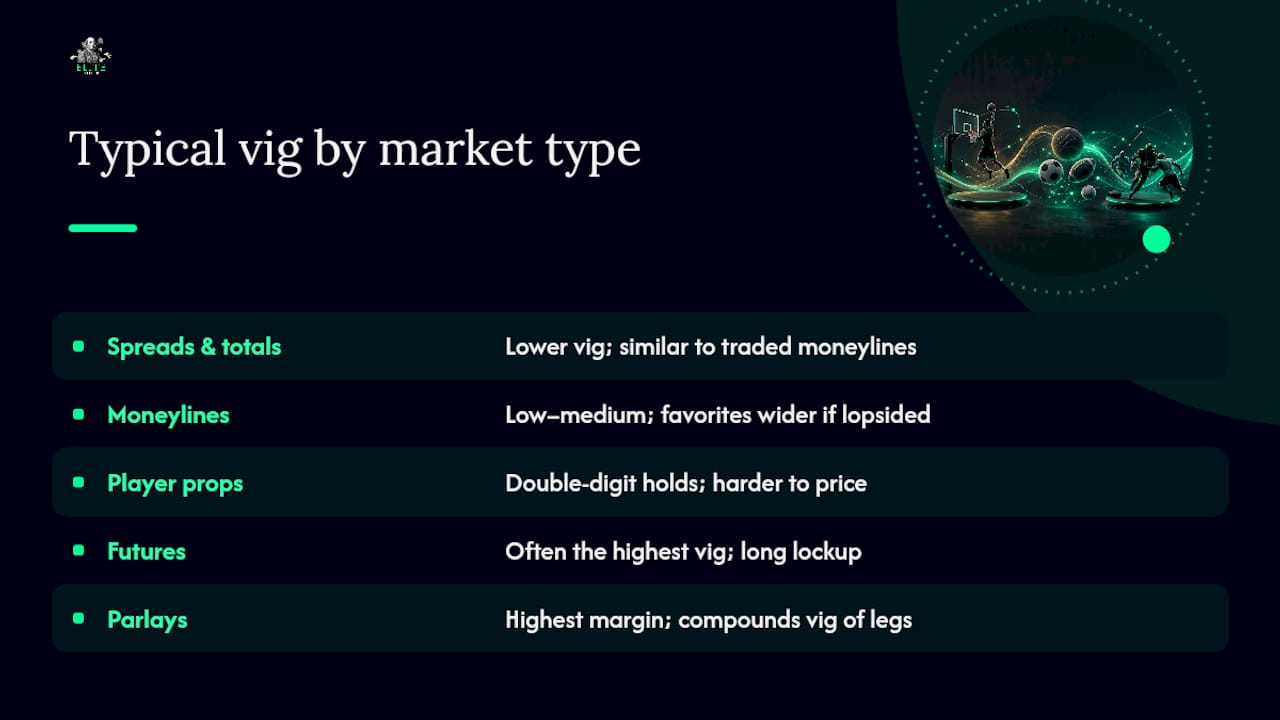
Moneylines on heavily traded games can be similar to spreads, but lopsided matchups (heavy favorites at -300 or more) often carry wider margins because the book takes on more risk pricing the underdog.
Player props regularly carry double-digit holds. Because these markets are harder to price and attract sharp action from stat-focused bettors, books protect themselves with wider spreads between the two sides.
Futures (Super Bowl winner, MVP, season win totals) often carry the highest vig of any market. Tying up your money for months while paying that kind of margin is a significant drag on any bettor’s returns.
Parlays, as covered above, compound the vig from each individual leg, making them the highest-margin product in a sportsbook’s catalog despite their popularity.
How vig affects your profits, and what you can do about it 💡
The break-even math
The difference sounds small, but across hundreds of bets it’s the gap between a profitable season and a losing one.
📌 Stat to know: Standard -110 pricing carries roughly a 4.76% overround and requires a ~52.4% win rate to break even, per Sporting News.
Consider two bettors placing 500 bets at $110 each. Bettor B finds a reduced-juice sportsbook at -105 on both sides (hold ≈ 2.38%). Same picks, different vig.
Five ways to reduce the vig you pay
- Line shop across multiple books. Odds vary by book, sometimes by a full point or more on spreads. Getting -108 instead of -110 adds up across a full season.
- Use reduced-juice platforms. Some books price standard markets at -105 instead of -110, cutting your effective hold nearly in half. Stake is one of the top options for competitive pricing and a wide market selection.
- Target betting exchanges. Exchanges let bettors trade against each other rather than against a book, charging a small commission (often 2–5%) only on net winnings. The effective vig is often lower than a traditional sportsbook.
- Use promos strategically. Deposit bonuses, odds boosts, and free bets reduce your effective cost per bet. A $10 odds boost on a -110 line is worth real money over time.
- Avoid high-vig markets when edge is thin. If your edge on a player prop is marginal, a 15% hold will erase it. Stick to lower-vig markets unless your edge is clearly larger than the margin.
Warning: Chasing lower vig on thin or illiquid markets can backfire. A -105 line on an obscure prop may look cheaper, but if the book has priced it poorly in its own favor, you’re paying less vig on a bad bet. Vig reduction only helps when the underlying pick has genuine value.
Vig outside sports betting: loans, loansharks, and U.S. law
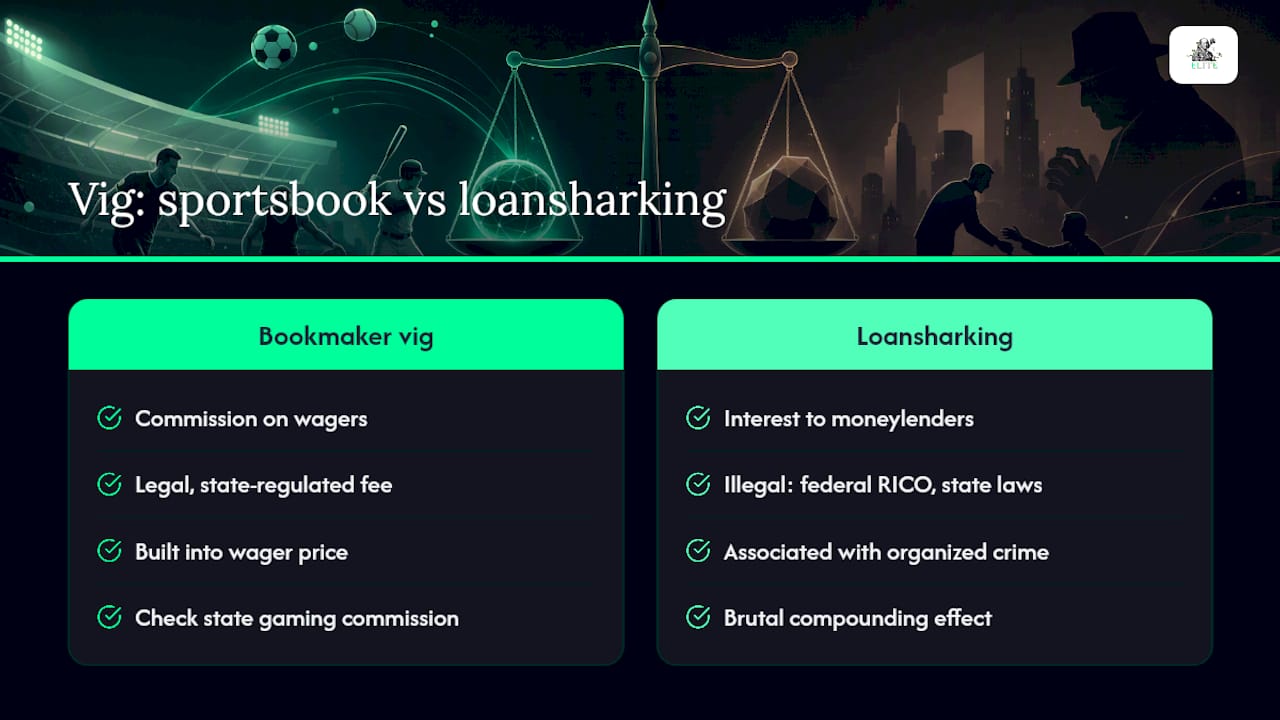
The word vig predates legal sportsbooks by decades. Merriam-Webster lists both meanings side by side: the bookmaker’s commission and the interest paid to a moneylender, particularly an illegal one.
The compounding effect is brutal, which is why the term carries a menacing connotation in crime dramas and real-world organized crime contexts.
For U.S. readers: a licensed sportsbook’s vig is a legal, regulated fee built into the price of a wager. Loansharking, by contrast, is a federal crime under the Racketeer Influenced and Corrupt Organizations Act and various state statutes. Always use licensed, state-regulated operators. If you’re unsure whether a betting service is licensed in your state, verify with your state’s gaming commission before depositing.
This article provides general information about vig in betting and lending contexts. It is not legal or financial advice. Confirm current regulations with your state’s gaming authority or a qualified professional.
Pro-level insights: CLV, EV after vig, and how sharp bettors think 🎯
Closing line value (CLV) and vig
CLV (closing line value) measures how your bet price compares to the odds at game time. If you bet a team at -105 and the line closes at -115, you captured +10 cents of CLV. That edge is meaningful because the closing line reflects the sharpest available information. Elite-bettings builds its entire pick selection process around CLV analysis, which is why it matters as a quality signal, not just a vanity metric.
The key insight: CLV is only meaningful net of vig. A bet at -105 that closes at -110 looks like a CLV win, but if you’re comparing against a no-vig price, you need to strip the margin from both sides first. Use the overround formula to find the fair price, then measure your entry against that.
EV after vig: a worked adjustment
- Raw EV = (0.55 × $100) − (0.45 × $110) = $55 − $49.50 = +$5.50 per $100 risked
- That’s positive before vig. But if the true no-vig price is closer to -108, your edge shrinks slightly.
The Wikipedia vigorish article notes that bookmakers adjust lines dynamically to balance liabilities, not just to extract margin. A line that moves from -110 to -115 may signal sharp money, not just a book widening its margin. Tracking that movement is part of how pros confirm their edge is real.
Use expected value frameworks to run the math before committing.*
On stake sizing: pros reduce unit size on high-vig markets even when EV looks positive, because the variance is higher and the margin for error is thinner. A full unit on a -110 spread and a half unit on a -120 prop with the same estimated edge is a rational adjustment, not timidity.
The Elite-bettings perspective on vig
Understanding vig isn’t just an academic exercise. It’s the single most controllable variable in your betting results. You can’t control outcomes, but you can control how much you pay the book on every bet.
At Elite-bettings, every pick recommendation accounts for vig from the start. That kind of sustained edge only holds when you’re consistently finding lines where the value exceeds the margin. Line shopping, reduced-juice access, and disciplined market selection are built into how we operate.
 Alt: Elite Bettings expert sports picks CLV analysis NFL NBA betting strategy
If you want picks that already account for vig and are selected for genuine line value, access our expert picks here — backed by a 100% money-back guarantee.
Sources
- What is a vig in sports betting? Beginner’s guide to vigorish and how sportsbooks make money on bets | Sporting News
- Vigorish
- What is Vig? — MarketMath
- What Is Vig in Sports Betting and How Does It Work | FOX Sports
- vigorish | Definition of vigorish by Merriam-Webster
FAQ
What is vig slang for?
Vig is short for vigorish, the commission a sportsbook charges by embedding it into the odds. In street slang, it also refers to the interest charged on an illegal loan.
What does 10% vig mean in betting?
What does 20% vig mean?
At that level, you need a substantial edge just to overcome the margin.
Why do they call loan interest “the vig”?
The term carries over from organized crime, where lenders charged weekly interest called vigorish on informal loans. Merriam-Webster confirms both the betting and lending definitions share the same Yiddish/Russian root, meaning “winnings” or “profit.”