 Skip to content


Expected Value Betting: Your Complete +EV Strategy Guide
Expected value (EV) tells you whether a bet is mathematically profitable over the long run. The formula is: EV = (P_win × profit if win) − (P_lose × stake). Bet $100 on a true 50/50 coin flip at +110 odds and your EV is +$5 per bet. Bet that same flip at -110 and your EV is -$4.55. One line makes you money over time; the other bleeds you dry.
If EV > 0, the wager is profitable over the long run. That single principle separates recreational bettors from sharp ones. Pro handicappers reinforce this with two additional tools: the Kelly Criterion for stake sizing, and Closing Line Value (CLV) as the primary signal that your probability estimates are accurate. Elite-bettings has built its entire methodology around these three pillars, producing a 73% hit rate and a 24% average ROI across 1,500+ documented picks since 2016.
Statistic: A bettor with consistent +2% average CLV will profit over time, even through losing streaks, because the math compounds across volume.
Pro Tip: Before placing any bet, run the EV formula first. If you cannot calculate a positive EV with a margin of at least +2%, skip the bet entirely.
Table of Contents
- What Does Expected Value Actually Mean for a Sports Bettor?
- How to Calculate Expected Value: Formula and Odds Conversion
- Three Worked Examples and How to Use an EV Calculator
- How Bookmaker Vig Distorts Odds and Where to Find Fair Lines
- CLV and Bankroll Discipline: What Pros Actually Track
- Pre-Bet Checklist: Should You Place This Wager?
- Key Takeaways
- The Edge Most Bettors Never Develop
- Useful Sources and Tools
- FAQ
What Does Expected Value Actually Mean for a Sports Bettor?
Win rate alone is a misleading metric. A bettor who wins 60% of bets at -200 odds is losing money. A bettor who wins 45% of bets at +150 odds is printing it. EV merges probability and payout into a single number, so you can compare any two bets on equal footing regardless of odds format or sport.
Think of it like owning a slot machine versus a vending machine. The slot machine has a negative house edge built in; every pull costs you money on average. A positive-EV bet is the opposite: you own the edge, and every bet placed at those odds adds to your long-run balance. Short-term results swing wildly, but the math always catches up over volume.
Here is what that means practically:
- Long-term focus is mandatory. EV is a statistical expectation, not a guarantee on any single bet. Losing 10 consecutive +EV bets is normal variance, not evidence the strategy is broken.
- Sample size matters enormously. Hundreds of bets are needed before P&L becomes statistically meaningful. CLV provides a faster signal of edge quality.
- Variance scales with odds. Longshot bets (+300 and above) produce wilder swings even when they are genuinely +EV. Sizing must account for that.
- EV% lets you compare bets of different sizes. A +$3 EV on a $50 bet (6%) beats a +$4 EV on a $200 bet (2%) on a per-dollar basis.
Calibrated probability models and Closing Line Value are the two most reliable ways to validate whether your estimated win probability is accurate. If your model consistently beats the closing line, your probabilities are well calibrated. If it consistently trails the closing line, you are overestimating your edge.
How to Calculate Expected Value: Formula and Odds Conversion
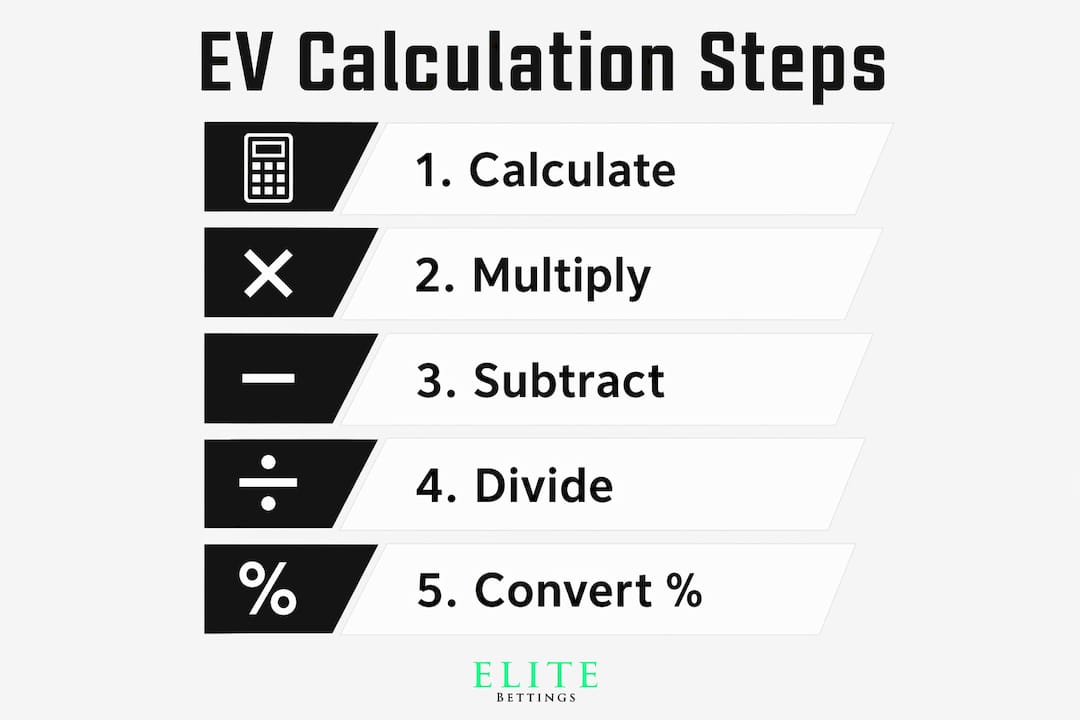
The canonical formula has two forms. Use the first for dollar amounts; use the second to compare bets of different sizes:
EV = (P_win × profit_if_win) − (P_lose × stake)

EV% = (EV ÷ stake) × 100
A +5% EV means you expect to return $0.05 per $1 wagered over the long run.
Converting American and decimal odds to implied probability
| Odds Format | Example | Implied Probability Formula | Result |
|---|---|---|---|
| American (favorite) | -150 | 150 ÷ (150 + 100) | — |
| American (underdog) | +130 | 100 ÷ (130 + 100) | — |
| Decimal | — | 1 ÷ — | — |
| Decimal | — | 1 ÷ — | — |
Break-even probability is the win rate you need just to avoid losing money at a given line: Break-even% = 1 ÷ decimal odds. At -110 (decimal 1.909), break-even is 52.4%. Your model must assign a probability above that threshold for the bet to carry positive EV.
A few practical notes on the math:
- Always strip the vig before comparing your probability to the market. Raw implied probabilities from a two-sided market sum to more than 100%, which overstates the book’s edge against you.
- EV% is the right unit for comparing a $25 prop bet to a $200 game-line bet. Dollar EV alone misleads you into chasing larger stakes.
- Rounding win probabilities to the nearest whole percent introduces meaningful error at tight lines. Work to one decimal place minimum.
Three Worked Examples and How to Use an EV Calculator
Example 1: Underdog moneyline showing +EV
An NFL underdog is listed at +140. Your model gives them a 45% chance to win.
- Decimal odds: 2.40. Profit per $100 wagered: $140.
- EV = (0.45 × $140) − (0.55 × $100) = $63 − $55 = +$8.00
- EV% = $8 ÷ $100 × 100 = +8.0%
That is a strong edge. The book’s implied probability at +140 is 41.7%; your model says 45%. That 3.3-point gap is your positive EV signal.
Example 2: Favorite at -115 showing marginal EV
An NBA favorite is priced at -115. Your model gives them a 55% chance.
- Decimal odds: 1.87. Profit per $100: $87.
- EV = (0.55 × $87) − (0.45 × $100) = $47.85 − $45 = +$2.85
- EV% = +2.85%
Marginal but above the +2% minimum threshold most sharp bettors use. Worth considering, but only if your model confidence is high.
Example 3: Decimal odds showing how vig compounds
A soccer match leg priced at 1.80 (implied 55.6%). Your model says 52% true probability.
- EV = (0.52 × $80) − (0.48 × $100) = $41.60 − $48 = -$6.40
- EV% = -6.4%
Negative EV. The vig has pushed the line past your model’s fair value. Pass.
Using an EV calculator step by step
- Enter your stake (e.g., $100).
- Enter the market odds in your preferred format (American or decimal).
- Enter your estimated win probability (from your model or sharp reference line).
- Toggle the no-vig option if available to see fair-odds EV separately.
- Read the output: dollar EV, EV%, and break-even probability.
- Compare EV% to your minimum threshold before deciding.
Pro Tip: Set a minimum EV threshold of +2% or higher before placing any bet. This margin of safety absorbs model error and estimation uncertainty. Bets between 0% and +2% EV are too close to call with confidence.
How Bookmaker Vig Distorts Odds and Where to Find Fair Lines
The vig (also called juice or margin) is the bookmaker’s built-in profit. At standard -110/-110 pricing on both sides of a bet, the combined implied probability is 104.8%, not 100%. That extra 4.8% is the house edge baked into every line you see.
To find the true, no-vig probability, divide each side’s implied probability by the total combined implied probability:
- Side A at -110: implied 52.38%
- Side B at -110: implied 52.38%
- Total: 104.76%
- No-vig Side A: 52.38% ÷ 104.76% = 50.0%
Now you have fair odds. Compare your model’s probability to that 50.0% figure, not the raw 52.38%. That distinction matters when you are hunting thin edges.
Where to benchmark fair probabilities:
- Closing lines at sharp books are the most accurate probability estimates available. Academic research on NFL games found closing spreads explain roughly 86% of game outcome variability.
- Consensus lines across multiple sharp sources reduce single-book noise.
- Opening lines at high-volume books before significant action has moved them.
Pro Tip: Line shopping across multiple books is one of the fastest ways to create +EV without improving your model at all. Getting +140 instead of +130 on the same bet adds roughly 2–3 EV percentage points instantly.
Practical limits to keep in mind: thin markets move fast when you bet them, maximum bet sizes cap your upside on soft lines, and books that notice consistent winning will limit your account. Prioritize liquid markets where your bet size does not shift the line.
CLV and Bankroll Discipline: What Pros Actually Track
Closing Line Value is the difference between the odds you got and the odds at market close. Positive CLV means you bought at a better price than the market’s final, most-informed estimate. It is the primary KPI used by professional operations because it signals edge far faster than P&L does.
Research by professional bettor and researcher Joseph Buchdahl found that consistent positive CLV can demonstrate skill in as few as 50–100 bets. Raw P&L, by contrast, often requires 2,000–3,000 bets to reach statistical significance. That gap is enormous for anyone trying to evaluate whether their model actually works.
CLV ranges and what they indicate
| Average CLV per Bet | Assessment |
|---|---|
| Below 0% | Consistently overpaying. Long-term losses likely. |
| 0% to +1% | Break-even territory. Barely covering vig. |
| +1% to +2% | Good. Likely profitable over large samples. |
| +3% to +5% | Excellent. Consistent, significant edges. |
| +5%+ | Exceptional. Rare; indicates elite timing or information advantage. |
Kelly Criterion for stake sizing
The Kelly formula sizes your bet as a fraction of your bankroll proportional to your edge: Kelly% = (edge ÷ odds) × 100. For a bet with a 5% edge at even money, Kelly says bet 5% of your bankroll.
Full Kelly is aggressive. Most professionals use fractional Kelly (typically one-quarter to one-half Kelly) to reduce volatility and drawdown risk. A 2.5% Kelly bet becomes a 0.625%–1.25% fractional Kelly bet. The math still compounds in your favor; the ride is just smoother.
Model validation checklist:
- Track CLV on every bet, not just winners.
- Backtest your model’s calibration by odds band (favorites vs. underdogs separately).
- Check sample-size thresholds: 50–300 bets for early CLV signals, 1,000+ for P&L confidence.
- If CLV trends negative over 100+ bets, refine model assumptions rather than blaming variance.
Pro Tip: CLV is a filter, not just a scorecard. If your model persistently disagrees with the closing line in the wrong direction, the market is telling you something. Fix the model.
Pre-Bet Checklist: Should You Place This Wager?
Run through these steps in order before committing any stake.
- Estimate true probability. Use your model, sharp reference lines, or both. Work to one decimal place.
- Convert market odds to implied probability. Strip the vig using the no-vig formula.
- Calculate EV and EV%. Apply the formula: EV = (P_win × profit) − (P_lose × stake).
- Check the minimum EV threshold. If EV% is below +2%, pass unless model confidence is exceptionally high.
- Verify your CLV signal. Does the line you are getting beat the sharp consensus? If not, your edge may be illusory.
- Size the stake. Apply fractional Kelly or a flat unit (1%–3% of bankroll for most bettors).
- Line-shop across books. A better number at another book can flip a marginal bet into a clear +EV opportunity.
- Log the bet immediately. Record your odds, your estimated probability, and the closing line after the event.
Red flags that should make you pass:
- Edge below +2% with low model confidence
- Thin market where your bet size will move the line
- No sharp reference line available to validate your probability estimate
- Model has shown negative CLV over the past 50+ bets in this market
Beware of overbetting longshots. A +300 underdog that is genuinely +EV at 5% edge still carries enormous variance. Kelly will size it small for a reason. Trust the math, not the excitement of a big payout.
Key Takeaways
Expected value betting is profitable only when you combine accurate probability estimation, vig removal, CLV tracking, and disciplined stake sizing into a consistent process.
| Point | Details |
|---|---|
| EV formula | EV = (P_win × profit) − (P_lose × stake); EV% = EV ÷ stake × 100. |
| Minimum EV threshold | Sharp bettors require at least +2% EV to allow a margin of safety against model error. |
| CLV as primary signal | Closing lines explain roughly 86% of outcome variability; consistent +CLV proves edge faster than P&L. |
| Kelly for sizing | Use fractional Kelly (one-quarter to one-half) to compound gains while controlling drawdown. |
| Elite-bettings track record | CLV-aware picks with a 73% hit rate and 24% average ROI across 1,500+ documented picks since 2016. |
The Edge Most Bettors Never Develop
Here is the uncomfortable truth about expected value in gambling: most bettors understand the concept and still lose money, because understanding EV and executing it consistently are two completely different skills.
The math is not the hard part. The hard part is resisting the urge to bet when your edge is unclear, staying disciplined through a 15-bet losing streak on genuinely +EV picks, and trusting CLV over your win-loss record when the two tell different stories. Short-term variance is not evidence your model is broken. Persistent negative CLV is.
Professional handicappers do not obsess over whether the last pick won. They obsess over whether they consistently got better prices than the closing line. That process orientation is what separates bettors who profit over 1,500+ picks from bettors who flame out after 200. The picks matter; the process matters more.
Any service quoting an ROI should be able to prove it, line by line. If you are evaluating us or anyone else, our guide on how to choose a sports handicapping service shows you exactly what to demand before you pay, and why an advertised win rate is meaningless without the average odds attached to it.
ELITE BETTINGS — THE PACK
Stop guessing. Start with a pick that costs you nothing. 🎯
Since 2016 we have published every single result — a 73% win rate at −137 average odds and a 24% average ROI over 1,500+ documented picks. 1–2 quality plays per day, 100% money-back if the record goes negative, and over 2,500 members already following the same bets we place ourselves.
🔥 Your first pick is FREE — use code 100WEB
👉 Get The Pack — First Pick Free
Prefer to check the receipts first? View our full public record →
Useful Sources and Tools
- Elite-bettings Expert Picks — CLV-aware picks with full documented results across NFL, NBA, NCAAF, NCAAB, and MLB. Start here for ready-to-use +EV signals.
- CalcMyBets EV Calculator — Enter your probability estimate and market odds for instant EV%, break-even probability, and Kelly stake. Best for quick pre-bet checks.
- CalcMyBets CLV Calculator — Plug in your line and the sharp closing line to measure your probability edge and validate model quality over time.
- Covers.com EV Guide — Clear walkthrough of the EV formula with worked examples and no-vig calculation steps.
- DumbMoneyPicks CLV Guide — Deep dive into CLV ranges, sample-size thresholds, and why closing lines explain 86% of outcome variability.
- EVBets CLV and Kelly Guide — Professional-level coverage of fractional Kelly sizing, CLV-based performance evaluation, and bankroll discipline.
- Parcae +EV Betting Explained — Practical guide to finding mispriced lines using sharp reference books, with realistic return expectations.
- Stake Sportsbook — Recommended book for placing +EV bets; competitive lines across major US sports markets.
Sports betting involves financial risk. This article is general educational information, not professional financial or legal advice. Confirm current rules and regulations in your state before placing bets.
FAQ
What is the expected value formula for a sports bet?
EV = (probability of winning × profit if you win) − (probability of losing × stake). Divide by stake and multiply by 100 to get EV%, which lets you compare bets of different sizes on equal footing.
Can you lose money on a +EV bet?
Yes. Expected value is a long-run average, not a per-bet guarantee. You can lose any individual +EV bet; the math only delivers reliably over hundreds of bets as variance smooths out.
What minimum EV threshold should I use?
Most sharp bettors require at least +2% EV before placing a bet. This margin of safety accounts for model error and estimation uncertainty, preventing marginal edges from flipping negative in practice.
How does CLV validate whether my bets are actually +EV?
Closing lines explain roughly 86% of game outcome variability, making them the most accurate probability estimate available. If you consistently beat the closing line, your bets were priced correctly even when individual results go against you.
How does Elite-bettings use EV and CLV in its picks?
Elite-bettings tracks CLV on every pick alongside the final result, producing a documented 73% hit rate and 24% average ROI across 1,500+ picks since 2016. You can review the full record at Elite-bettings before subscribing.