 Skip to content


Are MLB Picks Worth It? The Verdict for Bettors in 2026
Yes, paid MLB picks can be worth it, but only if the service can prove positive closing-line value (CLV) and shows you a full, transparent ledger of graded bets. A high win rate alone tells you almost nothing. A picks service that consistently beats the closing number, over hundreds of graded bets, is doing something the market itself struggles to do.
Before you pay anyone for MLB betting tips, run these three checks in under five minutes:
- Ledger check: Do they publish every graded pick, win or loss, with dates and odds?
- Sample size: Are there enough graded bets (ideally 500+) to separate skill from a hot streak?
- Terms check: Is there a clear refund or money-back policy if the service underperforms?
If a service passes those three filters, the smartest move is to test a single free or low-cost pick yourself and grade it against the closing line before committing real money.
Key Takeaways
Paid MLB picks are worth it only when a service proves positive closing-line value across a large, transparent, publicly graded sample.
| Point | Details |
|---|---|
| CLV beats win rate | A service showing consistent positive CLV demonstrates real skill, even with a moderate win rate. |
| Demand a full ledger | Every graded pick needs a date, odds taken, stake size, and closing line for comparison. |
| Wait for real sample size | Roughly 500 graded bets are needed before results reveal a reliable signal. |
| Manage variance with flat units | Even +EV systems lose money over 20 to 30 bet stretches; bet 1 to 2% of bankroll per pick. |
| Elite Bettings documents everything | Publishes a full ledger with verified picks and a free first pick to test the ledger yourself. |
Table of Contents
- How Pro Picks Deliver Value: Expected Value (EV) and Closing-Line Value (CLV)
- Where MLB Picks Most Often Find +EV: Markets and Situational Edges
- How to Vet a Picks Service: A Checklist and What Elite Bettings Documents
- Risks and Bankroll Rules: Surviving Variance When You Follow Picks
- Step-by-Step: How to Trial and Use MLB Picks for Maximum Profit
- Why Win Rate Is the Wrong Question to Ask
- Try Elite Bettings: Your First MLB Pick Is Free 🎯
- Sources
- FAQ
How Pro Picks Deliver Value: Expected Value (EV) and Closing-Line Value (CLV)
Every serious answer to “are MLB predictions reliable” starts with expected value. EV measures whether a bet is profitable over the long run, regardless of what happens in any single game. The EV formula multiplies your win probability by the payout, then subtracts your loss probability multiplied by your stake.
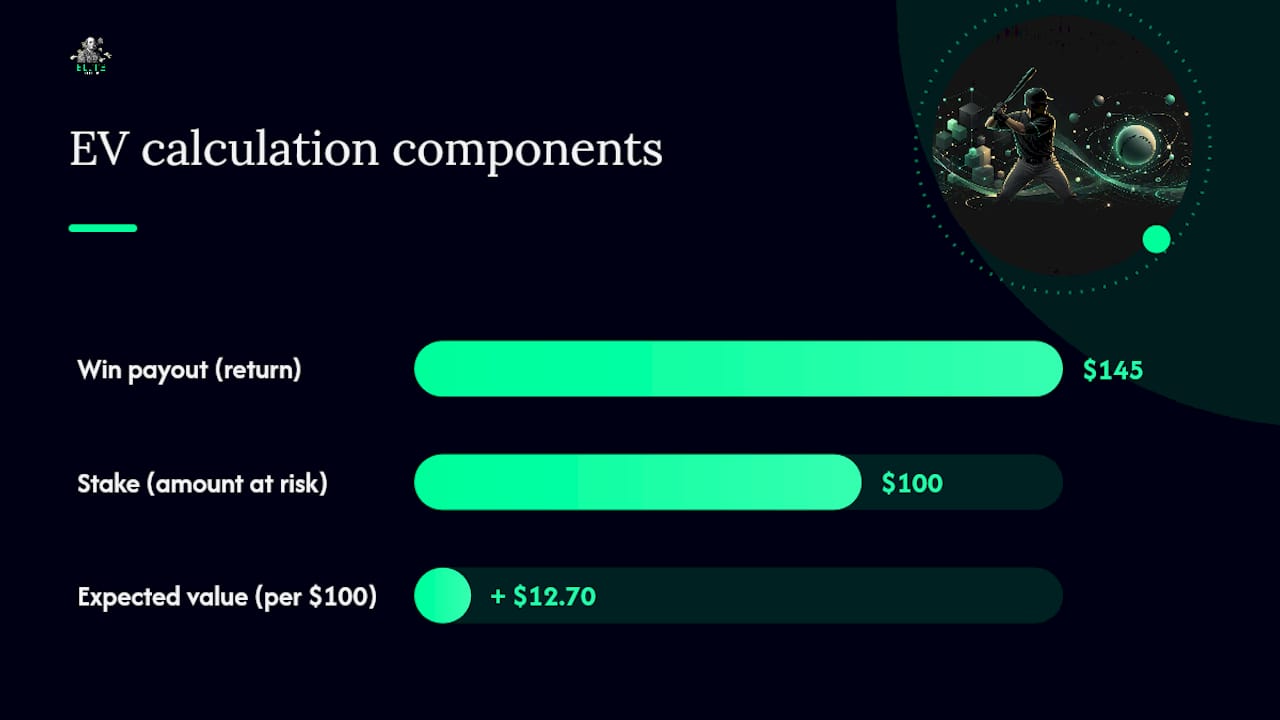
A $100 bet returns $145 if it hits. Your EV is (0.46 × $145) − (0.54 × $100) = $66.70 − $54.00 = +$12.70 per $100 wagered. That’s a real edge, not a lucky guess.
CLV takes this a step further. It compares the odds you actually got at the time you bet to the final closing odds. If you consistently get better numbers than the market settles on, you’re beating the collective judgment of every sharp bettor and algorithm pushing that line. That’s the strongest available signal of genuine skill, not variance.
A ledger with a great record but no CLV data should raise questions.
Before trusting any provider, demand these ledger items:
- Date and time of each pick
- Exact odds taken and at which sportsbook
- Stake size (in units, not dollars)
- Closing line for direct comparison
Where MLB Picks Most Often Find +EV: Markets and Situational Edges
Not every market offers the same value, and knowing where to look separates a useful picks service from a coin flip. The clearest, most repeatable edge in MLB betting sits with home underdogs priced between +120 and +160. That price band has historically outperformed what raw win totals would suggest, especially when the home team’s starting pitcher grades out well.

Run-line and totals bets often make more sense than the moneyline when a favorite is priced steeper than -180, since the break-even math gets brutal fast. In-play markets offer a different kind of opening: pregame favorites who fall behind early often get overpriced by live betting algorithms overreacting to a short-term deficit, creating a live-betting inefficiency sharp bettors quietly exploit.
Matchup-level edges come down to a handful of stats that matter more than the box score:
- FIP and xERA over raw ERA, since they strip out defensive luck
- Bullpen workload over the last three games
- Last-5 bullpen ERA as a fatigue indicator
- Lineup handedness splits against the starting pitcher
Pro Tip: Never bet a heavy road favorite just because the name looks good on paper. Check the bullpen’s last five appearances first. A tired bullpen behind a great starter is still a live-betting trap.
How to Vet a Picks Service: A Checklist and What Elite Bettings Documents
Evaluating a picks provider isn’t about trusting a slick website. It comes down to five checkable things:
- Full ledger covering every graded pick, wins and losses alike
- CLV reporting showing the closing line versus the line taken
- Sample size of 500 or more graded bets before you draw conclusions
- Transparent unit sizing so you know exactly how much was risked per play
- A stated refund policy with real terms, not vague marketing language
Elite Bettings publishes results this way.
A handicapper who consistently beats the closing line is producing an edge the market itself hasn’t fully priced in yet. That’s the real test, not a win streak.
To verify any provider’s claims yourself, check pick timestamps against when lines actually moved, compare captured odds to publicly archived closing lines, and read the full staking methodology behind how picks get built. Then trial the first pick before paying for anything long-term.
Risks and Bankroll Rules: Surviving Variance When You Follow Picks
Positive EV does not mean positive results every week. Even a system with a real, provable edge will lose money over stretches of 20 or 30 bets purely from variance. That’s math, not a flaw in the strategy.
Manage that risk with a few non-negotiable rules:
- Bet flat units (1 to 2% of bankroll per pick) instead of chasing losses with bigger stakes
- Set checkpoints at 100, 500, and 1,000 graded bets to reassess whether a service’s edge is holding up
- Never increase stake size after a loss to “get even” on the day
Pro Tip: Track your own CLV separately from the provider’s published numbers. If your captured odds consistently lag the close, the problem might be your timing, not the picks.
Watch for red flags that suggest a service isn’t legitimate: selective reporting that only shows winning streaks, missing timestamps on picks, refusal to share CLV data when asked directly, or guaranteed returns that sound too clean to be real. No handicapper wins every week. Anyone claiming otherwise is selling a story, not a strategy.
Step-by-Step: How to Trial and Use MLB Picks for Maximum Profit
Testing a service properly takes discipline, not luck. Follow this sequence from your first pick onward:
- Line shop across multiple sportsbooks and record the exact odds you get, not the number advertised in the pick
- Set a flat-unit staking plan (or a conservative Kelly-lite formula) before you place a single bet
- Grade every pick against the provider’s own ledger so you can spot discrepancies early
- Log your personal CLV for each bet you place, not just the provider’s reported average
- Reassess at 100 and 500 graded bets, deciding whether to scale up your stakes or walk away
A few habits make this process far smoother:
- Use a spreadsheet or line-shopping app to compare odds across books in seconds
- Never deviate from your unit size because a pick “feels” stronger than usual
- Review your own EV calculations independently rather than trusting the provider’s math blindly
Skipping any one of these steps is how bettors end up blaming a picks service for losses that were really a bankroll management problem.
Why Win Rate Is the Wrong Question to Ask
The betting industry sells win rate because it’s easy to understand and easy to market. But win rate without CLV context is close to meaningless, and most bettors evaluating a picks service never ask for the number that actually matters.
Conventional betting advice tells you to chase a hot handicapper or a flashy record from last month. That’s backwards.
What should you prioritize first? Sample size and transparency, in that order. A service willing to show you every loss, every timestamp, and every closing line comparison has nothing to hide. That transparency, paired with a documented CLV trend, is worth more than any single week’s results, good or bad.
Try Elite Bettings: Your First MLB Pick Is Free 🎯
Here’s the difference between Elite Bettings and most handicapping accounts you’ll find on social media: everything gets documented. Every pick, every closing line comparison, every result, win or lose, goes into a public ledger you can check yourself.
Every pick comes with CLV analysis built in, so you can see exactly whether the number you’re getting beats the closing line, not just whether the pick won. Personalized support is part of the service too, along with a money-back guarantee under stated terms if the picks don’t hold up.
👉 Your first pick is FREE. Grade it yourself, check the CLV, and decide if it’s worth trusting with real money. Claim your free expert pick here and see the ledger for yourself.
For placing your bets, Stake remains the strongest sportsbook option for MLB bettors who want fast line shopping and competitive odds across markets.
Sources
- Expected Value MLB Betting 2026 – True Probability Formula | DiamondPlay
- Bettingsite
- MLB Moneyline Strategy — How to Find Value Picking Sides
FAQ
Are MLB picks worth it for beginners?
They can be, if the service documents every result and shows positive CLV. Beginners should trial a free pick before paying for a subscription.
What is closing-line value and why does it matter?
CLV compares the odds you got when you bet to the final closing odds. Consistent positive CLV is one of the clearest signs a handicapper has a real, market-beating edge.
How many graded picks do I need before trusting a service?
Aim for at least 500 graded bets before drawing conclusions, since smaller samples make it hard to separate skill from variance.
Are free MLB picks as reliable as paid ones?
Free picks rarely come with documented ledgers or CLV data, which makes them harder to verify. Paid services like Elite Bettings that publish full records give you a way to check the claims yourself.
What’s the biggest red flag in a picks service?
Refusal to share CLV data or timestamps, combined with selective reporting that only highlights winning streaks, is the clearest sign a service isn’t being straight with its record.