 Skip to content


Cash Out vs Hedge: What Every Sports Bettor Needs to Know
Prefer a manual hedge whenever a clean two-sided market exists and you have the bankroll to fund it.
Use the bookmaker’s cash-out button only for convenience, when no opposing market is available, or when the ticket has grown large enough to threaten your bankroll. The core reason is simple: cash-out offers typically embed extra house margin, so you usually walk away with less than a manual hedge would pay.
Three rules of thumb to keep handy:
- Hedge manually when a clean opposing market exists, you have spare funds, and the math shows a better guaranteed return than the cash-out offer.
- Use cash-out when the ticket represents more than 10–15% of your bankroll, when no hedge market is liquid, or when speed matters more than squeezing extra EV.
- Hold the ticket when neither option improves your position and the original EV case still holds.
As James Holzhauer has noted, hedging on a whim usually means paying the vig twice. The decision should be premeditated, not emotional.
Key Takeaways
Manual hedging beats the bookmaker cash-out on guaranteed profit in most liquid markets because cash-out embeds the house margin twice, while a manual hedge pays the vig only once.
| Point | Details |
|---|---|
| Cash-out embeds double margin | The book applies its margin to the live line, making cash-out offers typically below fair present value. |
| Manual hedge preserves more EV | A manual hedge on an opposing market pays the vig once and usually locks more guaranteed profit. |
| Use the formula before deciding | Hedge Stake = Potential Payout ÷ (1 + Decimal Odds on Hedge); always compare net profit after fees. |
| Parlays and in-play favor cash-out | When no clean opposing market exists or lines are suspended, the cash-out button is the practical exit. |
| Elite-bettings picks apply this discipline | Every pick is built on CLV analysis with a documented average ROI over multiple picks since 2016. |
Table of Contents
- How sportsbook cash-out works and why it costs you more than you think
- What manual hedging is and what you need to execute it
- Cash out vs hedge: the EV math that usually favors a manual hedge
- When to cash out, hedge, or hold: a decision framework you can use in real time
- How to calculate your hedge stake: the formula and a step-by-step example
- How parlays, futures, and in-play bets change the cash-out vs hedge calculus
- The practical tools and pre-action checklist every bettor should use
- The Elite-bettings perspective on cash-outs and hedges in professional handicapping
- Why Elite-bettings expert picks take the guesswork out of risk management 🎯
- Sources
- FAQ
How sportsbook cash-out works and why it costs you more than you think
Cash-out is a bookmaker’s proprietary offer to settle your open bet before the event ends. The sportsbook calculates a real-time offer based on the current live line for your selection, then applies its own margin on top of that. You get instant liquidity. The book keeps a slice of your potential profit.
The pricing mechanic matters. When you placed the original bet, you paid the vig once. When the book prices a cash-out, it applies its margin again to the live probability. That double application of house edge is why cash-out offers are typically below fair present value. A quick mental check: divide the cash-out offer by your potential payout. That ratio is the probability the book is paying you for. Compare it to your own estimate of the true win probability. If the book’s paid probability is meaningfully lower, the offer is discounted.
📊 Key insight: Cash-out offers embed the house margin twice, once on your original bet and once on the live settlement price, which commonly makes them a discount to the ticket’s fair present value.
Pros of cashing out:
- Instant, guaranteed settlement with no additional accounts needed
- Available even when no opposing market exists (parlays, exotics)
- Removes exposure when a ticket has grown large relative to your bankroll
- No spare bankroll required to fund a hedge
Cons of cashing out:
- Lower expected value than a manual hedge in most liquid markets
- The discount is invisible unless you do the math
- Betting apps are designed to make the button feel like a win, even when the math says otherwise
The convenience is real. The cost is also real. Knowing which one matters more in a given situation is the skill.
What manual hedging is and what you need to execute it
A manual hedge means placing a bet on the opposite outcome of your original wager, using a second sportsbook or a betting exchange, to lock in a guaranteed profit regardless of the result. On a betting exchange, this is called a lay bet: you bet against an outcome rather than for it. On a standard sportsbook, you simply back the other side.
The academic modeling of hedging in betting markets confirms the core logic: opposite positions create a guaranteed payoff, but two practical frictions reduce the theoretical profit.
How to execute a manual hedge, step by step:
- Identify the opposing outcome (the team, player, or result that beats your original ticket).
- Find the best available odds on that outcome across sportsbooks or a betting exchange.
- Calculate the required hedge stake using the formula in the next section.
- Confirm the stake limits and market liquidity before placing.
- Place the hedge bet and record both sides of the ledger.
What you need to hedge manually:
- A second sportsbook account or a betting exchange account (for lay bets)
- Spare bankroll to fund the hedge stake
- A liquid market with reasonable odds on the opposing outcome
- Time to shop lines and calculate before odds shift
One important note on fees: a manual hedge pays the market vig only once, on the hedge bet itself. A bookmaker cash-out effectively charges you twice. That asymmetry is the core EV argument for hedging when the market is available.
Cash out vs hedge: the EV math that usually favors a manual hedge
Manual hedging almost always preserves more expected value when a clean opposing market exists. The reason is structural: the bookmaker’s cash-out offer prices in its margin on the live line, while a manual hedge only requires you to pay the vig on the new bet you place. Independent calculators consistently show that manual hedges yield a higher guaranteed profit than the equivalent cash-out in most liquid markets.
Worked numeric example:
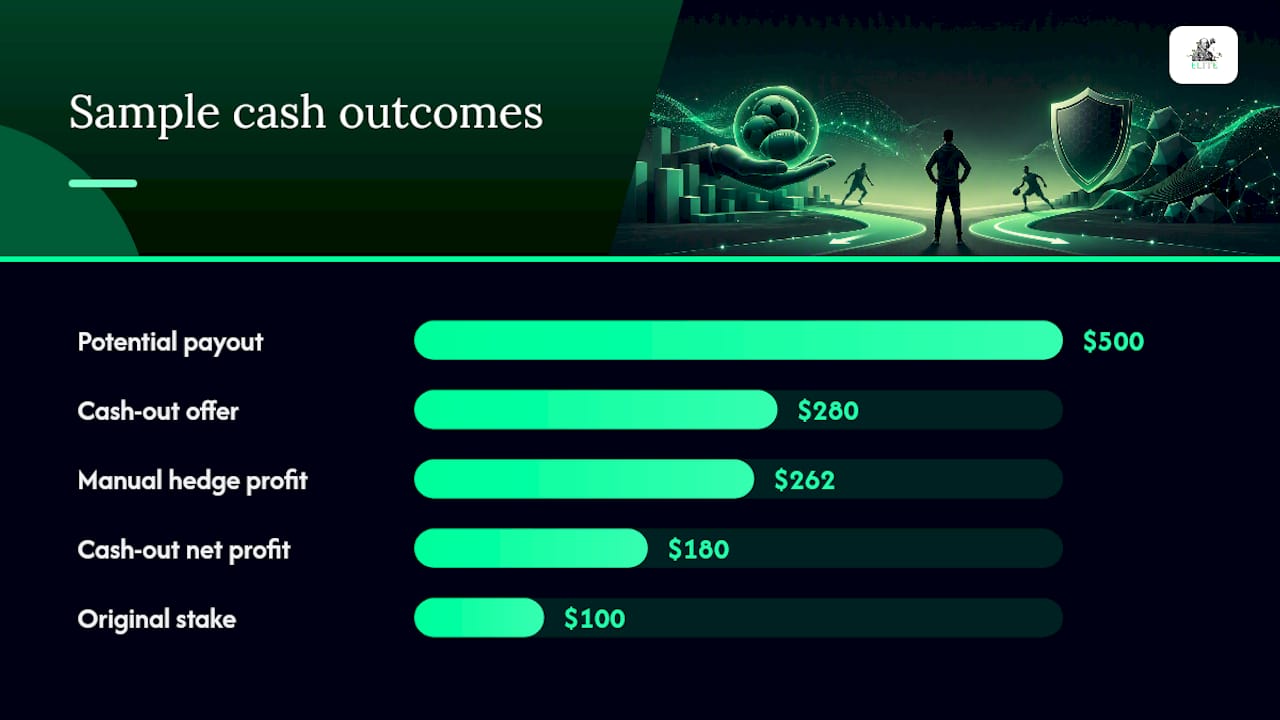
You placed a $100 bet on Team A to win the championship at +400 (potential payout: $500 including stake). Team A has reached the final. The bookmaker offers you a cash-out of $280.
Meanwhile, Team B (the opponent) is available at +110 on a second sportsbook.
Manual hedge calculation:
- Hedge stake on Team B = $500 ÷ (1 + 1.10) = $500 ÷ 2.10 ≈ $238
- If Team A wins: you collect $500, minus the $238 hedge stake = $262 net
- If Team B wins: you collect $238 × 2.10 = $500, minus the $238 stake = $262 net
- Guaranteed profit from manual hedge: $262
- Bookmaker cash-out offer: $280 (appears higher, but includes your original $100 stake return)
- Net profit from cash-out: $280 minus the $100 original stake = $180
The manual hedge locks $262 in net profit. The cash-out nets you $180. The gap is the hidden margin the book applied to the live line.
Pro Tip: Before touching the cash-out button, divide the offer by your potential payout. If that ratio is meaningfully below your estimated true win probability, the book is discounting you. Open a second tab and check the opposing odds first.
| Factor | Bookmaker cash-out | Manual hedge |
|---|---|---|
| Expected value | Lower (double margin) | Higher (single vig) |
| Guaranteed net profit | $180 (example above) | $262 (example above) |
| Speed of execution | Instant, one tap | Minutes, requires research |
| Access required | None beyond original book | Second sportsbook or exchange |
| Fees | Hidden in offer price | Exchange commission or book vig |
| Best for | Parlays, exotics, no hedge market | Singles, futures, liquid two-sided markets |
OddsJam’s practical guidance reinforces this: when an alternate market produces a better guaranteed return, hedge manually rather than pressing the cash-out button.
When to cash out, hedge, or hold: a decision framework you can use in real time
The right choice depends on four variables: ticket size relative to bankroll, market availability, bet type, and timing. Work through them in order.
Decision criteria, ranked by importance:
- Ticket size vs. bankroll. If the potential payout represents more than 10–15% of your total bankroll, the variance risk alone justifies locking in profit. Cash-out is acceptable here even at a discount. Holzhauer’s rule is direct: only hedge or cash out when the ticket has grown large enough to threaten your ability to keep betting.
- Hedge market availability. If a clean opposing market exists with reasonable odds and liquidity, run the hedge math first. If the manual hedge nets more guaranteed profit, take it.
- Bet type. Parlays and exotic tickets rarely have a clean two-sided market. Cash-out is often the only exit. Singles and futures almost always have a hedgeable opposing market.
- Timing and liquidity. In-play markets can suspend without warning. If you are watching a live game and the cash-out offer is on the screen while the opposing line is unavailable, speed beats precision.
One-line rules of thumb:
- Cash out when the ticket is large relative to bankroll and no hedge exists.
- Hedge manually when the math shows more guaranteed profit and you have the funds.
- Hold when neither option improves your position and the original bet still has positive EV.
- Never cash out purely because you are nervous. That is the book’s preferred outcome.
Pro Tip: Write down your hedge or cash-out threshold before the game starts. Deciding in advance removes the emotional pressure of watching a lead evaporate in real time. Reactive decisions almost always cost EV.
How to calculate your hedge stake: the formula and a step-by-step example
The standard hedge stake formula is:
Hedge Stake = Potential Payout ÷ (1 + Decimal Odds on Hedge)
Where Potential Payout is the total amount you would collect if your original bet wins (stake + profit), and Decimal Odds on Hedge is the decimal price available on the opposing outcome.
Step-by-step worked example:
- Original bet: $50 on Team X at +300 American odds. Potential payout = $200 (your $50 stake + $150 profit).
- Convert the hedge odds to decimal. Team Y is available at -150 American = 1.667 decimal.
- Apply the formula: Hedge Stake = $200 ÷ (1 + 0.667) = $200 ÷ 1.667 ≈ $120.
- If Team X wins: collect $200, subtract $120 hedge stake = $80 net profit.
- If Team Y wins: collect $120 × 1.667 = $200, subtract $120 hedge stake = $80 net profit.
- Guaranteed profit on both outcomes: $80.
In the example above, the $80 net profit on the winning hedge side becomes $80 × 0.95 = $76. Recalculate the stake slightly upward to equalize both sides if precision matters.
Before placing the hedge, verify:
- The opposing odds are still available and have not moved since you calculated.
- The sportsbook or exchange has not suspended the market.
- Your hedge stake does not exceed the book’s maximum stake limit.
- You have sufficient funds in the second account to cover the hedge.
- The net guaranteed profit after fees still beats the cash-out offer.
Pro Tip: Use the GamblingCalc hedge calculator to run both scenarios side by side in under 30 seconds. Paste in the cash-out offer and the opposing odds and it shows you which path guarantees more profit.
How parlays, futures, and in-play bets change the cash-out vs hedge calculus
Not every ticket has a clean two-sided market. That reality changes the decision significantly.
Parlays and exotic tickets are the clearest case for the cash-out button. A four-leg parlay has no single opposing market you can back to hedge all four outcomes simultaneously. You could theoretically hedge the final leg once the first three hit, and that is a legitimate strategy. But hedging mid-parlay requires you to be watching, have funds available, and find the right line at the right moment. For most bettors, the cash-out offer on a live parlay is the practical exit, even at a discount.

Futures bets are where strategic hedging shines. Say you backed a team to win the Super Bowl at +1200 in September. By January, they are in the conference championship and the odds have compressed to +200. You do not have to cash out or hedge the entire position. A partial hedge, backing the opposing team for a smaller stake, locks some profit while leaving upside if your original pick wins. Experienced bettors use futures as season-long positions and hedge selectively as the season narrows, rather than reacting to every swing.
In-play situations introduce a speed problem. Live lines can suspend mid-play, and the window to place a manual hedge may close before you finish calculating. If the cash-out offer is on screen and the opposing market has just suspended, taking the button is rational. The academic research on hedging frictions specifically flags liquidity limits as a real constraint, not a theoretical one. When speed is the variable, cash-out wins on execution even when it loses on price.
- Parlay: Cash-out is usually the only practical exit. Hedge the final leg only if you can execute quickly.
- Futures: Use partial hedges strategically as the season progresses, not reactively.
- In-play: If the opposing market is live and liquid, hedge manually. If it is suspended, take the cash-out.
The practical tools and pre-action checklist every bettor should use
Good execution requires the right tools and a quick check before you act. Skipping the checklist is how bettors leave money on the table.
Essential tools:
- Hedge calculator: GamblingCalc’s cash-out vs hedge tool compares both scenarios with one input set.
- Odds comparison site: OddsJam or a similar aggregator to find the best opposing odds across books.
- Betting exchange account: Gives you access to lay betting and often tighter prices than standard sportsbooks.
- Second sportsbook account: Required for manual hedges when no exchange is available. Stake is the recommended platform for US bettors wanting a reliable second book with competitive lines.
- Bankroll tracker: A simple spreadsheet or app to confirm you have funds available before committing to a hedge.
Pre-action checklist (run through this before every hedge or cash-out decision):
- Confirm the current cash-out offer and note the potential payout on your original ticket.
- Find the best available odds on the opposing outcome across at least two books.
- Calculate the required hedge stake using the formula above.
- Check that the opposing market is not suspended and that stake limits accommodate your hedge.
- Verify the commission or vig on the hedge side and recalculate net profit after fees.
- Compare net guaranteed profit from the manual hedge against the net from the cash-out offer.
- Confirm funds are available in the second account before you start.
For readers new to placing bets across multiple accounts, the Elite-bettings guide on how to place a sports bet walks through the mechanics step by step.
The Elite-bettings perspective on cash-outs and hedges in professional handicapping
At Elite-bettings, we treat hedging as a bankroll management tool, not a panic button. The decision to hedge or cash out should be written into your plan before the game starts, not improvised when the score gets tight. That discipline is what separates bettors who grow their bankroll from those who give it back to the house one cash-out at a time.
In practice, we advise clients to hedge manually when a clean market exists and the math confirms a better guaranteed return. We recommend the cash-out button only when the ticket has grown disproportionate to the bankroll or when no opposing market is available.
For bettors who want a reliable platform to place hedge bets or manage positions, Stake is the sportsbook we recommend. Competitive lines, fast settlement, and a clean interface make it a practical choice for the kind of multi-account setup that manual hedging requires.
Why Elite-bettings expert picks take the guesswork out of risk management 🎯
Managing cash-out and hedge decisions correctly requires real-time line access, a clear EV framework, and the discipline to follow the math under pressure. That is exactly what Elite-bettings delivers through its expert picks service.
 Alt text: Expert sports betting picks with cash out and hedge strategy guidance — Elite Bettings
Every pick is built on proprietary CLV (Closing Line Value) analysis, with fully documented results going back to 2016. No cherry-picked records. No hidden losses.
What you get with Elite-bettings picks:
- 📊 Picks backed by CLV analysis across NFL, NBA, NCAAF, NCAAB, and MLB
- 📁 Fully documented results with no selective reporting
- 💰 Money-back guarantee on qualifying packages
Ready to bet smarter? Access the expert picks now and put a proven, risk-managed system behind every wager.
Sources
- James Holzhauer on hedging bets and cashouts: Are they ever worth it?
- Cash-out vs. Hedging: Guaranteed Profit Comparison Tool
- Hedging on Betting Markets
- When Should You Cash Out a Bet? The Math vs. the Emotion
- When to Cash Out Sports Bets Early | OddsJam
FAQ
Is it worth it to cash out a bet?
Cashing out is worth it when the ticket has grown large relative to your bankroll or when no opposing market exists for a manual hedge. In most liquid markets, a manual hedge returns more guaranteed profit because the cash-out offer embeds the house margin twice.
What does cash-out mean in sports betting?
Cash-out is a bookmaker’s offer to settle your open bet early for a fixed amount, calculated from the current live line plus the book’s margin. Accepting it ends the bet immediately; you do not receive your original stake back separately, as the cash-out amount already accounts for it.
What is a hedge payout and how is it calculated?
A hedge payout is the guaranteed profit you lock on both sides of a hedged position. Calculate it using: Hedge Stake = Potential Payout ÷ (1 + Decimal Odds on Hedge). The resulting stake, placed on the opposing outcome, produces the same net profit whether your original bet wins or loses.
Do you get your stake back if you cash out?
No. The cash-out amount is the total settlement, which includes the return of your stake within the offer. You do not receive an additional stake refund on top of the cash-out figure.
When should you hedge instead of cashing out?
Hedge manually when a clean opposing market is available, you have the bankroll to fund the hedge stake, and the calculated net profit beats the cash-out offer after fees. As Holzhauer advises, the decision should be premeditated and bankroll-driven, not reactive.