 Skip to content


How to Verify Sports Picks Before You Trust or Pay for Them
The fastest reliable way to verify sports picks is to confirm three things at once: timestamped third-party tracking, transparent unit and ROI reporting, and consistently positive closing line value (CLV) across a large sample. Miss any one of those and you’re taking someone’s word for it.
Before you hand over money or place a bet based on someone else’s call, take these steps:
- Request the ledger link. Ask for a third-party verification page or tracker, not a folder of screenshots.
- Ask for the sample size. A legitimate record shows total picks tracked and results in units, not just dollars.
- Check for CLV data. A handicapper who tracks closing line value is showing you their actual edge, not just a hot streak.
Anything under 200 tracked picks should be treated as a small sample. It’s a start, not proof.
Key Takeaways
Verifying sports picks comes down to confirming timestamped third-party tracking, transparent unit and ROI reporting, and consistent positive CLV across a sample of at least 200 to 500 picks.
| Point | Details |
|---|---|
| Demand third-party proof | Look for a timestamped ledger on a platform like certify.gpwa.org or a synced tracker like Pikkit, not screenshots. |
| Require full sample size | Ask for 200 to 500-plus tracked picks with unit-based reporting, including losing months. |
| Track CLV, not just win rate | Consistent 1% to 2% positive CLV across hundreds of bets is the strongest signal of real skill. |
| Build your own record early | Start with a spreadsheet logging timestamp, line, stake in units, closing line, and outcome for every bet. |
| Elite Bettings publishes documented results | strong win rate and average ROI since 2016, with a free first pick to verify before paying. |
Table of Contents
- What to Check in a Handicapper’s Track Record
- Third-Party Verification: What It Actually Looks Like
- How Do You Measure CLV to Confirm Real Edge?
- How to Track Your Own Picks (Spreadsheet First)
- Red Flags Before You Pay for Picks
- 🏆 Elite Bettings’ Approach to Verified Picks
- Understanding Variance and Losing Streaks
- Reading Odds Movement as a Validity Check
- Are Sports Pick Contests and Leaderboards Legitimate?
- Short-Term Results vs. Long-Term Track Records
- Get Verified Picks Backed by Documented Results
- Sources
- FAQ
What to Check in a Handicapper’s Track Record
Screenshots prove nothing. Anyone can crop a winning ticket and ignore the ten losers sitting next to it. A real track record survives scrutiny because it’s built to be checked, not admired.
Here’s what to demand before you trust any sports handicapper’s record:
- Sample size of at least 200 to 500 tracked picks. Smaller samples are too noisy to separate skill from luck, according to the verification framework laid out by XCLSV’s handicapper guide.
- Unit-based reporting, not just dollar totals. Units normalize stake size across bets, so a service betting 1 unit on a favorite and 3 units on a high-confidence play shows you conviction, not confusion.
- Full monthly logs, including losing months. Any service that only publishes its best stretches is curating a highlight reel, not a track record.
- ROI calculated against total units risked, not against a cherry-picked subset of “featured” plays.
- A direct answer when you ask “can I see your full history?” Hesitation here is itself an answer.
Pro Tip: Ask a handicapper for their worst calendar month, not their best. How they answer tells you more about legitimacy than any highlight reel ever will.
Documented unit performance across hundreds of picks, spanning good stretches and bad ones, is the baseline. Anything less is marketing dressed up as data.
Third-Party Verification: What It Actually Looks Like
Third-party verification means a platform outside the handicapper’s own website is logging the pick, timestamping it, and making that history public and unalterable. That’s the difference between a claim and a receipt.
When you land on a verified ledger page, check for three things: a timestamp on every pick showing exactly when it was posted (before the game, not after), a history that can’t be edited retroactively, and public access so anyone can review it, not just paying subscribers. Listing services like Certify exist specifically to provide this kind of timestamped, tamper-resistant record.
Apps like Pikkit work differently but solve a similar problem. Pikkit syncs directly with sportsbook accounts and lets bettors follow and share verified results, which creates a persistent record that’s harder to fake than a manually updated spreadsheet.
A quick benchmark: the strongest verification checklist combines sample size, unit tracking, CLV, third-party confirmation, and visible losing months. Skip any one pillar and you’re trusting an incomplete picture.
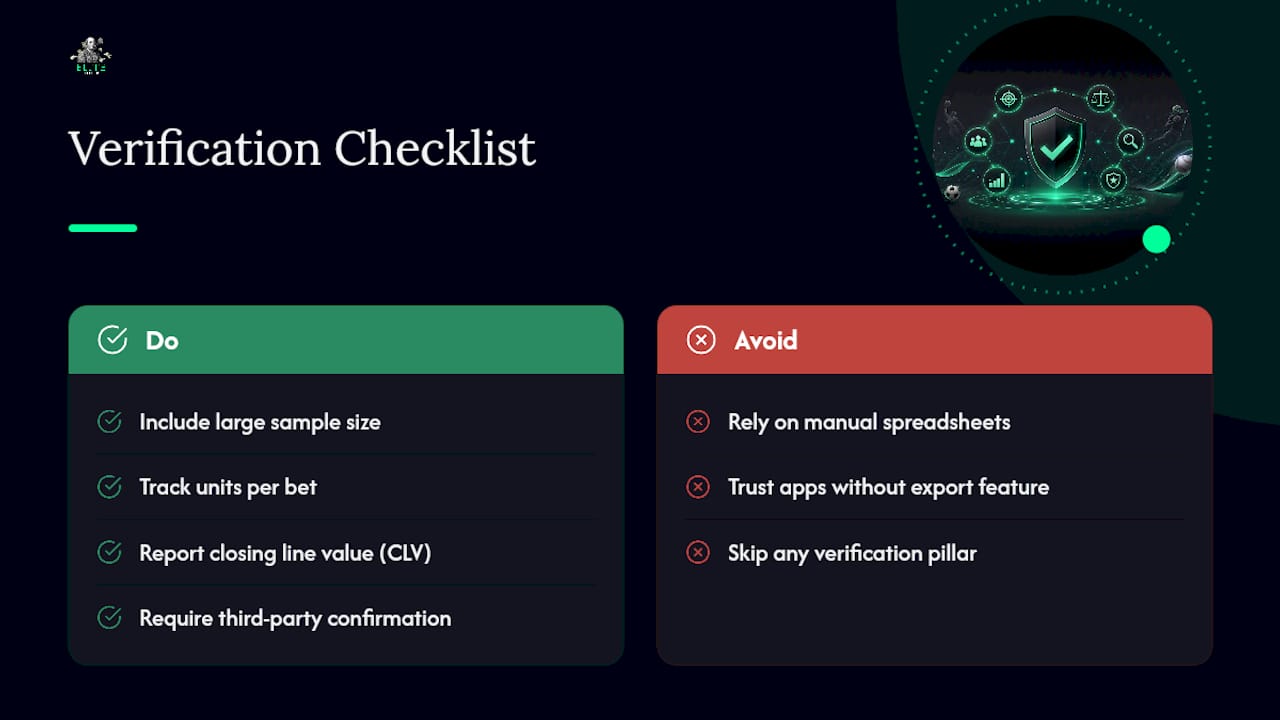
One caveat worth flagging: not every app that lists picks or scores is built for audit-grade proof. Mainstream apps on the Apple App Store and Google Play vary widely in whether they let you export timestamped data, so check that feature before treating any app’s numbers as gospel.
How Do You Measure CLV to Confirm Real Edge?
Closing line value is the gap between the odds you (or a handicapper) got when a bet was placed and the final closing line right before the game starts. It’s widely considered the single strongest predictor of long-term betting skill, stronger than win rate, according to CalcMyBets’ CLV guide.
Here’s why it works: closing lines represent the market’s best guess after absorbing all available money and information. If a handicapper consistently beats that number, they’re identifying value the market hasn’t priced in yet, before the crowd catches up.
To track it yourself:
- Record the exact line and odds at the moment a pick is placed.
- Compare it against the closing line at kickoff or tip off, using the line from a sharp, high-volume book.
- Calculate the percentage difference to get your CLV for that bet.
- Average CLV across your full sample, not just a handful of favorable results.
A single lucky week means nothing. A pattern across 300 picks means something.
CLV strips out the noise and shows whether someone is actually beating the market.
How to Track Your Own Picks (Spreadsheet First)
You don’t need software to start building a record that holds up to scrutiny. You need discipline and the right fields.
- Open a spreadsheet before you place another bet. Google Sheets or Excel works fine, and Sports Command’s tracking guide recommends starting here before jumping to any app.
- Record these fields for every single bet: timestamp, sport, market (spread, total, moneyline, prop), sportsbook, line at placement, stake in units, closing line, final outcome, and a notes field for context.
- Move to an app only if it exports data. If a tracking app won’t let you download your full history as a CSV or spreadsheet, you don’t actually own your record. Exportability should be a hard requirement, not a nice-to-have.
- Keep your sportsbook receipts as backup, not as your primary record. They confirm a bet happened, but they don’t track CLV, units, or trends over time on their own.
- Review weekly and monthly. Calculate units won or lost, ROI, and average CLV at both intervals so you catch drift in your results early instead of six months too late.
Pro Tip: Build your spreadsheet with a running CLV column from day one. Retrofitting it later means digging through months of historical lines you probably didn’t save.
Red Flags Before You Pay for Picks
Some warning signs show up before you ever place a bet on someone’s advice, and they’re worth memorizing.
- Screenshots as the only proof offered. Real records live on trackers or verified pages, not in a highlights folder.
- Vague or missing sample size. “Hundreds of winning picks” without a number attached is a dodge.
- Evasive answers about CLV or units. If a service can’t or won’t explain how they report results, that’s the answer.
- Guaranteed profits or “can’t lose” language. No legitimate handicapper promises certainty in a business built on probability.
- No visible losing streaks. A record with zero rough patches over a real sample size isn’t a track record, it’s a highlight reel.
Ask directly: “Can I see your full unit-based log, including losing months, and your CLV data?” A confident, specific answer is a green light. A pivot to testimonials or urgency (“only 3 spots left”) is your signal to walk away or ask for a trial period before committing money.
🏆 Elite Bettings’ Approach to Verified Picks
We built Elite Bettings around one principle: if you can’t inspect it, don’t trust it. Every pick we release gets logged with unit-based staking, tracked CLV, and full documentation, including the months that didn’t go our way.
Since 2016, we’ve published a substantial number of tracked picks across NFL, NBA, NCAAF, NCAAB, and MLB, with a documented strong win rate and average ROI that include both good and bad stretches. Those aren’t cherry-picked numbers. They include the cold stretches along with the hot ones, because that’s what a real record looks like.
Verification only means something if the losing months are just as visible as the winning ones. That’s the standard we hold ourselves to.
How to verify it yourself:
- Check how access and reporting work through our how-to-access guide.
- Compare our unit reporting against the checklist in this article before you commit a dollar.
🎯 Try Your First Pick FREE, No Risk to Verify Our Work
You don’t have to take our word for it. Claim your first pick FREE and see our documented CLV and unit tracking in action before you ever pay for a subscription. Head to our Expert Picks page to get started.
For placing bets once you’ve verified a pick, we recommend Stake as the strongest sportsbook option. You can join Stake here to get set up.
Understanding Variance and Losing Streaks
Even a genuinely skilled handicapper will hit losing streaks. Variance is built into sports betting, and a bettor who doesn’t understand that will misjudge a legitimate service as a scam, or worse, mistake a lucky streak for real skill.
Here’s the math reality: a handicapper hitting 55% of bets at standard odds will still lose five, six, even eight bets in a row somewhere across a large enough sample, purely by chance. That’s not a red flag. It’s statistics. The question isn’t “did they lose last week?” It’s “what does their full sample, including that losing week, look like over 300 or 500 picks?”
This is exactly why sample size and full transparency matter more than any single week’s results. A service that hides losing streaks is telling you they don’t trust their own long-term numbers. A service that shows you a rough month right next to a great one is showing you confidence in the underlying process.
The practical takeaway: don’t judge legitimacy off short-term results in either direction. A hot two weeks doesn’t prove skill any more than a cold two weeks proves a scam. Pull the full record, calculate units and CLV across the entire tracked history, and let the larger sample settle the question. Anyone asking you to judge them off last Sunday’s slate isn’t giving you enough information to make a real decision.
Reading Odds Movement as a Validity Check
Line movement tells you something screenshots never will: whether the market agrees with a pick after it’s been made public.
When a line moves toward a pick after it’s released, that’s often a signal that sharp money or informed action is following the same side. It doesn’t prove the pick will win, but it suggests the reasoning behind it holds up under scrutiny from people risking their own money. When a line moves against a published pick, or doesn’t move at all despite volume, that’s worth noting too.
This is where CLV and odds movement connect directly. If a handicapper consistently releases picks before lines move in their favor, and their documented CLV backs that up across hundreds of bets, you’re looking at a real, tracked signal of edge. If a service claims great instincts but their picks never seem to move the market and their CLV numbers are absent or negative, the “insight” they’re selling isn’t showing up anywhere except their own marketing.
One caution: don’t over-read a single game’s line movement. Injury news, weather, or a lopsided public betting split can move a line for reasons that have nothing to do with pick quality. The pattern across many picks, not any single line move, is what actually validates a track record.
Are Sports Pick Contests and Leaderboards Legitimate?
Pick 'em contests and leaderboard competitions are everywhere, and they deserve the same scrutiny as any paid handicapper, maybe more, because the incentive structure is different.
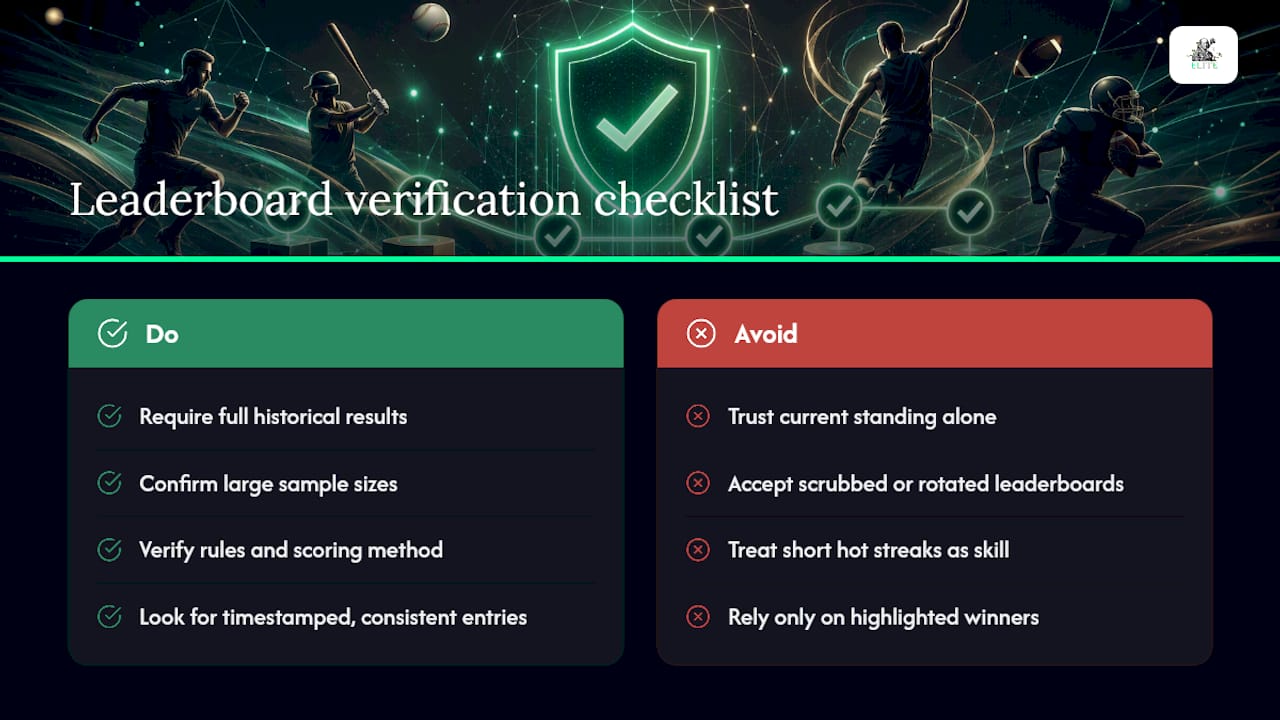
A contest leaderboard rewards short-term variance. Someone can go on a hot two-week run through pure luck and land at the top of a public leaderboard, then quietly disappear once the sample grows. That’s not evidence of a repeatable edge. Before trusting a leaderboard-topping “expert,” check whether the contest publishes full historical results for that person, not just their current standing, and whether the sample size behind their placement is large enough to mean anything.
Legitimate contests and competitions are transparent about rules, scoring methodology, and historical results for every participant, not just whoever’s currently winning. If a contest only highlights top performers from the current period and scrubs old leaderboards once a season ends, you have no way to check whether last year’s “champion” backed it up over time.
The same verification triad applies here as anywhere else: look for timestamped entries, unit or point based scoring that’s consistent across the field, and a visible history that includes bad weeks for every entrant, not just the current leader. A contest that can’t or won’t show you that history isn’t offering proof of skill. It’s offering a snapshot that happened to look good on the day you checked.
Short-Term Results vs. Long-Term Track Records
A hot week and a real track record are not the same thing, and confusing the two is probably the single most common mistake bettors make when evaluating picks.
Short-term performance, anything under roughly 100 picks, is dominated by variance. Two services with genuinely identical long-term skill can show wildly different results over a single month simply due to random distribution of outcomes. Judging a handicapper off 20 or 30 picks tells you almost nothing reliable about whether they’ll be profitable over the next 500.
Long-term evaluation, once you’re looking at 300 to 500-plus tracked picks, starts to separate real skill from noise. At that scale, consistent positive CLV and stable unit-based ROI are much harder to fake or stumble into by accident. This is also where full transparency, including the inevitable rough patches, becomes non-negotiable, because no legitimate long-term record is a straight line up and to the right.
The practical rule: weight short-term results as a directional signal at best, never as proof. Weight the long-term, full-sample record, including losing months and CLV trends over time, as your actual basis for a decision. If a service or a bettor you’re evaluating can only offer you the short-term view, that’s telling you something on its own.
Why verification matters more than confidence
Confidence is easy to fake. A documented, inspectable record isn’t. Elite Bettings publishes full unit and CLV history because we believe that’s the only standard worth holding ourselves to, and we’d ask any bettor to demand the same proof from anyone else before paying for picks.
Get Verified Picks Backed by Documented Results
Most handicapping services ask you to trust their word. Elite Bettings asks you to check our work first. Every pick we release is logged with unit tracking, tracked CLV, and a full public history, wins and losses both, going back to 2016.
You don’t have to guess whether we’re legitimate. Compare our documented win rate and average ROI across many tracked picks against the checklist in this article, then decide for yourself. Better yet, start with your first pick completely FREE 🎯 and see the verification process firsthand before spending a dollar.
Ready to see it for yourself? Visit our Expert Picks page to claim your free pick and review our full track record. If you’re new to placing bets once you’ve verified a pick, our step-by-step betting guide walks you through the process, and we recommend Stake as the sportsbook to pair with your picks.
Sources
- Pikkit | Sports Bet Tracker
- How to Verify a Sports Handicapper’s Track Record in 2026: The Bettor’s Complete Guide - XCLSV
FAQ
What’s the fastest way to check if a sports handicapper is legitimate?
Look for a third-party timestamped record, unit-based reporting over at least 200 to 500 picks, and documented positive CLV. If a service can’t produce all three, treat their claims with skepticism.
Is there a free tool to verify player prop picks or track results?
Spreadsheets remain the most flexible free option for tracking your own results, and apps like Pikkit offer free tiers for syncing and tracking sportsbook bets. Neither replaces checking a handicapper’s own third-party verified history.
What is the best pick finder or prediction tool?
No single tool guarantees accuracy. The most reliable approach combines a verified, documented track record like Elite Bettings’ unit and CLV based reporting with your own tracking to confirm results over time.
How do I verify my identity on a sportsbook like PrizePicks?
Identity verification on daily fantasy and betting platforms typically requires submitting a government ID and matching personal details through the app’s account settings, following each platform’s own verification flow.
Why does CLV matter more than win rate when judging a handicapper?
Win rate can look strong while a bettor still loses money at bad prices. CLV measures whether picks consistently beat the closing line, which is a more reliable indicator of long-term edge, according to CalcMyBets’ CLV guide.