 Skip to content


How to Use Multiple Sportsbooks to Maximize Your Betting ROI
Yes, a disciplined multiple sportsbooks strategy is the single most reliable way to permanently improve your long-term ROI. Open 3–5 funded accounts, line-shop every wager with an odds aggregator, and track Closing Line Value (CLV) on every bet. That’s the whole system. Everything below shows you exactly how to run it.
Here’s your immediate action checklist:
- ✅ Open several verified, funded sportsbook accounts (FanDuel, DraftKings, BetMGM, Caesars, and BetRivers are solid starting points)
- ✅ Install an odds aggregator: OddsJam, OddsChecker, or Action Network
- ✅ Decide which book handles your main volume and which ones you use for price capture
- ✅ Line-shop every single bet before placing it, no exceptions
- ✅ Log each wager with the line taken, the closing line, and your result to track CLV over time
- ✅ Pair expert picks from a service like Elite-bettings with your shopping routine to combine precision with best-price execution
The rest of this guide walks through each step in detail, including arbitrage basics, account protection, and a daily routine you can run in under five minutes per bet.
Key Takeaways
A disciplined multiple sportsbooks strategy — combining 3–5 funded accounts, an odds aggregator, CLV tracking, and expert picks — is the most reliable structural edge available to any sports bettor.
| Point | Details |
|---|---|
| Open 3–5 accounts | FanDuel, DraftKings, BetMGM, Caesars, and BetRivers cover price, promos, and redundancy. |
| Line-shop every bet | Moving from -110 to -105 on average produces a free 1–2% edge across a large sample. |
| Track CLV religiously | Positive CLV on 500+ bets predicts long-term profitability better than win rate alone. |
| Protect your accounts | Vary bet sizes and spread volume to delay restrictions and preserve high-limit access. |
| Use Elite-bettings picks | A 73% win rate and 24% average ROI since 2016 pairs directly with your shopping routine for maximum edge. |
Table of Contents
- Why a multiple sportsbooks strategy pays off
- How many sportsbook accounts should you open?
- A repeatable pre-wager routine to line-shop every bet 🔄
- Which odds-comparison tools save you the most time? 🛠️
- Arbitrage and middling: the math, the money, and the real risks ⚡
- Why sportsbooks limit winning bettors and what to do about it
- Bankroll management and tracking Closing Line Value 📊
- Common mistakes bettors make with multiple sportsbooks ❌
- How to combine Elite-bettings’ expert picks with your multi-book workflow 🏆
- Elite-bettings: expert picks built for the multi-book bettor
- Sources
- FAQ
Why a multiple sportsbooks strategy pays off
The math is simple, and it compounds fast. Every sportsbook builds a margin (the “vig” or “juice”) into its lines. A standard -110 market requires you to win just over half of bets to break even. Moving that average to -105 lowers your break-even rate and produces a free edge of roughly 1–2% across a large sample of bets. That’s not a rounding error — over 500 wagers, a 1.5% edge is the difference between a losing year and a profitable one.
Line shopping — checking the same bet across several books and placing it at the best number — is the most reliable habit any bettor can build. Small juice differences compound across hundreds of bets in ways that dwarf most handicapping edges. According to Sporting News, signing up at multiple sportsbooks also lets you capture more promotions, manage risk by spreading volume, and stay in action if one book restricts your account.
Three concrete benefits stand out:
- Price capture: Props and player markets frequently differ by half-points or several cents of juice across books. NFL key numbers (3, 7, 10) make those half-points especially valuable.
- Promotion stacking: Welcome bonuses, reload offers, and odds boosts are one-time or limited events. Multiple accounts mean more opportunities to capture them without sacrificing price.
- Account redundancy: If FanDuel limits your max bet, you still have DraftKings, BetMGM, and Caesars running at full capacity. One restriction doesn’t derail your whole operation.
Pro Tip: When a promotion forces you to take a worse price, skip it. A -115 line with a bonus is often worse than a clean -105 line without one. Price beats promotion almost every time.
CBS Sports’ betting strategy guidance reinforces this: knowing what you’re betting on and shopping lines consistently are two of the most important disciplines a bettor can develop. Check out comparing betting strategies for a deeper look at how professional bettors layer these methods.
How many sportsbook accounts should you open?
Opening multiple funded and verified accounts is the practical sweet spot. Too few limits price variation; too many can be operationally messy.
Here’s a priority framework for choosing which books to open first:
Step-by-step onboarding checklist:
- Choose your core five: FanDuel and DraftKings for market depth and liquidity; BetMGM and Caesars for promos and rewards programs; BetRivers or PointsBet for sharper lines on certain markets and state availability.
- Complete identity verification immediately: Upload your government ID and proof of address on day one. Delays here mean you miss time-sensitive lines and promos.
- Fund each account strategically: Don’t dump your entire bankroll into one book. Spread it across accounts so you always have capital where the best price lives.
- Download every app and enable push notifications: Line movement happens fast, especially in the hour before kickoff.
- Claim welcome bonuses in order of value: Read the playthrough requirements before depositing. A $1,000 deposit match with a 10x rollover is often worse than a $200 no-sweat bet with a 1x rollover.
For a full breakdown of which books tend to post the sharpest numbers, the best sportsbook guide at Elite-bettings is worth bookmarking.
Which book for which purpose:
- FanDuel: Best app UX, fastest live betting interface, strong same-game parlay market
- DraftKings: Deep prop coverage, consistent odds on major markets, solid loyalty program
- BetMGM: Frequent odds boosts and reload promos, good for recreational-style plays
- Caesars: Rewards program with real-world value, competitive spreads on NFL and NBA
- BetRivers / PointsBet: Often post sharper lines earlier, useful for CLV-focused bettors
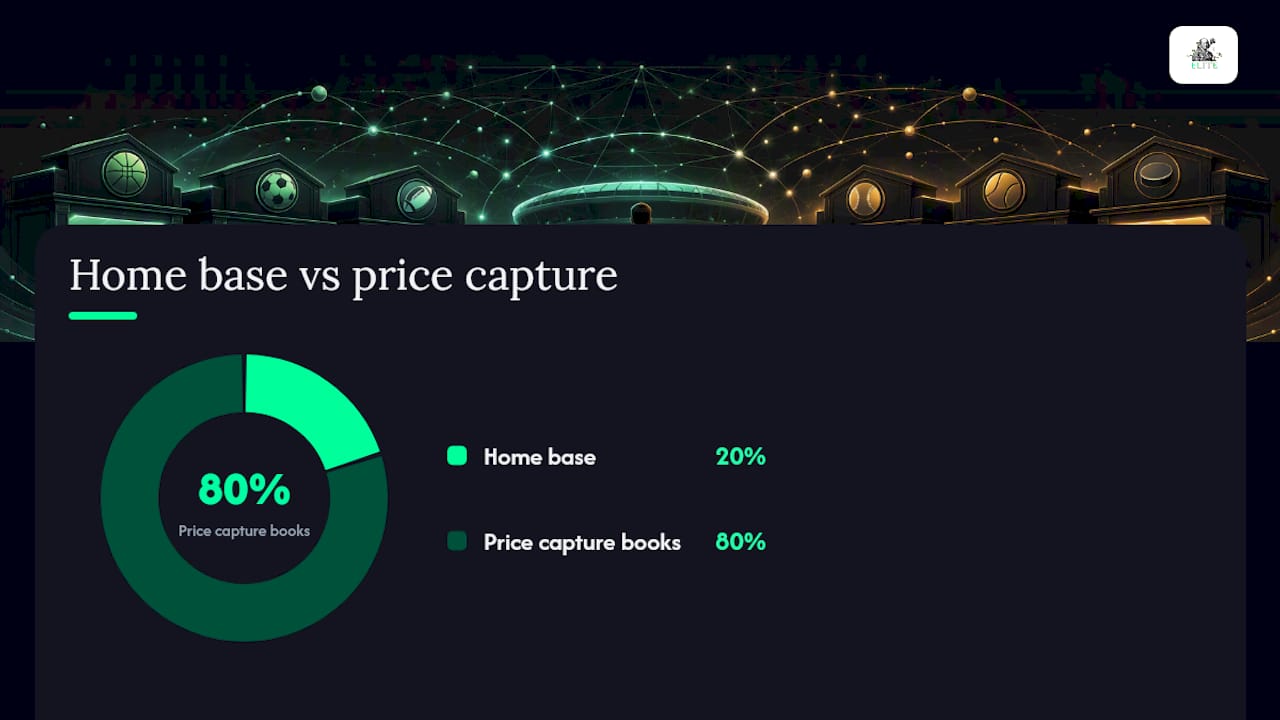
Pro Tip: Pick one book as your “home base” for live streaming and mobile convenience. Use the other four purely for price capture and promo value. Mixing those two roles in one book leads to lazy shopping habits.
New to placing bets? The how to place a sports bet guide at Elite-bettings covers the mechanics from deposit to confirmation.
A repeatable pre-wager routine to line-shop every bet 🔄
The goal is a routine you can run in under five minutes before every wager. Here’s the exact sequence:
- Identify your bet criteria first. Before opening any app, know the market (spread, total, prop), the side you want, and your maximum acceptable juice. This prevents you from getting anchored to the first number you see.
- Open your odds aggregator. Pull up OddsJam, OddsChecker, or Action Network and search the market. You’ll see every available price in one view.
- Note the best price and which book offers it. Also note the second-best. If the gap is more than five cents of juice or a half-point on the spread, the decision is obvious.
- Check for active promotions at the top-priced book. If a promo applies without worsening the price, use it. If it forces a worse number, ignore it.
- Confirm bet limits. Some books cap prop bets at $500. If your intended stake exceeds the limit, split it across two books at comparable prices.
- Place the bet and log it immediately: market, line taken, book used, stake, and the current best available closing-line estimate.
Timing matters. For NFL spreads, the sharpest prices often appear Sunday morning, 2–3 hours before kickoff, when books have adjusted to early sharp action. For props, lines are frequently softer on Monday and Tuesday when books first post them. Tracking CLV means you need to know not just what price you got, but whether the market moved toward or away from you by game time.
Worked example: A Chiefs-Bills spread is posted at Kansas City -3 (-110) at FanDuel and Kansas City -3 (-105) at BetRivers. On a $110 wager, the -110 line requires a $110 risk to win $100. The -105 line requires only $105 to win $100. Over 100 identical bets at that five-cent difference, you save $500 in juice — a meaningful edge that accumulates without winning a single extra game.
Pre-bet confirmation checklist:
- ✅ Best available odds confirmed across at least three books
- ✅ Stake within the book’s posted limit for this market
- ✅ No active promo forces a worse price
- ✅ Cashout rules reviewed if you plan to use that feature
- ✅ Bet logged in your tracking sheet before you click confirm
Which odds-comparison tools save you the most time? 🛠️
Odds aggregators point you to the best price in seconds, but they don’t replace having funded accounts at the books they reference. The tool shows the opportunity; your accounts capture it.
Here’s how the three major tools compare across the dimensions that matter most:
| Tool | Best for | Odds coverage | Promo visibility | Speed | Cost |
|---|---|---|---|---|---|
| OddsJam | Arb hunting, CLV tracking, props | Widest US market coverage | Yes (bonus tracker) | Fast, real-time | Paid subscription |
| OddsChecker | Quick line comparisons, casual shoppers | Strong on major markets | Limited | Very fast | Free |
| Action Network | Game analysis + odds in one place | Good on NFL/NBA/MLB | Partial | Fast | Free + paid tier |
OddsJam’s subscription tier is worth the cost if you bet more than 10–15 times per week. Its real-time arbitrage alerts and CLV tracking tools alone can justify the monthly fee. OddsChecker is the fastest free option for a quick pre-bet scan. Action Network adds editorial context alongside the odds, which helps when you want to understand why a line moved before deciding whether to chase it.
How to configure each tool for maximum efficiency:
- Set market filters to your active bet types (spreads, totals, or props only — not all three at once)
- Create watchlists for the sports and leagues you bet most
- Enable price-alert notifications for markets where you have a pending decision
- On OddsJam, configure the arbitrage scanner to show only plays where you have accounts at both books
Pro Tip: Build two saved screens in your aggregator: one for pregame markets (sorted by best spread/total price) and one for live in-play watches (sorted by fastest-moving lines). Switching between them takes three seconds and keeps you from missing a window.
Arbitrage and middling: the math, the money, and the real risks ⚡
Arbitrage means placing bets on all outcomes of the same event at different books so that you profit regardless of the result. A middle means betting both sides of a spread at different numbers, hoping the final score lands between them for a double win.

Simple two-way arbitrage example:
That gap below 100% is the arb. To calculate stakes on a $1,000 total bankroll:
- Stake on Team A: $1,000 × (47.6 / 96.4) = $494
- Stake on Team B: $1,000 × (48.8 / 96.4) = $506
- Guaranteed profit: approximately $19 regardless of outcome
Middling example (NFL spread):
You bet the Chiefs -2.5 (-110) at FanDuel early in the week. By Sunday, BetRivers posts Bills +3.5 (-110). You bet the Bills +3.5. If Kansas City wins by exactly 3, both bets win. If the score falls outside that window, one bet wins and one loses — roughly a push. The risk is small; the upside is a double win.
Before executing any arb or middle, capture these inputs:
| Input | Why it matters |
|---|---|
| Odds at Book A | Determines implied probability and stake split |
| Odds at Book B | Completes the probability calculation |
| Combined implied probability | Must be below 100% for a true arb |
| Stake split | Calculated from implied probabilities |
| Required bankroll | Total capital needed across both books |
| Bet limits at each book | A capped limit at one book breaks the math |
Risk checklist — read this before every arb attempt:
- ⚠️ Books can void bets if they detect a pricing error (known as a “palpable error” clause)
- ⚠️ Consistent arb betting is the fastest way to trigger account restrictions
- ⚠️ Execution timing risk: odds move in the seconds between placing bet one and bet two
- ⚠️ Promotional terms sometimes exclude arb-style plays from bonus eligibility
- ⚠️ Limits at one book may force an unbalanced stake that kills the guaranteed profit
For a deeper breakdown of stake-splitting mechanics and US-specific execution tips, the arbitrage sports betting guide at Elite-bettings covers the full process.
Pro Tip: Arb hunting is a short-term edge. Books identify consistent arbers quickly and limit them. Use arb plays selectively — when the opportunity is large and the books involved are ones you don’t rely on for volume.
Why sportsbooks limit winning bettors and what to do about it
Books are businesses. When a bettor consistently beats their lines, the book’s margin shrinks. The response is predictable: reduced max bet sizes, slower limit increases, or outright account closure. Understanding what triggers this protects your access.
Behaviors that accelerate restrictions:
- Betting maximum limits on soft lines immediately after they open
- Consistently placing bets that close at better prices than you took (high positive CLV)
- Depositing, betting, and withdrawing in patterns that look purely transactional
- Targeting the same markets repeatedly at the same book with the same bet size
Mitigation tactics:
- Vary your bet sizes. A bettor who always bets exactly $110 looks algorithmic. Mix in $75, $130, and $95 wagers on the same markets.
- Place occasional recreational-style bets (small parlays, futures) at books where you’re most active. This signals a broader betting profile.
- Spread your volume across all five books rather than concentrating it at the one with the best line.
- Use books with higher limits (BetMGM, Caesars, FanDuel) for your larger wagers and save the sharper books (BetRivers, PointsBet) for price capture on smaller stakes.
If a book restricts you:
- Document your account history: screenshots of bet history, limits, and any communication from the book.
- Contact customer support and ask politely whether the limit is permanent or temporary. Some limits lift after a losing stretch.
- Redeploy that book’s bankroll to your remaining accounts. A restriction at one book is exactly why you built a five-account operation.
- Don’t close the account. A restricted account still has value for promotions, small wagers, and future limit reviews.
Red flags that a restriction is coming:
- Your max bet on a specific market drops without explanation
- The book starts requiring manual review on bets above a certain size
- Odds boosts and promotions stop appearing in your account
Pro Tip: Think of your sportsbook accounts as assets with a lifespan. Manage them carefully — don’t burn a high-limit account chasing a single arb play. The long-term access is worth more than the short-term profit.
Bankroll management and tracking Closing Line Value 📊
CLV is the most honest measure of whether your betting process is working. If you consistently get better prices than where the market closes, you’re making good decisions — even in losing stretches. If you’re consistently on the wrong side of line movement, the process needs fixing regardless of your win rate.
Your tracking spreadsheet should include these columns:
| Column | What to record |
|---|---|
| Date | Game date |
| Market | Spread / total / prop and the specific line |
| Line taken | The odds you got |
| Closing line | The final price at the book before game time |
| CLV | Line taken minus closing line (positive = you beat the close) |
| Stake | Dollar amount wagered |
| Result | Win / loss / push |
| ROI | Result divided by stake |
Example rows:
Beating the close by 7–8 cents consistently is a strong signal. Over 500 bets, that kind of positive CLV correlates directly with long-term profitability — even if short-term variance produces losing weeks.
Bankroll rules to follow:
- Size each bet at 1–3% of your total bankroll (one unit = 1%)
- Never exceed 5% exposure on a single game across all books combined
- When a book limits your max bet below your standard unit size, reduce your stake at that book rather than chasing the full unit elsewhere at a worse price
- Review your CLV numbers monthly. If your average CLV turns negative over 100+ bets, your shopping routine or timing needs adjustment
The sports betting trends guide at Elite-bettings covers how risk management has evolved and why CLV tracking is now a baseline expectation for serious bettors.
Common mistakes bettors make with multiple sportsbooks ❌
Most of the value from a multi-book operation gets left on the table through a handful of repeatable errors.
The biggest ones:
- Loyalty to one book. Betting exclusively at FanDuel because the app is clean costs you real money every week. The best price wins long term, and loyalty to a single book is the fastest way to donate your edge back to the house.
- Chasing promos at the cost of price. A $50 odds boost that forces you to take -130 instead of -105 is a net loss. Always calculate the effective price after the promotion before deciding it’s worth it.
- Skipping CLV tracking. Without a record of your closing line performance, you have no way to know whether your shopping routine is working. Gut feel is not a substitute for data.
- Opening too many accounts before mastering the basics. Seven accounts with no system is worse than three accounts with a clear routine. Build the habit at 3–5 books before expanding.
- Ignoring props. Player props are often the softest markets across books, with the largest price discrepancies. A bettor who only shops spreads and totals is missing the highest-variance opportunity for line-shopping gains.
Consistent line-shopping, as CBS Sports notes, is one of the most important disciplines a bettor can develop — and it’s the one most casual bettors skip entirely.
How to combine Elite-bettings’ expert picks with your multi-book workflow 🏆
Expert picks and line-shopping are not competing approaches. They’re complementary. A pick tells you what to bet; your multi-book routine determines where to bet it and at what price. Combining both is how you protect and amplify the edge.
Operational checklist for using a pick with your shopping routine:
- ✅ Receive the pick and note the recommended side and market
- ✅ Open your odds aggregator and find the best available price across your books
- ✅ Check whether any active promo at the top-priced book applies without worsening the number
- ✅ Confirm the stake based on your unit-sizing rules (not the pick provider’s suggested amount)
- ✅ Place the bet at the best available price and log it immediately
Timing is critical. Expert picks often carry the most value when acted on quickly, before the market adjusts. A pick released at -105 that moves to -115 by game time still wins at the same rate — but your ROI drops because you paid more for the same outcome. Shopping fast and logging CLV on every pick tells you exactly how much edge you’re preserving.
📊 Elite-bettings’ documented performance: Elite-bettings has tracked a 73% win rate and an average ROI of 24% across more than 1,500 picks since 2016, covering NFL, NBA, NCAAF, NCAAB, and MLB. Every result is documented — no selective record-keeping.
Pro Tip: Use your aggregator to check whether the pick’s recommended line is still available or has already moved. If the line has moved more than five cents against you, reassess whether the play still carries value at the current price.
Pair those picks with your line-shopping routine and you’re not just getting a good call — you’re getting the best available price on a good call. That combination is what separates recreational bettors from profitable ones.
👉 Access Elite-bettings’ expert picks here and start combining precision handicapping with your multi-book workflow today.
Where the multi-book strategy returns the most value
The honest answer is that a multi-book approach doesn’t help equally across all bet types. Spreads on major markets (NFL, NBA) are usually priced within a few cents of each other across the big books. The real opportunity lives in three places: player props, NFL key numbers, and same-game parlays where individual leg pricing varies widely.
Props are where books are most inconsistent. A wide receiver’s receiving yards total might be 64.5 at DraftKings and 67.5 at BetMGM — that’s not a juice difference, that’s a different bet. Shopping props isn’t just about saving a few cents; it’s about finding a materially better number. That’s where the line-shopping edge is largest and where disciplined bettors pull the most value.
Realistic expectations matter here. That’s not a get-rich-fast number — it’s a structural edge that compounds quietly over hundreds of bets. The bettors who combine that with quality picks and disciplined bankroll management are the ones who show up profitable at year-end.
Record-keeping is non-negotiable. Without it, you’re flying blind — and no amount of shopping discipline can compensate for not knowing whether your process is working. Keep the spreadsheet, review it monthly, and let the CLV numbers tell you the truth.
Elite-bettings: expert picks built for the multi-book bettor
Every result is on record. No cherry-picked wins, no hidden losses. The picks are built around CLV analysis, which means they’re designed to be placed at the best available price — exactly what your multi-book routine is set up to capture.
For bettors who want to start with a trusted sportsbook, Stake is the preferred sign-up option. It offers competitive lines, a clean interface, and broad market coverage that pairs well with a line-shopping workflow.
Every Elite-bettings pick comes with a money-back guarantee. You get expert-level handicapping without the guesswork, and your multi-book setup handles the execution.
👉 Get your expert picks now and put your multi-book routine to work on picks that are built to beat the close.
Sources
Odds aggregators and line-shopping guides:
- Line Shopping: The Free 1-2% Edge Most Bettors Skip
- Line Shopping Guide: Why the Best Price Wins Long Term - Compare n’ Bet
Responsible gambling resources:
Betting should be approached as a disciplined, data-driven activity. If gambling is affecting your finances, relationships, or mental health, contact the NCPG helpline at 1-800-522-4700.
FAQ
Is it legal to have accounts at multiple sportsbooks?
Yes, in every US state where sports betting is legally licensed, there is no restriction on holding accounts at multiple licensed operators simultaneously. Confirm that each book holds a valid license in your state before depositing.
How does line shopping actually improve your win rate?
It doesn’t change how often you win — it changes how much you earn when you do. Getting -105 instead of -110 consistently lowers your break-even threshold, so the same win rate produces a higher ROI over time.
Are multi-bets (parlays) worth shopping across books?
Yes, and often more so than single-game bets. Individual leg pricing varies across books, and a small difference on each leg compounds into a meaningful difference in the parlay payout. Always build parlays at the book offering the best individual leg prices, or split legs across books where the platform allows.
What is the 1% rule in gambling?
It limits downside during losing streaks and keeps you in action long enough for your edge to materialize across a large sample.
Who has the best documented track record for sports picks?
Access the picks here.