 Skip to content


Futures Betting Strategy: Win More in 2026

Table of Contents
- What is futures betting and how does it work?
- Popular futures bet types across major US sports leagues
- Key strategies for successful futures betting
- Optimal timing: when should you place futures bets?
- Hedging futures bets: techniques and rationale
- Benefits, risks, and payout timing of futures bets
- Elite-bettings’ proven expertise in futures betting
- Why Elite-bettings is the right call for serious futures bettors
- FAQ
- Key Takeaways
What is futures betting and how does it work?
Futures betting is a long-term wager on an outcome that won’t be decided for weeks or months, like which team wins the Super Bowl, who takes the NBA MVP, or which pitcher leads the league in strikeouts. Unlike a single-game bet that settles Sunday night, a futures position locks in your odds at the moment you place it and ties up your capital until the season resolves. That’s the core trade-off: you get potentially bigger payouts in exchange for patience and capital commitment.
What separates futures from game-day bets is the probability distribution you’re forecasting. You’re not predicting one event. You’re estimating how a team or player performs across an entire season, accounting for injuries, trades, schedule strength, and momentum shifts. Futures markets require bettors to think in probability distributions over long seasons, not single outcomes.
Key characteristics that define futures bets:
- Odds lock in at placement. The line you get is yours regardless of how the market moves later.
- Capital is tied up. Your stake is unavailable until settlement, which can be months away.
- Dynamic management is possible. You can hedge, add positions, or cash out mid-season depending on the sportsbook.
- Settlement timing varies. Payouts happen at season end, award announcements, or playoff conclusion.
- Market efficiency changes. Preseason lines carry more error; late-season lines reflect sharper consensus.
Popular futures bet types across major US sports leagues
The futures market spans every major American league, and each sport has its own signature wager types with distinct odds structures and settlement windows.
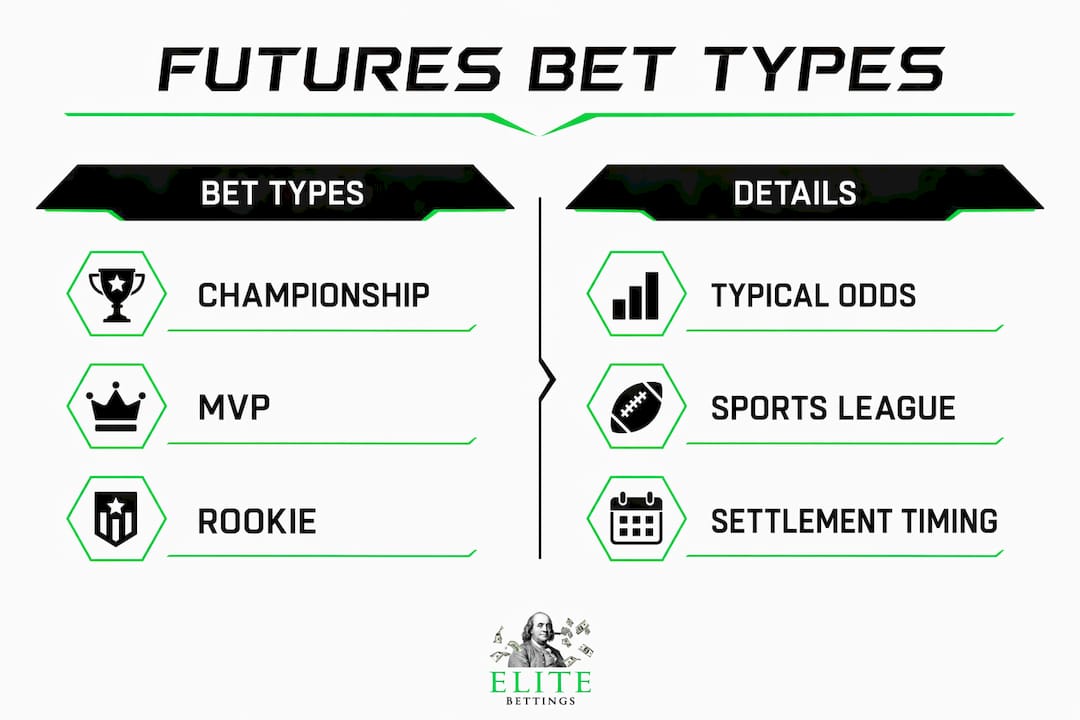
| Bet Type | Sport | Typical Odds Range | Settlement Timing |
|---|---|---|---|
| Championship winner | NFL, NBA, MLB, NHL | +3000 or higher | Season/playoff end |
| Conference/division champion | NFL, NBA | +1000 to +3000 | Conference finals |
| Regular season MVP | NFL, NBA | +200 to +3000 | End of regular season |
| Rookie of the Year | NFL, NBA | +600 to +1800 | End of regular season |
| Season stats leader (points, TDs, HRs) | NBA, NFL, MLB | +1000 to +3000 | End of regular season |
| World Series winner | MLB | — | October |
| Stanley Cup winner | NHL | +400 | June |
Popular futures bets include league champions, division winners, MVP, Rookie of the Year, and season statistical leaders, with odds shifting constantly as the season progresses and news breaks.
A few things worth knowing about how these markets differ by sport:
- NFL futures open in the spring and attract the heaviest public money, which inflates prices on popular teams like the Chiefs or Cowboys.
- NBA futures move aggressively around trade deadlines and injury reports, creating sharp windows of value.
- MLB futures run from February through October, giving you the longest exposure window of any major sport.
- Award futures (MVP, Cy Young, Defensive Player of the Year) often carry more value than championship markets because fewer bettors track them closely.
Key strategies for successful futures betting
The single most important principle in any futures betting strategy is identifying the gap between a team’s implied probability and its true probability. If a sportsbook prices a team at +400 (implying roughly a 20% chance), but your research suggests a 30% true probability, that’s a positive-expected value bet worth taking.

Bankroll management is non-negotiable. Futures bankroll allocation is commonly recommended at 5–15% of your total bankroll overall, with individual position sizes between 0.25 and 1.0 units per bet. Spreading across uncorrelated outcomes reduces the risk of a single bad break wiping out your futures portfolio.
Core strategy principles to build around:
- Shop multiple sportsbooks. A team priced at +350 at one book might be +420 at another. That difference compounds over a season of futures plays.
- Avoid correlated positions. Betting the Chiefs to win the AFC and the Super Bowl ties your fate to one outcome twice. Diversify across conferences, sports, and bet types.
- Use implied probability math. Convert odds to implied probability (divide 100 by the decimal odds equivalent), then compare to your own model or research-based estimate.
- Track roster and injury news. A single star player injury can shift a team’s championship odds by hundreds of points overnight.
- Build a simple simulation model. Even a basic win-probability model using team stats, strength of schedule, and historical performance gives you a framework to evaluate whether a line has value.
Pro Tip: Never place a futures bet without first converting the odds to implied probability. If the implied probability is higher than your estimated true probability, the bet has negative expected value regardless of how much you like the team.
Optimal timing: when should you place futures bets?
Timing is where most bettors leave money on the table. The best entry point depends on the phase of the season and what the market has already priced in.

Markets evolve throughout season phases: preseason carries the largest potential edges but also the highest overrounds (the sportsbook’s built-in margin). As the season progresses, lines tighten and efficiency increases, meaning the easy value gets harder to find.
Here’s how to think about each phase:
- Offseason (February–July for NFL, May–September for NBA): Odds are widest and most mispriced. This is when you find the best value on dark horse teams before the public narrative forms. The trade-off is maximum capital lockup.
- Preseason and training camp: Roster news, injuries, and coaching changes create sharp repricing. Watch for teams that quietly upgrade at key positions.
- Early regular season (first 4–6 weeks): Small sample sizes cause overreaction. A team that starts 1–3 in the NFL often sees its Super Bowl odds balloon to +3000 or higher, sometimes creating real value.
- Mid-season: Market efficiency peaks here. Value is harder to find, but trade deadline moves in the NBA and MLB create short windows of mispricing.
- Late season and playoffs: Odds compress dramatically. The edge shrinks, but this is when hedging decisions become most critical.
Pro Tip: The best futures value in the NFL typically appears in July and August, before training camp injuries and preseason results shift the market. Set calendar reminders to check lines when the schedule releases.
A practical example: a team enters the NBA season as a legitimate contender but loses its starting point guard in week two. The market overreacts, pushing their championship odds from +600 to +1800. If the injury is short-term and the team’s underlying talent remains, that’s a textbook mid-season entry point.
Hedging futures bets: techniques and rationale
Hedging a futures bet means placing an opposing wager to reduce your risk or lock in a guaranteed profit before the original bet settles. Done right, it’s a tool for bankroll protection. Done reflexively, it destroys the expected value you built when you placed the original bet.
Hedging is optimal when your position has grown large relative to your bankroll, when the edge that justified the original bet no longer exists, or when locking in a profit makes more sense than riding out variance. Pure expected value maximizers hedge only when it increases overall utility, not out of anxiety.
When hedging makes sense:
- Your original futures bet is now a large percentage of your active bankroll.
- The team or player you backed has lost the edge that made the bet valuable (key injury, coaching change, chemistry breakdown).
- You’re approaching a single elimination game where variance is extreme.
- Locking in a profit guarantees a meaningful return regardless of outcome.
When hedging destroys value:
- You hedge every futures bet as it gets close to settling.
- You hedge based on emotion after a bad week, not based on math.
- The hedge bet carries significant juice that eats into your locked profit.
Hedging calculation example: You bet $100 on a team to win the championship at +1000, giving you a potential $1,000 profit. They reach the finals. Their opponent is priced at -200 to win the series. Betting $400 on the opponent guarantees you a profit regardless of outcome: if your original pick wins, you net $600 ($1,000 minus the $400 hedge). If the opponent wins, you net roughly $200 from the hedge bet.
Live hedging during volatile late-season or playoff futures positions can protect your bankroll while preserving edge. The key is calculating the hedge amount based on guaranteed profit targets, not gut feeling.
Pro Tip: Before hedging, calculate your guaranteed profit at multiple hedge amounts. Sometimes a partial hedge, covering 50% of your exposure, gives you the best balance between locking in profit and preserving upside.
Benefits, risks, and payout timing of futures bets
Futures bets offer something most single-game wagers can’t: the chance to win at long odds on information the market hasn’t fully priced in yet. A well-timed futures position can return multiples on your stake while keeping you invested in a team or player across an entire season.
| Factor | Benefit | Risk |
|---|---|---|
| Odds | Longer prices than game-day bets | Public bias inflates popular team prices |
| Engagement | Season-long interest in outcomes | Capital locked up for months |
| Market inefficiency | Fewer participants means more mispricing | Less liquidity makes line shopping harder |
| Timing flexibility | Multiple entry points across the season | Late entries carry compressed odds |
| Hedging options | Profit locking before settlement | Over-hedging reduces or eliminates edge |
Risks of futures betting include capital lockup, potential over-hedging, and chasing public bias. The benefits include better odds and sustained engagement across longer periods.
The most common mistakes bettors make with futures:
- Frozen bankroll syndrome. Tying up too much capital in futures leaves nothing for high-value game-day opportunities.
- Chasing the public. Betting the most popular teams (Cowboys, Lakers, Yankees) means paying a premium for name recognition, not actual probability.
- Ignoring payout timing. A futures bet that settles in October ties up capital through the entire baseball season. Factor that into your sizing.
- Skipping active management. Futures aren’t set-and-forget. Track your positions, monitor odds movement, and reassess when circumstances change.
Payouts typically occur at season end for championship futures, at award announcement dates for MVP and similar markets, and at conference finals conclusion for conference champion bets. Most sportsbooks credit winnings within 24–48 hours of official settlement.
Elite-bettings’ proven expertise in futures betting
Elite-bettings has built its reputation on one thing: documented results. While most handicapping services cherry-pick their best weeks, Elite-bettings maintains transparent records of every pick, including futures positions across the NFL and NBA. That level of accountability is rare in this industry.
The service reports a 74% hit rate with full documentation of results, built on a methodology centered on critical line value (CLV) analysis and disciplined bankroll control. CLV measures whether the line moved in your favor after you placed the bet, which is one of the strongest indicators of long-term profitability in futures markets.
| Performance Metric | Elite-bettings Standard |
|---|---|
| Documented hit rate | 74% across tracked picks |
| Core methodology | Critical line value (CLV) analysis |
| Sports covered | NFL, NBA, NCAAF, NCAAB, MLB |
| Record transparency | Full documentation of all results |
| Bankroll approach | Disciplined unit sizing and risk management |
The futures methodology at Elite-bettings goes beyond picking winners. The team tracks implied probability shifts, monitors roster news across all covered leagues, and applies unit sizing principles consistent with the 0.25–1.0 unit range that professional bettors use for long-term positions. Bettors who follow the documented picks report meaningful profit increases, particularly on NFL and NBA futures where CLV analysis creates the clearest edge.
Why Elite-bettings is the right call for serious futures bettors
Most futures bettors spend hours researching picks, converting odds, and second-guessing their timing, only to realize they’ve been paying the public premium on the same teams everyone else backed.

Elite-bettings cuts through that. Instead of hours of research with uncertain results, you get documented picks backed by CLV analysis, transparent records, and a 74% hit rate that covers NFL, NBA, NCAAF, NCAAB, and MLB futures. The service is built for bettors who want an edge without building a full analytics operation from scratch. No vague tips, no selective record-keeping. Just picks with a paper trail you can verify.
If you’re serious about futures this season, the next step is straightforward: visit Elite-bettings and check the documented pick history before you commit to anything. The record speaks for itself.
FAQ
What is the best strategy for futures betting?
The most effective futures betting strategy combines value identification (comparing implied probability to true probability), disciplined bankroll allocation of a moderate total exposure, and strategic hedging only when your edge has evaporated or your position has grown too large relative to your bankroll.
What is the most profitable sports betting approach long-term?
Tracking critical line value and shopping multiple sportsbooks for the best available odds are the two habits most consistently associated with long-term profitability in futures markets, since even small odds differences compound significantly over a full season.
What is the 80/20 rule in sports betting?
The 80/20 principle applied to sports betting suggests that roughly 80% of your profits tend to come from 20% of your bets, which is why disciplined selection and avoiding low-value plays matters more than betting volume.
How do futures bets get paid out?
Futures bets settle at the conclusion of the relevant event: championship futures pay out after the final game, MVP and award futures pay after official announcements, and most sportsbooks credit winnings within 24–48 hours of settlement.
Key Takeaways
A disciplined futures betting strategy built on value identification, precise timing, and selective hedging consistently outperforms reactive or volume-based approaches across NFL, NBA, and MLB markets.
| Point | Details |
|---|---|
| Lock in odds early for value | Preseason and offseason lines carry the widest margins and the best potential edges. |
| Size positions at 5–15% total | Keep overall futures exposure at 5–15% of your bankroll, using conservative position sizes of 0.25 to 1.0 units per bet, to protect against overexposure while maximizing value. |
| Hedge on math, not emotion | Hedge only when your position is oversized, your edge is gone, or locking profit is clearly beneficial. |
| Shop lines across sportsbooks | Odds differences between books on the same futures market directly impact long-term profitability. |
| Elite-bettings documents results | Elite-bettings applies CLV analysis with a documented 74% hit rate across NFL, NBA, and other major league futures. |